
A Rate Measured in Grams Per Hectare Doesn’t Shrink Into a Dropper Bottle
Bonsai, orchid and aquaponics growers dose in milliliters, sometimes drops, into a container that might hold a liter or two. Field agronomy doses the same trace elements in grams per hectare — a unit built for ten thousand square meters. Those two scales don’t translate the way a quick mental division suggests, and cobalt is the clearest example of why.
Cobalt is a real, narrow requirement — for legumes, via their bacteria
Cobalt isn’t classified as essential for most plants, but it is genuinely required by legumes — not directly, but through the rhizobial bacteria that fix nitrogen in their root nodules. Several of the enzymes those bacteria depend on are cobalamin-dependent, and cobalamin needs cobalt to assemble. Deficiency in legume tissue shows up below roughly 0.02–0.04 mg of cobalt per kg of shoot dry weight. The corrective rate published for field correction: 1.8 to 145.6 grams per hectare. Toxicity doesn’t start until somewhere around 30–40 mg/kg in tissue, and typical soils already carry 4.5 to 12 mg/kg — so the entire useful window sits in a narrow band, corrected with a genuinely tiny field-scale rate.
Why that number can’t just be scaled down
A hectare is 10,000 square meters. Divide 145.6 grams across that area and you’re already down to roughly 0.0146 mg per square meter — and a bonsai pot, orchid flask or aquaponics grow bed is a tiny fraction of even one square meter. Scaled down naively, the correct dose for a single container isn’t a drop, it’s a quantity too small to weigh on anything a home grower owns, let alone measure reliably with a pipette. That’s not a reason cobalt doesn’t matter at small scale — legumes in a container still run the same rhizobial chemistry — it’s a reason nobody builds a precision trace-element correction by diluting a bulk field rate at home. The math doesn’t survive the scale change intact.
Trace elements with real, published evidence behind them — cobalt among them — tend to matter in quantities too small to eyeball. That’s an argument for deliberate, declared dosing, not for skipping them.
What declared micro-dosing actually looks like on a real label
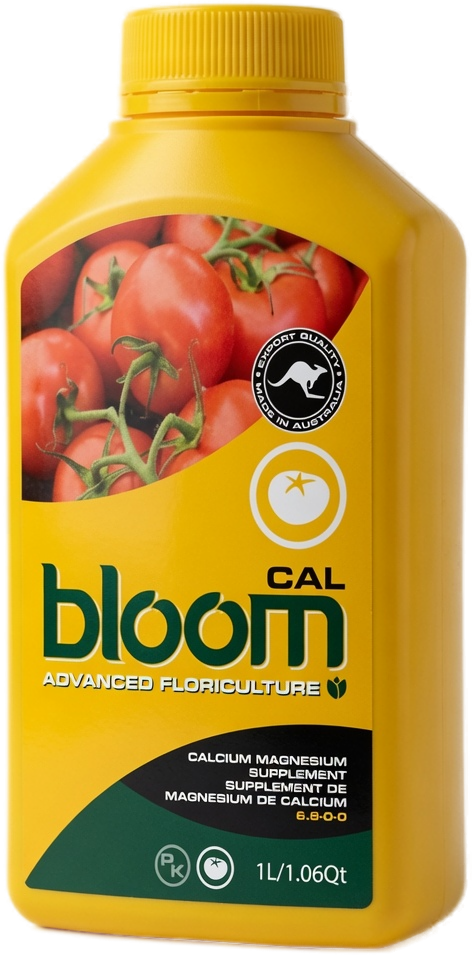
Bloom CAL doesn’t declare cobalt — that’s not a product in our range, and we’re not implying otherwise (see why CAL’s chelate choice matters more in a flask than in a grow tent for more on how that label reads in a small reservoir). What CAL’s own guaranteed analysis does show is what deliberate trace-element dosing looks like when it’s done on purpose: 0.5% iron, carried as chelated DTPA rather than EDTA specifically because DTPA holds iron stable to a higher pH than EDTA manages, and 0.036% zinc, carried as chelated EDTA. Those aren’t round, convenient numbers. They’re declared to the ten-thousandth of a percent because the chelate chemistry and the dose both have to be exact for a micronutrient to actually reach the plant instead of precipitating out in the reservoir.
The takeaway for a small reservoir
If you’re feeding anything in a container measured in liters rather than hectares, the lesson from cobalt’s field-scale rate isn’t “skip the trace elements.” It’s “don’t try to eyeball a field rate down to container scale on your own, and look for a label that already declares the exact percentage and chelate form instead of a vague mineral blend.” The elements that genuinely do something tend to be the ones dosed in writing, to the decimal point — not the ones added in a pinch because the ocean, or the soil, happens to contain them somewhere.
This isn’t unique to cobalt or to legumes, either — it’s a general pattern worth keeping in mind for any small-reservoir setup. A soil’s typical cobalt content already sits at 4.5 to 12 mg/kg, well above the deficiency threshold, so most legume rotations in reasonable soil never need a correction at all; the gram-per-hectare rate above only applies where a soil test actually shows a shortfall. The same logic holds in a pot or flask: before adding any trace element because a field-scale paper says it matters somewhere, check whether your actual growing medium is already carrying enough of it. A precision correction aimed at a deficiency that doesn’t exist isn’t precision, it’s just a different kind of guesswork. Test first, dose deliberately, and let the label — not the bottle’s marketing — tell you what’s actually in the mix.