Not Every Cut Flower Can Even Take Up the Silicon You Feed It
Silicon supplements get sold on sturdier stems and tougher cell walls, and growers reach for them the way they’d reach for calcium — the same impulse behind checking what a greenhouse water test actually tells you before dosing Cal-Mag — assuming any crop will take up what’s in the bottle. Plant physiology doesn’t work that way for silicon. Whether a crop can actually use a silicon feed depends on which plant family it belongs to, and that’s worth knowing before a greenhouse budget line gets spent on it.
Silicon needs a dedicated transporter to get in at all
Plants take up silicon as silicic acid, a dissolved form, through a set of dedicated transporter proteins: one moves it into the root, a second pushes it toward the vascular tissue, a third carries it up into the shoot. Once it’s in the shoot and water evaporates off through transpiration, the silicic acid polymerizes into solid silica gel — which is why, once deposited, it doesn’t move back out of the plant the way a mobile nutrient like potassium can.
The catch: not every plant family built those transporters with the same capacity. Some crops accumulate silicon readily. Many don’t, no matter how much is available in the root zone.
Three classes of accumulator, and where the gap sits
Published plant-silicon research sorts species into three rough bands by how much silicon ends up in shoot dry weight: low accumulators sit under 0.1%, intermediate accumulators land around 1%, and high accumulators run past 5% — rice shoots can reach 10%. Grass and sedge families (Poaceae and Cyperaceae) are the reliable high end, typically exceeding 4%; some broadleaf families sampled in the same work, including nettle and cucurbit relatives, land in a lower 2–4% band. The spread between classes isn’t subtle — it’s a fifty-fold range from the low end to the high end.
Most cut-flower and ornamental greenhouse crops — roses, chrysanthemums, snapdragons, lilies and the like — aren’t grasses or sedges. We haven’t found a published, species-specific silicon-accumulation survey for the florist trade’s actual crop list, so we won’t tell you which exact cut flowers land where. What the family-level pattern does tell you: silicon uptake capacity is not a given across the board, and it’s worth checking whether your specific crop family has published accumulator data before assuming a silicon feed will do anything measurable on it.
Soil silicon isn’t the limiting factor most people assume
Even for a crop that is a strong accumulator, most of the silicon sitting in soil isn’t available to it. Between half and two-thirds of soil silicon sits locked in solid silicon dioxide, and uptake tracks dissolved silicic acid in the soil solution, not the total silicon content of the growing medium. Field trial work on responsive field crops found a benefit once soil silicon tested above roughly 40 mg/L — well above a typical soil average closer to 14 mg/L — with amendment pushing tissue silicon from roughly 700–1,530 ppm up toward a 10,000 ppm flag-leaf target in that crop.
Where that leaves a Bloom Silica question
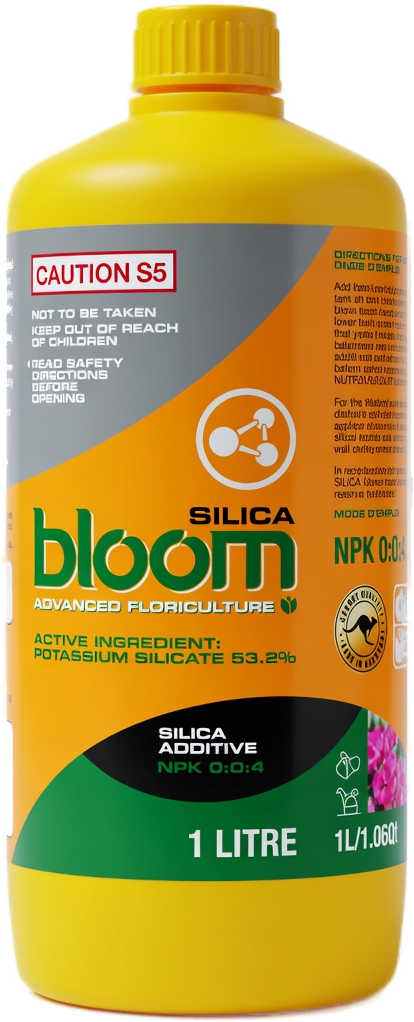
We get asked whether Bloom Silica carries a guaranteed-analysis silicon percentage worth comparing to any of this. Honestly: we haven’t pulled that product’s actual label into our own reference files yet, so we’re not printing a figure for it here rather than guess. What we can say with confidence is the two questions worth asking before spending on any silicon product for a greenhouse crop: does this crop family actually accumulate silicon in the first place, and does the soil or substrate test low enough for an amendment to matter? Those two checks will tell you more than any bottle’s marketing copy.
There’s a third, practical check too: ask what form the silicon is actually in. Manufactured silicate products only stay dissolved in a narrow, high-pH window, and most of the silicon drops out of solution as an inert gel once the mix drifts toward a neutral pH — which is exactly the range most greenhouse substrates and feed solutions are run at. A product that isn’t stable at the pH it’s actually going to be mixed and applied at isn’t delivering the silicon printed on its label, accumulator crop or not. That’s a formulation question worth asking a supplier directly rather than assuming the bottle solved it.