

Powder beat liquid in the biggest seaweed study ever run. Here’s where our bottle sits
A 2026 meta-analysis pooled 2,021 treatment-control comparisons of seaweed-based biostimulants and found that powder formulations outperformed liquids by a real margin. We sell a liquid. Here’s the honest version of what that gap does and doesn’t tell a cut-flower or greenhouse grower deciding what to mix into the feed tank.
The biggest seaweed study ever run
Published in 2026, the meta-analysis behind this post pooled 198 peer-reviewed studies into 2,021 independent treatment-control comparisons of seaweed extract biostimulants — by far the largest dataset assembled on the category. It broke the results down by extraction method, by species, by how the product was applied, and by how it was formulated: dried and reconstituted as a powder, or sold ready-to-use as a liquid.
Formulation turned out to matter. Across the studies it could sort, powder-form products produced a significantly larger average yield response than liquid-form products did — not a trivial rounding difference, and not something we’d rather not mention because our own bottle sits on the smaller-effect side of it.
The numbers, and where our bottle sits
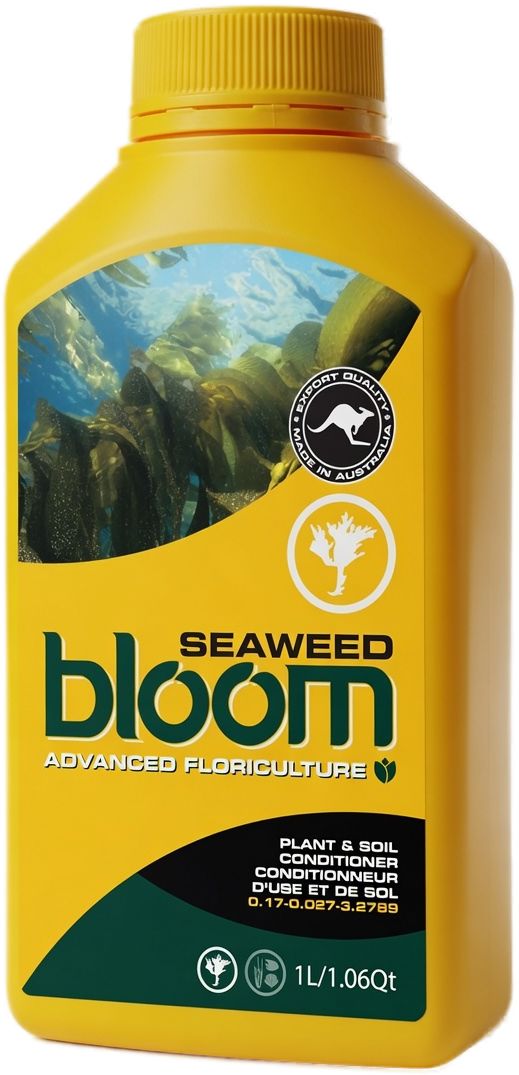
Powder formulations: +22.6% average yield response. Liquid formulations: +15.3%. Bloom Seaweed is a liquid, diluted at 1 ml/L. We’re not going to pretend the gap isn’t there, and we’re not going to repackage as a powder to chase a number — a liquid measures accurately into a feed tank without a scale, and that’s the trade we’ve made.
What the number was actually measuring
Two honest caveats before anyone reads this as a reason to switch products. First, the meta-analysis measured yield — fruit, biomass, marketable harvest — across a wide range of crops. It was not built around cut-flower stem count, bud quality or vase life specifically, so a floriculture grower should read “+22.6%” as a general vigor signal from the wider literature, not a bloom-quality figure for any particular crop. We’d rather say that plainly than let a number from tomatoes and turf grass quietly stand in for a claim about roses.
Second, the powder number rests on a much smaller slice of the evidence. Of the 2,021 comparisons in the dataset, 1,714 — about 85% — tested a liquid. Only 299 tested a powder. A result built on roughly one-seventh as many trials can still be real, but it’s a thinner average, pulled from fewer products and fewer crops, and it deserves to be read with that in mind rather than treated as the settled answer for every powder on a shelf.
Our own label carries one figure this whole discussion can lean on without borrowing anyone else’s data: Bloom Seaweed is 0.17-0.027-3.278, derived from Durvillaea potatorum, diluted at 1 ml/L. That’s what’s actually in the bottle — not a claim about which formulation wins.
Why we still sell a liquid
A greenhouse running benches of mums, lisianthus or ranunculus is measuring into a tank on a schedule, often by more than one set of hands. A liquid at a fixed ml/L rate is something a crew can get right every time without a scale, a reconstitution step or a chance to get the water ratio wrong on a powder that behaves differently depending on how long it sits mixed. The meta-analysis’s own formulation split doesn’t erase that practical argument — it just means we’re not going to claim the yield-response crown while we’re at it.
If a grower wants to chase the larger average from the powder side of this chart, that’s a legitimate question to put to a powder product directly — dose, species and process all still apply. What we can tell you honestly is what’s declared on our own label, and what 1 ml/L of it has going for it in a working greenhouse. Read more about the species behind that figure in our piece on the best published root data for our declared seaweed species.
Growing fruit or veg? See the Fruit & Veg growers page and the week-by-week feed chart.