
The Iron Chemistry That Keeps Working After Your Reservoir Drifts
Any recirculating hydro reservoir moves around in pH between top-offs — the plant pulls different ions at different rates as the days pass, and a system you dialed in on day one can read half a point or more higher by day four. That drift is normal. What matters is whether the iron you dosed is still dissolved and usable by the time it happens, or whether it has already dropped out of solution and settled somewhere the roots can’t reach it.
Two chelates, two pH ceilings
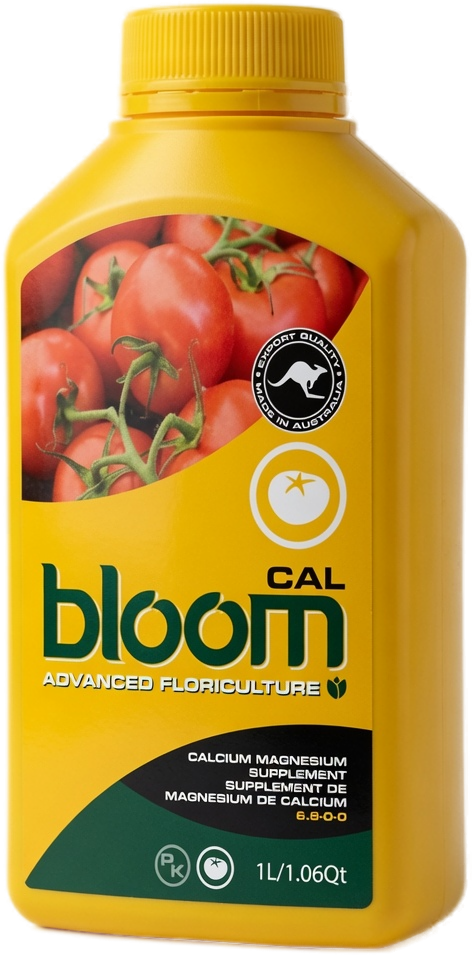
Bloom CAL declares its iron as chelated with DTPA and its zinc as chelated with EDTA — that’s the exact wording on the label, not a formulation detail we’re guessing at. The two chelating agents aren’t interchangeable stand-ins for each other. EDTA is the more common, cheaper chelate in hydroponic lines, and it does the job well in the low-to-mid 6s. Above roughly pH 6.5, though, EDTA starts losing its grip on iron, and the iron goes back to being a free ion that can precipitate out as an insoluble oxide — invisible rust at the bottom of your reservoir, not a nutrient your plant can use. DTPA holds on considerably longer, keeping iron chelated to around pH 7.5.
Bloom CAL’s declared analysis: 5.2% Total Nitrogen (all nitrate), 5% Calcium, 1.4% Magnesium, 0.5% Iron (all chelated, as DTPA), 0.036% Zinc (all chelated, as EDTA). Derived from: Calcium Nitrate, Magnesium Nitrate, Iron DTPA, Zinc EDTA.
The sulfate Bloom CAL never adds
A second reservoir problem shows up whenever growers build their own Cal-Mag from calcium nitrate and Epsom salt (magnesium sulfate). The calcium in calcium nitrate and the sulfate riding along with Epsom salt react to form calcium sulfate — gypsum — which is only sparingly soluble. In a single-pass feed that might just mean a little cloudiness. In a recirculating system, the same water passes through the same lines, drippers and pump dozens of times over a feeding cycle, so whatever precipitates keeps accumulating in the narrowest points of the system rather than washing out once.
Bloom CAL supplies its magnesium as magnesium nitrate instead of magnesium sulfate. There’s no sulfate in the bottle for the calcium to react with, so that particular precipitation reaction has nothing to work with. It’s a real, label-backed difference between a DIY mix and the bottle — not a claim about what the DIY version does wrong in general, just what these two specific ingredients do when they meet in the same tank.
The trade-off runs the other way on nitrogen: Bloom CAL’s 5.2% N is all nitrate, so it’s worth counting toward your feed’s total nitrogen budget rather than treating it as a “just Cal-Mag” addition that sits outside the N math.
Running the nitrogen math
We’ve written before about how a product with a tiny total nitrogen figure still discloses its nitrogen form honestly on the label. CAL sits at the opposite end of that spectrum — its nitrogen is anything but incidental. Say you’re dosing CAL at 1 ml/L of feed water. At 5.2% total nitrogen, that single-digit volume is adding roughly 52 ppm of nitrate nitrogen to your reservoir before any base nutrient touches the tank. That’s not a criticism of the product — calcium nitrate is a completely standard calcium carrier, and nitrate nitrogen is exactly the form most hydro crops want. It’s a reminder to add it up: if your base line is already tuned to a target N ppm, CAL’s nitrate needs to be part of that total, not an addition sitting quietly outside it.
Put together, the two mechanisms point the same direction: know what’s actually in the bottle before you decide how to use it. DTPA buys you a wider pH window before iron drops out than EDTA does. The absence of sulfate means no gypsum fouling your lines the way a DIY sulfate-based mix can. And the nitrate is real nitrogen that belongs in your budget, not a footnote. None of that requires taking our word for it — it’s what’s declared on the label, read plainly.
None of this is a reason to chase a lower pH number for its own sake, either — a reservoir sitting well under 6.0 brings its own lockout problems with other micronutrients, and a one-time reading tells you less than watching where the number drifts between top-offs. The practical habit is simple: check pH on the same schedule you check EC, and treat a slow upward creep as useful information about your root zone rather than something to panic-correct every time you see it. A chelate with more headroom just means you have a wider window to notice the drift and act on it before iron actually drops out of solution.