
The Potassium Number That Varies 36-Fold Between Seaweed Products That Look the Same
A LECA reservoir usually holds a liter or two. There’s no big tank to even out a mixing mistake — as covered in what a seaweed extract is actually delivering in a small reservoir — which is exactly why the declared number on a seaweed bottle matters more here than it does on a field-scale operation. A 2022 survey of twenty commercial seaweed extracts found potassium content ranging across a 36-fold spread between products. That’s not a typo — it’s the category.
Twenty Products, One Survey, a 36-Fold Spread
The study pulled sixteen liquid and four solid commercial extracts, made from Ascophyllum nodosum and Ecklonia maxima, produced by three different routes still in active commercial use: cold extraction, acid-media extraction and alkaline (KOH) extraction. Across those twenty products, declared potassium ranged from about 5.04 grams per kilogram at the low end to about 180 grams per kilogram at the high end — roughly 36 times apart. The same survey found alginic acid content spanning roughly 29-fold across the same twenty products. Extraction route and formulation choices measurably change what ends up in the bottle.
Twenty commercial seaweed extracts, same general category, potassium content spread 36-fold from lowest to highest. There is no single “normal” number for a seaweed product — there’s a declared number, specific to that bottle.
Where Bloom Seaweed Sits, and Why That’s the Point
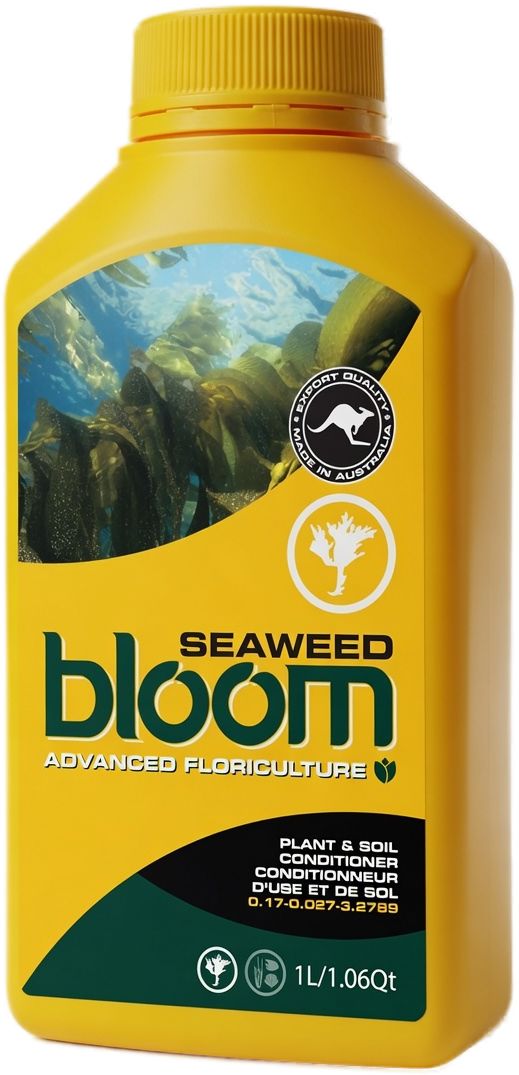
Bloom Seaweed’s label declares 0.17% nitrogen, 0.027% available phosphate and 3.278% soluble potash — that potash figure works out to roughly 32.78 grams of K2O per kilogram, derived from Durvillaea potatorum, dosed at 1 ml/L of nutrient solution. That number sits inside the range the survey found, not above it or below it as some kind of claim to a “stronger” formula. The point isn’t that one product in that 36-fold spread is right and the others are wrong. It’s that the spread exists at all, which means the number printed on whatever bottle is in front of you is the only number that actually describes what’s in that bottle.
The survey doesn’t rank extraction routes by outcome — cold, acid-media and alkaline extraction are all in active commercial use today. The number that changes is composition, not a verdict on which method is “better.”
Why a Small Reservoir Has No Room to Average This Out
On a field-scale system, the irrigation volume is large enough that a composition difference between two seaweed products gets diluted into a huge total delivery rate — it’s still real, but it’s a smaller fraction of everything else going into the soil. A LECA reservoir holding a liter or two doesn’t have that buffer. Whatever potassium concentration is in the bottle you poured from is a much bigger share of the total nutrient solution the plant’s roots are actually sitting in. Swapping products without checking the new label’s declared analysis against the old one is a bigger deal at this scale, not a smaller one.
None of this is an argument against any particular seaweed product, including the ones nowhere near Bloom’s own declared number. It’s an argument for reading the guaranteed analysis on whatever bottle you’re actually using, every time you change bottles, especially in a growing system small enough that there’s nowhere for a surprise to hide.
What the Survey Doesn’t Tell You
A 36-fold spread in potassium, and a roughly 29-fold spread in alginic acid across the same twenty products, says the category is compositionally wide open — it doesn’t say which composition performs better in a pot or a flask. The survey measured what’s in the bottle, not plant response, and it covered sixteen liquid and only four solid formulations, so it isn’t a clean liquid-versus-powder comparison either. Treat the spread as what it is: proof that “seaweed extract” is a description of an ingredient category, not a single, standardized product, the same way “orange juice” doesn’t tell you the sugar content of the carton in front of you.
That’s also why a dose rate only means something next to a declared analysis. 1 ml/L is a meaningless instruction on its own — it’s an instruction for delivering 0.17-0.027-3.278 at that rate, specifically. Swap in a different seaweed product at the same 1 ml/L and you could be delivering anywhere from a fraction of that potassium to several times it, depending on which end of the 36-fold range the new bottle happens to sit on. In a tent or a raised bed that’s a rounding error against everything else in the feed. In a LECA pot, it’s most of what’s there.