Walk the aisle of any hydro shop and you’ll see it: growers buying one all-purpose bottle and
running it from clone to harvest. It’s simple, and simple sells. It’s also not how Bloom builds a range. Ultra exists because the plant a grower is feeding in week two of
flower is not the same plant they were feeding in veg — and a bottle built for one stage
shouldn’t be asked to do the other’s job.
Part of the original lineup
Ultra isn’t a recent add-on. Bloom’s earliest surviving label artwork — printed in 2012,
back when the range was known internally as the “Signature Six” — already includes Ultra
alongside Roots and Pre. It has been part of the core system for as long as Bloom has had a
system to speak of.
A flowering-stage product, not a set-and-forget feed
Internally, Bloom groups its range into stacks that mirror the plant’s own timeline: a
vegetative stack built around structure and root development, and a flowering stack built
around what happens once a plant shifts into bloom. Ultra sits in the flowering stack. That
single fact explains a lot about how — and how not — to use it.
It’s also why Ultra gets ruled out for passive, set-it-and-walk-away systems like semi-hydro
LECA setups. Those systems are built around a static reservoir that a grower doesn’t want to
touch for days or weeks at a time. Ultra isn’t designed for that kind of stillness — it’s
designed for a feeding program that moves, week by week, the same way the plant it’s feeding
does. A flowering-cycle product wants a grower who’s actively managing the cycle, not a
reservoir that’s meant to be left alone.
This is really a question of philosophy as much as chemistry. Bloom has never been built
around one bottle doing everything — the range is built in stages on purpose, with Roots
addressing the root zone, Pre carrying a plant through vegetative structure, and Ultra picking
up once that plant turns the corner into bloom. Each one is designed to layer onto a base
feeding program rather than replace it outright. That’s a deliberate trade against the
convenience of an all-in-one jug: more bottles on the shelf, but each one asked to do one job
well instead of every job adequately.
It also means the questions worth asking about Ultra aren’t “does it work” in the abstract —
they’re “is this the stage my plant is actually in.” A grower running a passive semi-hydro
reservoir they don’t want to touch for two weeks is, by definition, not running a staged
flowering program — which is precisely why that channel gets ruled out for Ultra internally.
A grower actively managing a soil or run-to-waste system through defined weeks of bloom is
exactly who the flowering stack was built for.
Why you won’t find a rate in this post
We could print a dose here. We’re not going to. Bloom’s application rates live in one place on
purpose: the printed feed chart and the label on the bottle in your hand. Those are the two
sources we treat as authoritative internally, in that order, and a blog post copied and
re-copied for years is the wrong place to freeze a number that a feed chart update could
change. If you’re dialing in Ultra for the first time, pull the feed chart that matches your
system — soil, run-to-waste, or recirculating — and read the rate straight off it.
Same manufacturer, every bottle
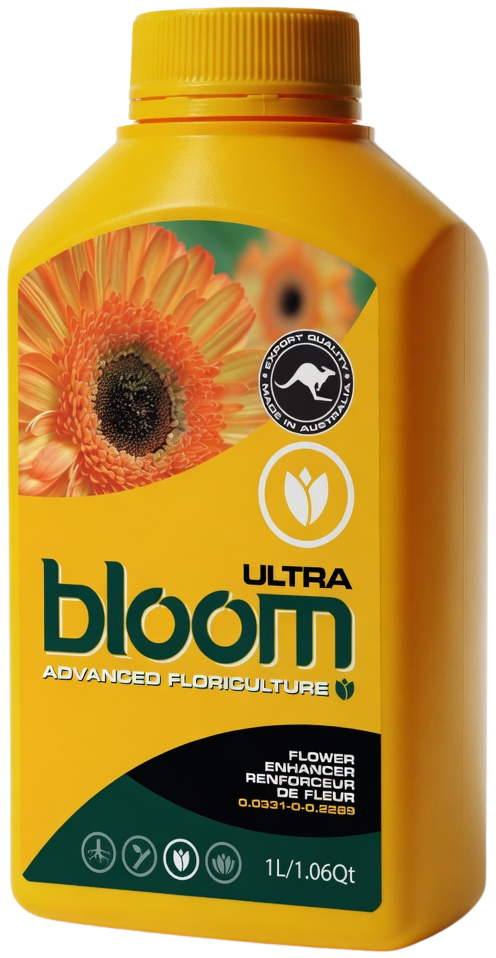
Ultra is made by the same company that makes the rest of the Bloom range: Agricultural
Organics (Aust) P/L, 5 Belfree Drive, Green Fields, South Australia — the address printed on
every Bloom label, including Ultra’s. Nothing about that changes bottle to bottle or stage
to stage. It’s one manufacturer, one address, running the whole lineup.
None of this is a claim that Ultra will transform your flower — we’re not going to promise you
an outcome we haven’t proven. What we can tell you plainly: Ultra was built for the flowering
stage specifically, it’s been part of Bloom’s core range since the earliest labels the company
still has on file, and it’s made in the same South Australian facility as every other bottle
with a yellow cap. If you’re running a structured flowering program and want a flowering-stage
layer to add to it, that’s exactly the gap Ultra sits in.
That’s also the reason you’ll see us write about the range this way generally — heritage,
positioning, what a product is actually for and who it’s built for — rather than reaching for
a number every time. A dose rate only means something in the context of your system, your
week in the cycle, and the feed chart sitting next to your reservoir. A blog post is the wrong
place to substitute for that. It’s the right place to help you understand why the bottle
exists in the first place.
Have a feed chart question about running Ultra in your system? Reach out through the contact
page — a real person reads every message.