
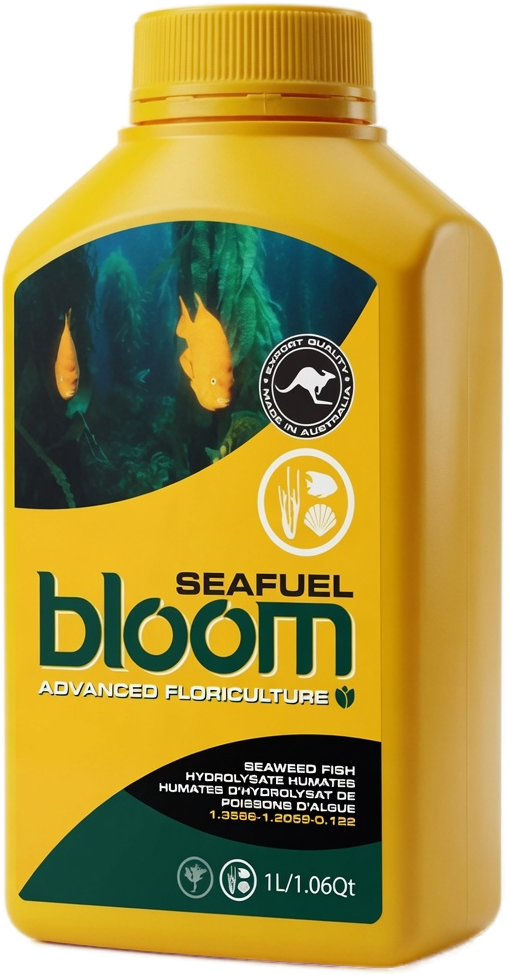
Why We Tell You Never to Premix Seafuel With a Silicate Product
An orchid flask, a bonsai tray and an aquaponics sump all share one thing: a small shared reservoir, and a real temptation to combine every input into one mix to save a step. For most of what you feed, that’s fine. For Seafuel and any silicate-based product, it’s the one combination that actually matters, and it matters more in a small container than a large one.
Two Products, Two Opposite Chemistries
Seafuel’s own safety data sheet puts it at pH 4–5, specific gravity 1.2–1.4, and states it is incompatible with alkali agents. That’s not a vague caution — it’s a specific compatibility statement on the product’s own documentation. Manufactured potassium silicate — and, per the two routes a silicate product is actually made by, the active ingredient in any silicate-based feed supplement — sits at the opposite end of the scale entirely: stable, soluble silicate ions only exist above roughly pH 11–12, and solubility collapses sharply once the solution drops below pH 9, at which point most of the dissolved silica precipitates out as a solid gel. One product needs to stay acidic to stay stable. The other needs to stay strongly alkaline to stay dissolved at all.
Seafuel’s own MSDS: pH 4–5, incompatible with alkali agents. A manufactured silicate product: stable only above roughly pH 11–12. Put those two numbers next to each other and the problem is obvious before you’ve mixed anything.
What Actually Happens in a Shared Jug
Pour both into the same concentrate jug and the acidic Seafuel drags the mix away from the alkaline window a silicate needs to stay dissolved. The silica that was in solution starts converting to solid, amorphous gel — the same precipitation reaction that happens any time a silicate solution drops below roughly pH 9. At the same time, Seafuel’s own documentation already flags alkali agents as something it’s not compatible with, independent of silicate chemistry specifically. Neither product is unstable on its own. Mixed together, each pushes the other toward the edge where it stops behaving the way its label describes.
We aren’t printing a Bloom Silica guaranteed-analysis figure here — that label hasn’t been read into our own reference files yet, so we’re not going to cite a number we can’t stand behind. The pH chemistry above is general to any manufactured silicate product, not a claim about one specific formulation.
Why This Matters More in a Small Reservoir
In a large tank, you might get away with a brief pH swing during mixing before everything re-equilibrates and dilutes. An orchid flask, a bonsai humidity tray or an aquaponics sump doesn’t have that margin. There’s less total volume to buffer the clash, less time before the mixture reaches the plant or the biofilter, and often no second container to let a precipitate settle out before you’ve already poured it in. The fix isn’t complicated: dose Seafuel and any silicate product separately, on different days or at opposite ends of your feeding schedule, never premixed in the same jug.
Reading the Safety Data Sheet Is Part of the Job
A guaranteed analysis tells you what’s in a bottle. A safety data sheet tells you how that bottle behaves around other things — pH, specific gravity, what it shouldn’t be combined with. Seafuel’s MSDS doesn’t single out silicate products by name; it states, plainly, incompatibility with alkali agents as a category. That’s a more useful warning than a brand-specific one, because it applies to any strongly alkaline input you might reach for next, not just the one this post happens to use as the example. If you’re running a specialty setup with more than two or three concentrated inputs in rotation, it’s worth reading each one’s MSDS the same way you’d read its label — not for the dose rate, but for what it says about compatibility.
None of this is a knock on either product. It’s the same thing a label-literate grower would do with any two inputs at opposite ends of the pH scale, in any growing system — it just shows up faster, and with less room to recover, when the whole reservoir fits in your hands.