
Will steeping horsetail from your yard actually give your plants silica?
If you garden long enough, someone tells you to pull the horsetail growing by the fence, boil it into a tea, and feed it to your tomatoes for silica. It is one of the oldest DIY feeding tricks there is. We went looking for the actual measurement behind it, because “boil a weed, get silica” is exactly the kind of claim that sounds right and deserves a number.
What horsetail is supposed to have in it
Horsetail (Equisetum arvense) is often described as containing somewhere around 5 to 8 percent silicic acid by dry weight — that figure comes from an older herbal reference, not a controlled lab panel, so treat it as a starting claim rather than a settled fact. Silicic acid, written Si(OH)₄, is also the only form of silicon a plant root can actually absorb. Plants bring it in through dedicated transport proteins and then lay it down as solid silica once water evaporates out of the leaf — which is also why, once silicon is inside a plant, it does not move back out again.
So the chemistry a horsetail tea would need to deliver is specific: not “silicon” in general, but dissolved silicic acid, in a form roots can use before it locks back up.
What one actual test found
We could find exactly one quantified extraction experiment on this. Researchers boiled 2.0 grams of dried horsetail in 200 mL of water for three hours and measured 55 mg of soluble silicon in the liquid — which works out to about 2.75% soluble silicic acid by weight. That is roughly a third to half of the plant’s declared total content, and this was under a long, hard boil, not a quick steep. (Both figures trace back to an older herbal-reference compilation rather than a peer-reviewed lab panel — it’s simply the only extraction measurement we could track down, so take it as the best available number, not a settled one.)
In plain terms: the number on the “horsetail is high in silica” claim and the number that actually ends up dissolved in your bucket are two different measurements. Nobody we found has tested the second one against a simple cold steep — only a hard boil.
Why a jar on the counter is still a guess
This isn’t unique to horsetail — it’s the same gap we keep finding whenever a backyard remedy gets compared to the one lab test that actually exists for it. The lab test used dried, pre-processed plant material, a measured amount of water, and three full hours at a full boil. A jar of fresh-cut horsetail left on a counter overnight is not that experiment, and nobody has run the version that matches what most gardeners actually do.
Why manufactured silicon products are so fussy about pH
This also explains why bottled silicon products come with specific mixing instructions instead of “use freely.” Dissolved silicate is only stable across a narrow, high pH range — roughly pH 11 to 12. Drop below about pH 9 and most of it starts dropping back out of solution as solid silica, the same way it would inside a plant. That is a real manufacturing constraint, not a marketing detail: it is the reason a silicon product has to be formulated and buffered carefully rather than just diluted straight into a watering can.
Here’s the honest version: a horsetail tea is a real plant with real silicon in it, steeped in a process nobody has carefully measured at the temperature most people actually use. We’re not going to tell you it doesn’t work — we’re telling you nobody has the data to say how well it works, which is a different and more useful thing to know before you build a feeding routine around it.
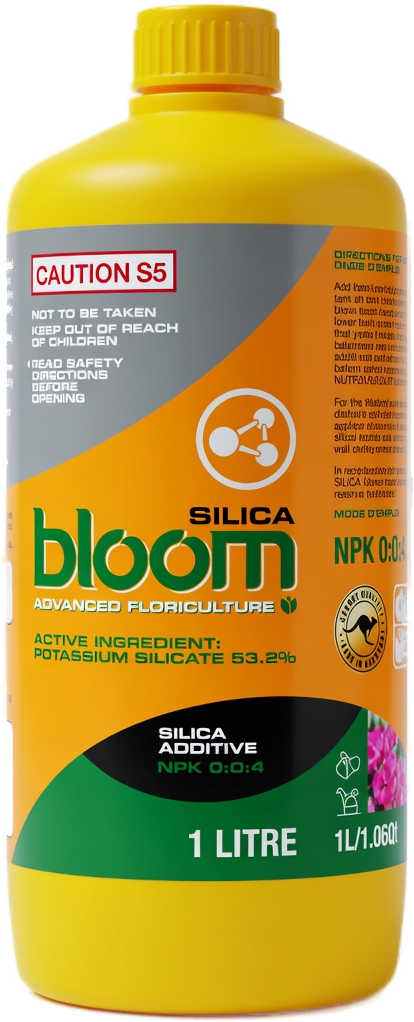
If you want a silicon routine with a known dose instead of a kitchen-counter guess, that’s what a formulated silicon product is for — ours is built and buffered to stay in solution rather than relying on a backyard boil. For everyone else, boiling horsetail isn’t a bad habit; just don’t expect it to behave like a lab reagent.