Grower education · Lighting
You swapped the lamps.
Now swap the plan.
LED gave you more photons for fewer watts. It also quietly took away something the HPS was doing for free — throwing radiant heat straight at your canopy. Cooler leaves, a different VPD, a different pull on the tank. Here’s what actually changes, what the research backs, and what to stop believing.
About 8 minutes · Two tracks — tent room and commercial room · Every figure sourced at the bottom
Start here
Three things changed the day you re-lamped
Not the feed chart. Not the genetics. Three physical things — and every knock-on effect growers blame on “LED being harsh” traces back to one of them.
1. The radiant heat left
An HPS pushes a big slug of near-infrared down onto the canopy. LEDs emit almost none of it — they dump most of their waste heat as convection at the fixture instead, where your fans deal with it, not your leaves.
2. The leaf runs cooler
Same air temperature, cooler leaf. Modelling from Utah State puts it at about 1.3 °C; a measured greenhouse tomato trial found 0 to 1.8 °C depending on the run. Small — until the room gets hot and still, where the modelled gap opens to 4 °C.
3. Nothing about the food changed
The plant still wants the same concentrations in its tissue. What changed is how much water is carrying them up there — and calcium in particular only travels on that water.
Read the red band, not the yellow one. That’s the difference your plants feel. The same modelling puts the near-infrared share at 0.22 of lamp input for HPS against 0.02 for LED — roughly eleven times less radiant heat landing on the leaf. These are modelling figures for a greenhouse, not a measurement of your fixture, but the direction is not in dispute.
The bit that matters
Same room, same readout, two different plants
VPD is the pull the air puts on the leaf, and it’s worked out from the leaf’s temperature, not the air’s. Your controller doesn’t know the leaf temperature — it measures air and humidity and prints a number. Drop the leaf a degree and that printed number stops describing what the plant is experiencing. Both rooms below are set to 26 °C and 65% RH. Both controllers read 1.18 kPa. The plants are living in different weather.
Where those leaf temperatures come from. Utah State’s leaf-energy-balance work puts LED leaves about 1.3 °C cooler than HPS under typical indoor conditions. Split that either side of air temperature and run it through the standard saturation vapour pressure equation and you get 1.31 kPa against 1.05 kPa — same air, same controller, a fifth less pull. Be straight about the caveat: the 1.3 °C is a modelled figure, not a thermocouple reading. The closest measured comparison, in greenhouse tomato at matched light, found HPS leaves 0 to 1.8 °C warmer.
And here’s the part most pages won’t tell you. The obvious next step — cooler leaf, less transpiration — is not settled. The energy-balance model says transpiration drops about 17%. A published tomato trial that actually grew plants under each lamp measured the opposite: stomatal conductance about 6% higher under LED and transpiration 2–24% higher, because the plants built more stomata and ran them more open. A separate full-cycle lettuce trial landed the other way again, with 15% less water used under LED. Different crops, different measures. So don’t take a percentage off a web page and apply it to your room — watch your own irrigation and runoff volumes for a fortnight after the swap, and let your own numbers tell you which way yours went.
Your room, your list
What to change on the environment side
Same physics, very different jobs depending on the size of the room. Pick your track.
Tent / small room
1–4 lights · hand or recirc
1
Nudge the air temperature up not down
The degree of leaf warmth the HPS was giving you for nothing now has to come out of the air. Nobody has published a “raise it by X” figure for an LED swap, so treat 1–2 °C as arithmetic off the leaf-temperature gap rather than gospel. Move it, watch the plants for a few days, stop when they look right.
2
Get air moving across the canopy the big one
Cornell’s hydroponic lettuce work couldn’t push past 12 mol·m⁻²·d⁻¹ of light without tipburn — until they blew air straight down onto the canopy at 140 cfm per square foot of bench. With that airflow, 17 mol ran clean. Lettuce, not cannabis, but the mechanism is the same everywhere: moving air over the leaf is what drags calcium up into new growth.
3
Stop trusting the VPD readout use a leaf probe
A cheap infrared thermometer pointed at a fan leaf will tell you more than the controller will. If the leaf is running below air temperature, your real VPD is lower than the display — so the room can look perfect and still be sitting soft.
4
Don’t be shy with the light published
A Guelph trial ran cannabis from 120 up to 1,800 µmol·m⁻²·s⁻¹ and yield rose in a straight line the whole way — 116 to 519 g·m⁻², four and a half times — at ordinary room CO₂. Leaves saturate long before the canopy does, which is why a single-leaf number is a poor guide to what the crop can use.
5
Watch the res temperature hard limit
No radiant heat on the tank any more, but a small room still runs warm. Warm water simply cannot hold oxygen — see the chart further down. Cornell run lettuce water at 25 °C or under, target 7 mg/L dissolved oxygen, and call under 3 mg/L crop failure.
6
Expect them to come up shorter spectrum
An HPS throws roughly 5% of its light as far-red; most horticultural LED modules throw close to none. Far-red is what tells a plant to stretch — a 2025 cannabis trial got significantly taller plants just by adding it. Tighter internodes after a swap is the lamp, not your feed.
Commercial room
Sealed · fertigated · CO₂
1
Your heating bill goes up budget it
The lighting load drops and the heating load rises, because the lamps were part of your heating system. Modelled across a spread of climates, greenhouses moving HPS→LED saw heating demand rise between 9% and 49%. Sealed indoor rooms aren’t greenhouses, but plan for the heat to come from somewhere else.
2
Rework the humidity plan not just less
Whole-greenhouse modelling shows latent heat loss falling after the swap — less transpiration, less moisture to shift. In a sealed room it’s messier, because a lot of your dehumidification happens incidentally on the cooling coil, and cutting the sensible load cuts coil runtime. That one is a field observation, not something we found published, so treat it as a thing to measure rather than a rule.
3
CO₂ is worth more now economics
Enrichment raises the light saturation point, so the brighter you run, the more it earns. Michigan State put practical saturation around 1,000 ppm and note the first few hundred ppm buy far more than the last few. A Wageningen cannabis trial ramped 600→1,200 ppm alongside 600–1,000 µmol and reported cannabinoid yield per plant up 140% and terpenoids up 214%.
4
Nothing is warming the root zone check it
Slabs and pots used to catch radiant heat off the lamps. There’s no cannabis data on this, and nobody appears to have measured media temperature under the two lamp types — but published lettuce work under LED lands the root-zone optimum between 25 and 28 °C, in one case warmer than the optimal air temperature. Put a probe in the slab before you assume it’s fine.
5
Manage by element, not by EC important
A Purdue recirculation study held EC on target and still ran plants into deficiency: tissue nitrogen fell from 37.6 to 24.3 mg/g, phosphorus 5.4 to 2.7, potassium 42.0 to 25.4, iron 74.2 to 46.3 mg/kg — while EC drifted up, because calcium, magnesium and bicarbonates out of the source water were piling in behind them. If you recirculate, get tissue and solution analyses.
6
Don’t buy UV to replace what you lost two trials say no
Two independent peer-reviewed groups tested added UV on cannabis. Utah State found cannabinoid concentration 3–13% higher but not statistically significant, with flower yield down 12% at the highest dose and plants going chlorotic. A Guelph group found the same nil result. Spend the money on photons or CO₂.
The tank
What your EC meter is actually telling you
Before anyone argues about numbers, settle whose numbers they are. Two growers can run an identical tank and quote figures 40% apart, because ppm isn’t a measurement — it’s an EC reading with a multiplier bolted on, and the meters don’t agree on the multiplier.
| EC (mS/cm) | ppm — 500 scaleNaCl · Hanna default | ppm — 700 scaleTruncheon · “442” |
|---|---|---|
| 0.8 | 400 | 560 |
| 1.0 | 500 | 700 |
| 1.2 | 600 | 840 |
| 1.4 | 700 | 980 |
| 1.6 | 800 | 1120 |
| 1.8 | 900 | 1260 |
| 2.0 | 1000 | 1400 |
| 2.2 | 1100 | 1540 |
| 2.4 | 1200 | 1680 |
| 2.6 | 1300 | 1820 |
| 2.8 | 1400 | 1960 |
Use it as a ready-reckoner, not chemistry. Bluelab’s own support notes put it best: “ppm cannot be measured by an EC meter” — the conversion is a guide only. Hanna ship a default factor of 0.50 and say in their manual that a typical factor for strong ionic solutions is 0.50 while for weak ionic solutions such as fertilisers it’s 0.70. Myron L’s “442” is its own standard again — 40% sodium sulfate, 40% sodium bicarbonate, 20% sodium chloride. Three makers, three justifications, one number. If you’re comparing notes with a mate, swap EC and skip the argument.
EC falling isn’t a bad sign
Nitrogen, phosphorus and potassium are taken up actively — the plant pulls them out of solution faster than it pulls water. Bugbee’s lab put it plainly: hold EC constant and you accumulate the passive stuff while you deplete the active stuff. A low EC doesn’t automatically mean a deficiency.
EC rising can be the bad sign
In that Purdue recirculation study the EC drifted up while tissue nitrogen, phosphorus, potassium and iron all fell by a third to a half. What was climbing was ballast out of the source water. A number going up is not the same as a plant being fed.
Light multiplies the total, not the strength
That Guelph trial got 4.5 times the yield across a fifteen-fold light range while the EC sat flat at about 1.77. More light means the crop eats far more in total over the run. It doesn’t mean the solution has to be stronger.
So when should you feed stronger?
There is one clean, published rule, and it has nothing to do with the lamp. Bugbee’s group express it as:
desired tissue concentration × water-use efficiency = solution concentration
Water-use efficiency is dry biomass per litre transpired. An open greenhouse at 40% humidity and 400 ppm CO₂ runs about 3 g/L. A closed room at 60% humidity and 1,200 ppm CO₂ runs about 6 g/L. Same plant, half the water moved — so every litre has to carry twice as much to land the same tissue concentration.
Read that again, because it’s the whole answer: the thing that justifies a stronger tank indoors is humidity and CO₂, not the spectrum of your lamp. If your LED swap also sealed the room up and pushed the humidity and CO₂ higher, then yes — feed accordingly. If all you did was change fixtures, you’ve changed the driver far less than the internet thinks.
And keep an eye on the res
The lamps aren’t warming anything any more, but rooms still run warm — and warm water physically cannot hold oxygen. This isn’t agronomy, it’s a solubility ceiling. No amount of airstone beats it.
Between 20 and 30 °C you lose about 17% of the ceiling. Cornell run lettuce water at 25 °C or below, hold 7–8 mg/L, and call under 3 mg/L crop failure — and note there’s no advantage chasing 20.
Straighten this out
Four things you’ll read that don’t hold up
What gets repeated
×
“Running LED? Take your EC up 15–20%.”
×
“LEDs burn through cal-mag — just pour more in the tank.”
×
“You lost your UV, so potency drops. Add a UV bar.”
×
“All that extra light means you need to push the K hard in flower.”
What the published work says
✓
No trial anywhere compares EC under LED against HPS. Even the nutrient company that gives this advice gives it both ways, keyed to room temperature rather than the lamp.
✓
Calcium is delivered by the transpiration stream and is virtually phloem-immobile. Bugbee’s lab states flatly that calcium cannot be forced in by raising the concentration at the roots. Supply matters — but delivery is the half that fails first.
✓
Two independent peer-reviewed groups tested it. Cannabinoid concentration rose 3–13% and wasn’t statistically significant; yield fell 12% at the highest dose.
✓
A flowering-cannabis response-surface study ran potassium from 60 to 340 mg/L — nearly six-fold — with no significant yield effect anywhere in that range. Optimal nitrogen and phosphorus came out at 194 and 59 mg/L.
None of that means feeding doesn’t matter. It means the lamp swap moved water, not appetite — and the things worth fixing are the ones that move water over the leaf.
Where we fit
Four bottles that earn their spot under LED
We’ve been supplying the US market for 26 years and we’ll be straight with you about what a bottle can and can’t do. These are additives — they sit on top of your base feed, they don’t replace it. Here’s the honest case for each one in a room that’s just gone LED.
The root zone
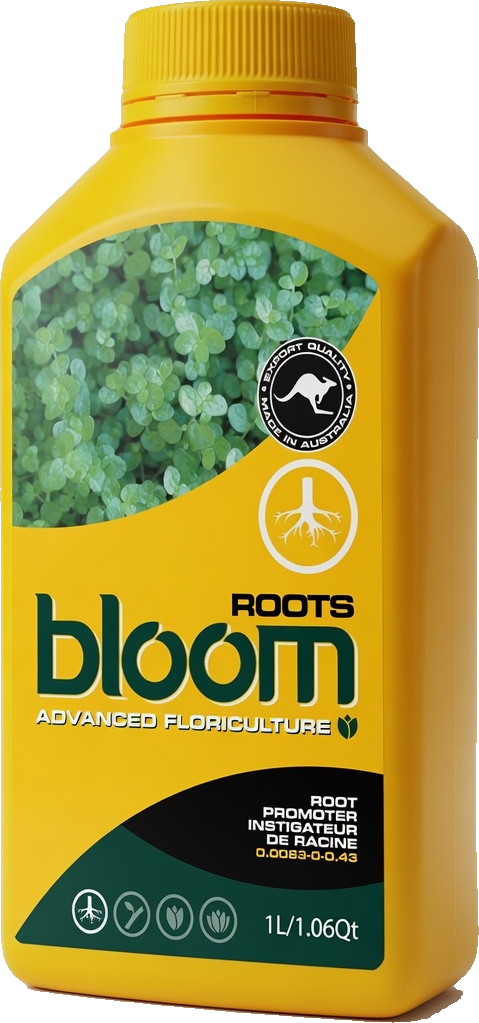
ROOTS
Your slabs and pots used to pick up radiant heat off the lamps. They don’t any more, and a cold root zone is a slow root zone. ROOTS is a Durvillaea potatorum seaplant extract with leonardite humic acid and thiamine, run at 0.5 ml/L through establishment and early veg while the new root mass is going in.
0.0083–0–0.43 · 0.075% humic acid · 0.054% thiamine (B1) · 0.5 ml/L
Straight up: the label declares no auxin, and neither does any seaweed product. If you want a rooting hormone, buy an IBA product — this is a different job.
See ROOTS →
Pushing the light up
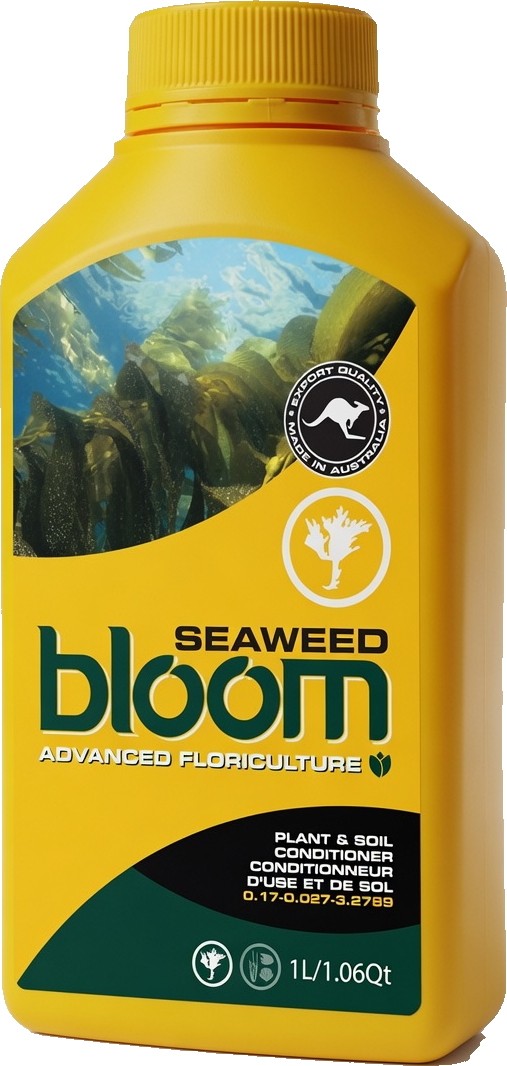
SEAWEED
The upside of LED is that you can run brighter — the Guelph work says yield keeps climbing well past where most HPS rooms sat. The catch is that everything else has to keep up while you find the ceiling. SEAWEED is the same Durvillaea potatorum extract at 1 ml/L, and it’s the layer growers reach for while they’re turning the dial up.
0.17–0.027–3.278 · from Durvillaea potatorum · 1 ml/L
See SEAWEED →
The one this page is really about
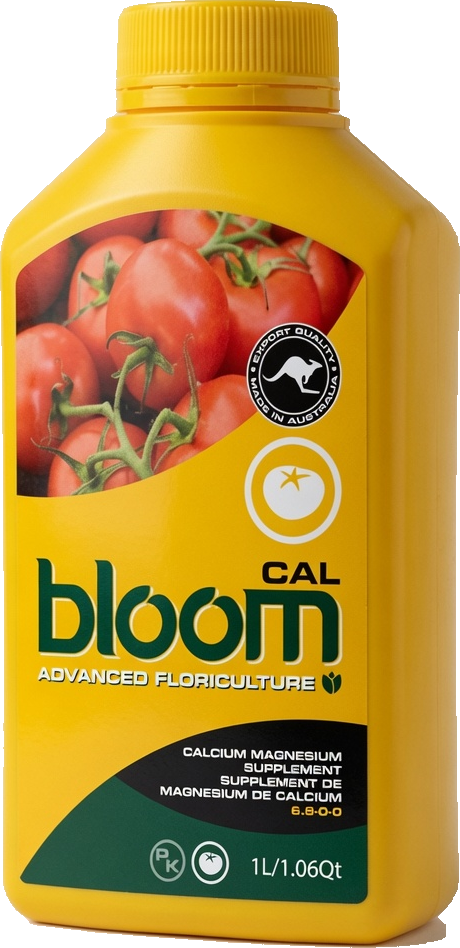
CAL-MAG
Calcium only moves on the transpiration stream and it doesn’t travel back down the phloem, so under a cooler leaf it’s the first thing to come up short in new growth. Magnesium sits at the centre of the chlorophyll molecule — 15–35% of what a plant absorbs ends up there — and two separate reviews find magnesium deficiency bites harder under high light, because unused light energy has nowhere to go.
The formulation detail that matters: this is calcium nitrate and magnesium nitrate. The DIY route is calcium nitrate plus Epsom salt, which puts calcium and sulfate in the same concentrate and drops gypsum out of it. There’s no sulfate in here, so that reaction has nothing to work with. The iron is DTPA-chelated, which holds to around pH 7.5 where EDTA lets go above about 6.3.
5.2–0–0 (all nitrate N) · Ca 5% · Mg 1.4% · Fe 0.5% DTPA · Zn 0.036% EDTA · 1 L · 2.5 L
Count it in your nitrogen budget — at 5.2% N, a 1 ml/L dose adds roughly 52 ppm of nitrogen to the tank. And don’t expect it to fix tipburn on its own: see the note below.
Shop CAL-MAG →
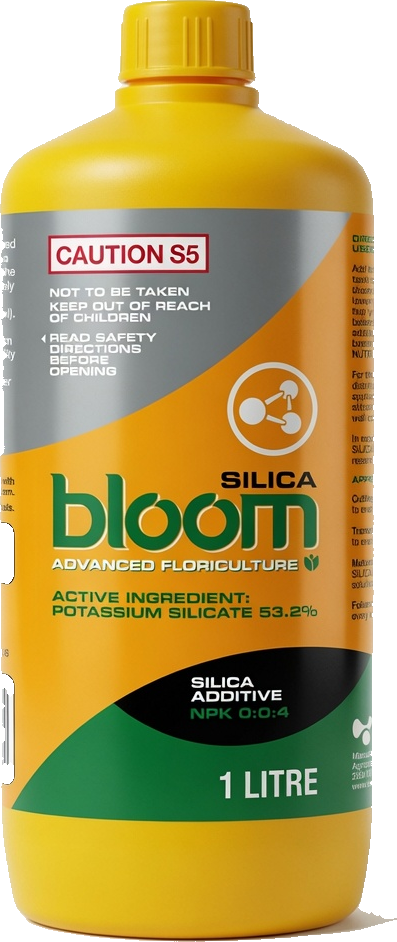
Holding weight under brighter light
SILICA
Plants take silicon up in exactly one form — monosilicic acid — and in the published research it gets laid down in and around cell walls, with reported associations to heat and light stress tolerance. Worth knowing under LED for a plain structural reason: brighter light means heavier flowers on shorter, tighter plants with less far-red stretch, and that weight has to be carried by the stem you grew.
Goes into the tank first, on its own, and gets pH’d before anything else joins it.
See SILICA →
The bit a fertiliser company probably shouldn’t print, so here it is. Bugbee’s lab tested whether you can fix lettuce tipburn by raising calcium at the roots and concluded you can’t — more calcium in solution didn’t reduce it. Calcium supply and calcium delivery are two different problems, and a bottle only solves the first one. So fix the airflow over your canopy first, get the real leaf VPD where you want it, and then make sure the supply is there to be carried. Anyone telling you a cal-mag bottle alone cures tipburn in a still room is selling you something.
The short version
Move the air.
Then feed it.
Then feed it.
The lamp swap changed how much water crosses the leaf. Everything else on this page follows from that one sentence.
Just re-lamped?
Let’s get the tank right.
Shop CAL-MAG →
Send me your room — lamp, PPFD, air temp, RH, EC and what your leaves are doing — and I’ll tell you what I’d change first. No charge, no pitch.
nathan@bloomyellowbottles.com · (970) 556-1678 · bloomyellowbottles.us · @bloomyellowbottles · @bloom_crew_nate
Sources
Nelson & Bugbee, PLOS ONE 10(10):e0138930 (2015) — leaf temperature under sunlight, HPS and LED · Palmitessa et al., Plants 10:810 (2021) — measured leaf temperature, stomatal conductance and transpiration, tomato · Bugbee, Utah State — spectral quality and radiation capture (near-infrared emission) · Katzin, Marcelis & van Mourik, Applied Energy 281:116019 (2021) — HPS→LED heating demand and lamp energy fractions · Nauta et al., Energies 16:1015 (2023) — modelled lamp energy split and dehumidification · Dannehl et al., Sustainability 13:8651 (2021) — full-cycle water use, lettuce · FAO Irrigation & Drainage Paper 56, ch.3 eq.11 — saturation vapour pressure · Prenger & Ling, Ohio State Extension AEX-804-01 — VPD and canopy temperature · Cornell CEA Hydroponic Lettuce Handbook (2013) — downward airflow, tipburn, DLI 12 vs 17, water temperature and dissolved oxygen · Hocking et al., Front. Plant Sci. 7:569 (2016) — calcium xylem transport and phloem immobility · Langenfeld & Bugbee, Front. Plant Sci. (2026) — mass-balance nutrition, EC behaviour, calcium and tipburn · Langenfeld, Payne & Bugbee, Utah State — water-use efficiency and solution concentration · Miller, Adhikari & Nemali, Front. Plant Sci. 11:607643 (2020) — recirculation, EC drift and tissue depletion · Rodriguez-Morrison, Llewellyn & Zheng, Front. Plant Sci. 12:646020 (2021) — cannabis yield vs light intensity at constant EC · Westmoreland/Zheng et al., Front. Plant Sci. 12:764103 (2021) — N, P and K response surface, flowering cannabis · Sae-Tang et al., JARMAP 43:100583 (2024) — high light intensity and specialised metabolites · Westmoreland, Kusuma & Bugbee, Front. Plant Sci. 14:1220585 (2023) — elevated UV photon flux · Rodriguez-Morrison et al. (2021) — UV-B and cannabinoid concentration · Peterswald et al., Scientific Reports (2025) — far-red light and medicinal cannabis · Runkle, Michigan State, in Greenhouse Product News — light, CO₂ and temperature interactions · Carotti et al., Front. Plant Sci. 11:592171 (2021) and Levine et al., Annals of Botany 132(3):455 (2023) — root-zone temperature under LED · Chen et al., Front. Plant Sci. 13:802274 (2022) and Guo et al., The Crop Journal — magnesium, chlorophyll and high light · Mandlik et al., J. Exp. Bot. 71(21):6703 (2020) — silicon uptake as monosilicic acid · Sekhon, Resonance (2003) — iron chelate pH stability · YSI oxygen solubility table · Bluelab, Hanna Instruments and Myron L technical documentation — EC to ppm conversion scales · Bloom guaranteed-analysis figures read from the product labels.
Where the literature is thin or contested we’ve said so on the page rather than rounding it into a confident number. If you find something here that’s wrong, tell us and we’ll fix it.