
A small reservoir sitting on a kitchen counter, feeding a houseplant in LECA or a semi-hydro setup, doesn’t get flushed often. Whatever’s actually in a fish-derived input matters more there than in a run-to-waste system that gets rinsed every week. So it’s worth asking a question most feed charts skip entirely: when two bottles both say “fish protein,” are they actually delivering the same amino acids?
Same starting tissue, two different endpoints
A 2024 comparison of trout viscera processed two ways — enzymatic hydrolysis versus acid-based silage — found the two routes landed at nearly the same total yield of free amino acids: 50.3% by the enzymatic route versus 49.2% by acid silage, measured on a dry-matter basis. On that one number, it’s close to a tie. But the profile of which amino acids came out on top wasn’t the same at all. The acid route’s most abundant amino acids were glutamic acid, lysine, leucine, and arginine. The enzymatic route’s most abundant were glutamic acid, leucine, alanine, and valine. Two of the four top amino acids differ by process, from the exact same raw tissue.
Why the acid route lands differently
Acid silage works by liquefying minced fish at room temperature with an acid — commonly formic acid, driving the mixture to roughly pH 3.5–4.5 — while the fish’s own digestive enzymes, particularly pepsin from the viscera, do the actual protein breakdown. Enzymatic hydrolysis skips the acid step and uses added enzymes under controlled, usually mild, conditions instead. Thermal autolysis — breakdown driven mainly by heat and the tissue’s own residual enzyme activity, without a deliberate enzyme addition — is documented as lower-to-medium efficiency for producing free amino acids compared with a properly enzymatic process. Three routes, three different chemistries, and in the case of the amino acid comparison above, two measurably different outcomes from one species of fish.
Acid silage: 49.2% free amino acids
Thermal: lower-to-medium efficiency
It’s worth being honest about what a near-tie in total yield actually implies, too. A 1.1-percentage-point gap between 50.3% and 49.2% isn’t a meaningful performance difference on its own — within the kind of variation a single trial on a single fish species can produce. The more durable finding here isn’t “enzymatic wins” or “acid wins” on raw yield. It’s that the composition of the end product — which specific amino acids show up in what proportion — depends on the processing choice, independent of the total yield number. A feed chart that only reports total nitrogen or total protein content is silent on exactly the detail this comparison found varies most.
Reading the word on the label
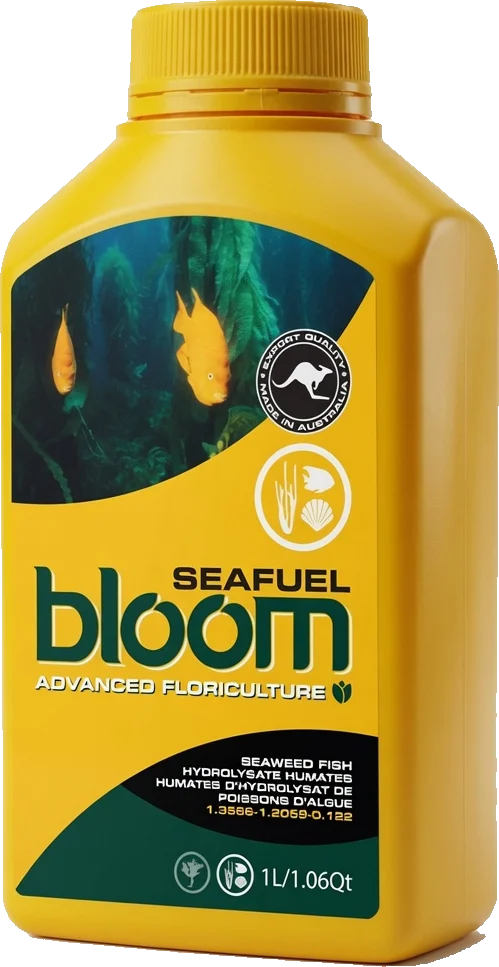
Bloom Seafuel’s label declares its fish-derived input plainly as “Hydrolized Blue Fin Tuna (Fish Hydrolysate)” — that specific word, not “emulsion” or “silage,” is what’s printed on the artwork. The label also lists 0.075% humic acid from Leonardite, dosed at 1 ml/L. What the label doesn’t spell out is the exact enzyme, temperature, or pH used in Seafuel’s own hydrolysis step — that’s a manufacturing detail this project hasn’t confirmed yet, so we’re not asserting it here.
Why this matters more in a small reservoir
In a houseplant or semi-hydro reservoir that might sit for a week or two between top-offs, whatever amino acid mix actually went into the water is what the roots are exposed to the whole time — there’s no weekly flush diluting out an unexpected profile the way there is in a run-to-waste hydro setup. That’s not a reason to avoid fish-derived inputs in a small reservoir. It’s a reason to read “hydrolysate” as a specific, documented processing choice rather than a generic descriptor, and to recognize that the word on the label is telling you something real about how the product in the bottle was made.
For a small, infrequently flushed reservoir specifically, that word matters more than the guaranteed-analysis percentages alone can convey. Two bottles with similar nitrogen and potassium figures on their labels can still be delivering meaningfully different amino acid chemistry underneath those numbers, simply because of how the fish protein was broken down before it ever reached the bottle.