
White paper 09 · Organic & living soil · Grower proof series
Sits on top of
what you built
For growers who spent years on their soil and won’t risk it: how Bloom is used in living soil, teas and organic programs, and a very clear statement of what Bloom is not.
Reading time ~4 minutes · Label figures transcribed from the product labels · Sources listed at the end · October 2026
Who this is for
The hardest customers in the shop
Living-soil growers have spent years building something biological, and they’re not going to pour an unknown bottle into it on anyone’s say-so.
Six growers in Bloom’s record run teas, living soil or organic programs. They use Bloom the way they’d use any amendment: over the top, carefully, watching what happens. One ran a side-by-side on the same organic base.
6
Growers on record running organic or living-soil programs
12 gal
Roots dip batch @white_buffalocultivationco mixes
No
USDA organic certification · made from marine, humic and plant extracts
What’s actually different
Three things worth knowing
It layers, it doesn’t replace
Bloom products are additives over an existing feed. For a living-soil grower, that’s the only acceptable shape.
Growers use it their own way
One dips clones in a 12-gallon Roots batch. One adds it to compost tea. One split two plants on the same organic base, one with Bloom on top. The record shows adaptation, not a schedule.
We don’t overclaim
Not USDA-certified organic. PHAT and OOZE also declare boric acid and sodium molybdate as their boron and molybdenum sources, and we’d rather you hear that from us.
Worth knowing. We can’t yet tell a living-soil grower what this does to their soil biology. That’s the gap, and it’s the one living-soil growers care about most.
What growers are reporting
In their own words
Quotes come from Bloom’s grower review records. Some are lightly trimmed for length and spelling, with the meaning unchanged; the original messages are on file. Growers in the trial program agreed to their feedback being shared.

“One of the Raspberry Parfait is getting Yellow Bottles and [their organic base], the other is getting [that base] with no other inputs.”
@therealbestbudz
Roots · SWTNR · 1 Aug 2025 · the set-up
“The Yellow Bottles plant is really showing off… Ultra has really taken over and made a big difference in such a short time frame.”
@therealbestbudz
Ultra · 31 Aug 2025 · two weeks into flower
“The products are easy to use and show great results. My favorite trio complements organic gardening fantastically.”
@therealbestbudz
Roots · SWTNR · Ultra · 8 Sep 2025
“I used Ooze in my regimen the last few rounds and noticed a real difference: same clone, same soil and tea.”
@aficionadoestates
Ooze · 16 Oct 2024
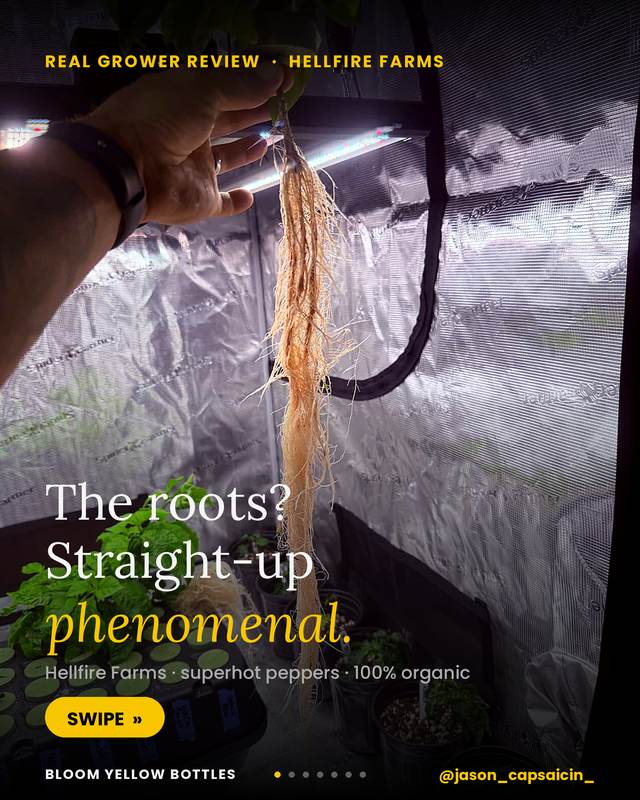
“As additions to a compost tea, the Sea Minerals and that line are bad ass.”
@jason_capsaicin_
Sea Minerals · in compost tea
“Roots works best as a dip. I mix a 12-gallon batch and dip my teens roots and all. Cuts the smell too.”
@white_buffalocultivationco
Roots · 22 Nov 2024

“It’s night and day: more biomass, terpier and smoother.”
@squidward_organics
Roots · 5 May 2026
The numbers
What’s on the label
Guaranteed analysis is the figure printed on the product label, not a marketing claim. Rates are Bloom’s standard schedule.
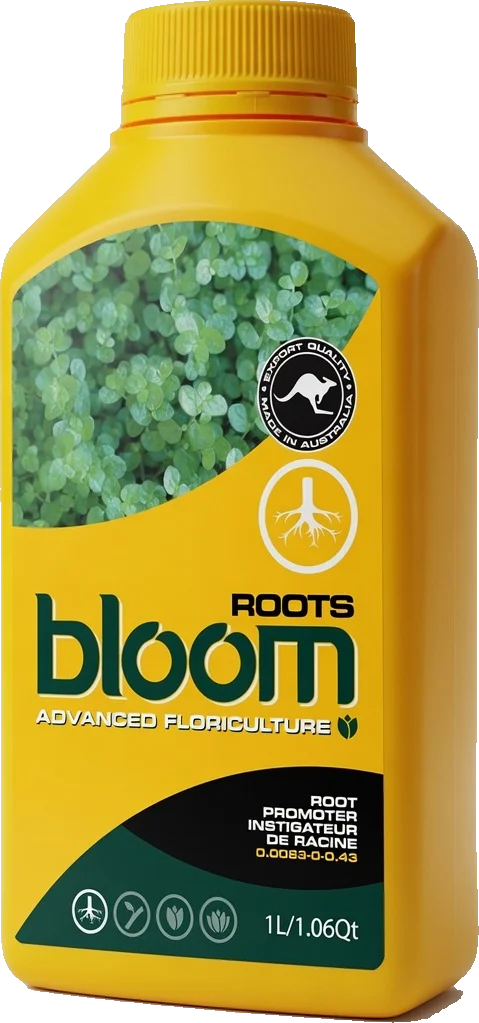
ROOTS
Guaranteed analysis 0.0083-0-0.43
Total Nitrogen (N)
0.0083% (0.0021% ammoniacal, 0.0062% water-soluble organic)
Soluble Potash (K₂O)
0.43%
Derived from
Durvillaea potatorum (seaplant extract)
Also contains (non plant food)
0.075% humic acid (from leonardite), 0.054% thiamine hydrochloride (vitamin B1)
Rate
0.5 ml per litre in feed; 1 ml per litre as a dip for cuttings and plugs
OOZE
Guaranteed analysis 0.306-2.337-2.4573
Total Nitrogen (N)
0.306% (0.0323% ammoniacal, 0.2737% water-soluble organic)
Available Phosphate (P₂O₅)
2.337%
Soluble Potash (K₂O)
2.4573%
Boron (B) · Molybdenum (Mo)
0.16% · 0.0578%
Derived from
Molasses, Ahnfeltia plicata, Laminaria japonica, boric acid, sodium molybdate
Also contains (non plant food)
0.075% humic acid (from leonardite), 0.054% thiamine hydrochloride (vitamin B1)
Rate
2.5 ml per litre every feed, weeks 5–8 of flower
What we can stand behind
Sourced, or it isn’t here
6 growers on record run Bloom inside organic, living-soil or tea-based programs.
Source: Bloom grower review records, counted 30 Oct 2026
Bloom is not USDA-certified organic.
Source: Bloom product labels (no organic certification claim)
PHAT and OOZE declare boric acid and sodium molybdate.
Source: Product labels
Straight answers, every bottle
Want the full input list for any bottle? Ask Nate and you’ll get it.
See every grower review →Talk to Nate directly: nathan@bloomyellowbottles.com · (970) 556-1678 · bloomyellowbottles.us · @bloomyellowbottles · @bloom_crew_nate
Sources
- Bloom grower review records, counted 30 Oct 2026 — 6 growers on record run Bloom inside organic, living-soil or tea-based programs.
- Bloom product labels — Bloom is not USDA-certified organic.
- Product labels — PHAT and OOZE declare boric acid and sodium molybdate.
- Bloom product labels — Agricultural Organics (Aust) P/L, Green Fields, South Australia