
Jack’s Nutrients and Bloom
Jack’s dry salts on the left, Bloom’s liquids on the right, matched on the job each one does. The Jack’s base and the water test stay. Here’s what goes into the tank on top.
Last checked 5 November 2026 · Public information only
This Fit Report is a summary of publicly available information about Jack’s Nutrients and its products, taken from their own website, labels and published material as of 5 November 2026. We’ve linked each source so you can check it yourself. Rates are as printed on each company’s own pages; we don’t show prices. It isn’t affiliated with, endorsed by or approved by Jack’s Nutrients, and product names belong to their owners. Products, rates and claims change, so please confirm current details with the manufacturer before making any decision. Spotted something out of date? Email nathan@bloomyellowbottles.com and we’ll correct it.
All salts, no extracts, so the tonics go on top.
Jack’s is a mineral program built from dry salts, picked to suit your water test. Their lineup has no seaweed, fish, humic, silica or carbohydrate product. Bloom’s liquids do those jobs, at small weekly rates, in the same tank as the 3-2-1 mix.
- Stays as is: 5-12-26 Part A and Cal Nit Part B, the one-part bases, 15-6-17 Clone and the lab.
- Both have one: a bud-set formula, a finish, a zero-N PK and magnesium.
- Not on their list: kelp, tuna, humic, sea minerals, silica, carbs and foliars.
Where each bottle sits in the cycle
Jack’s Nutrients’s timing in grey, Bloom’s in yellow, across shared stages of the grow.
| Stage | Root | Veg | Flip | 3–4 | 5+ | Last 2 | Flush |
|---|---|---|---|---|---|---|---|
| Jack’s Nutrients, per their pages | |||||||
| 15-6-17 Clone | |||||||
| 5-12-26 Part A + 15-0-0 Part B | |||||||
| Epsom salt | |||||||
| 10-30-20 Bloom (Jack’s), 1 week | |||||||
| 7-15-30 Finish, 1 week | |||||||
| Clear water flush, 4–7 days | |||||||
| Bloom, per Bloom’s weekly feed charts | |||||||
| Roots | |||||||
| Pre | |||||||
| Ultra | |||||||
| Phat (weeks 3 and 4) | |||||||
| Ooze (wk 5 to flush) | |||||||
| Final (with Ooze) | |||||||
| Seafuel | |||||||
| Seaweed · Humate · Sea Minerals | |||||||
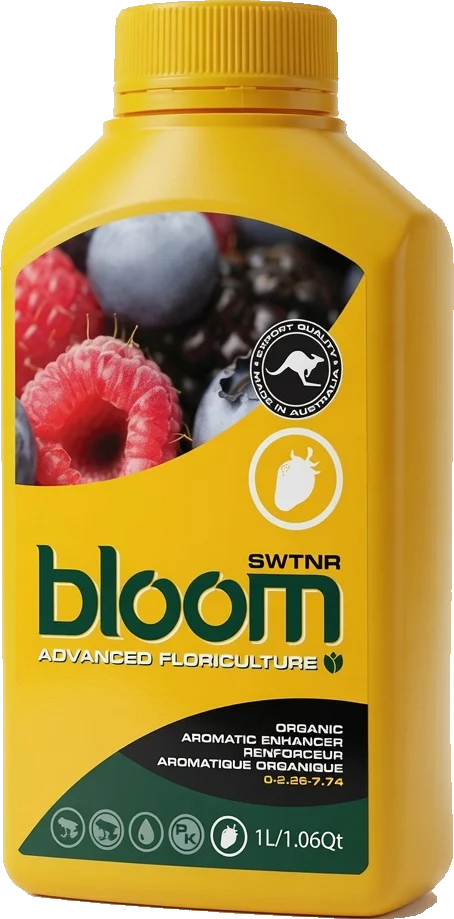
| SWTNR | |||||||
| Cal-Mag | |||||||
| Groigen (foliar, as needed) | |||||||
| Florigen (foliar, as needed) | |||||||
| PK (as needed) | |||||||
| Silica | |||||||
Timing comes from Jack’s 3-2-1 one-gallon cannabis schedule: Clone for propagation, Part A and Part B for veg and flower, 10-30-20 Bloom for one week at bud set, 7-15-30 Finish for one week in late flower, then 4–7 days of clear water. The schedule doesn’t put Epsom in a stage, so it’s pale, and A and B are pale in the bud-set and finish weeks (our read). Bloom’s bars follow its weekly feed charts; pale Bloom bars are tapers or as-needed bottles.
Jack’s Nutrients and Bloom in short
Part A and Cal Nit Part B, the one-part and specialty bases, 15-6-17 Clone and the lab.
10-30-20 Bloom, 7-15-30 Finish, 0-12-26 Part A and Epsom each sit near a Bloom product.
Seaweed, Seafuel, Humate, Sea Minerals, Silica, SWTNR, Pre, Phat and the foliars.
Why each one fits
What the Bloom product does, the research behind that kind of input, and where it sits in a program that already runs.
Kelp and tuna in a salt tank
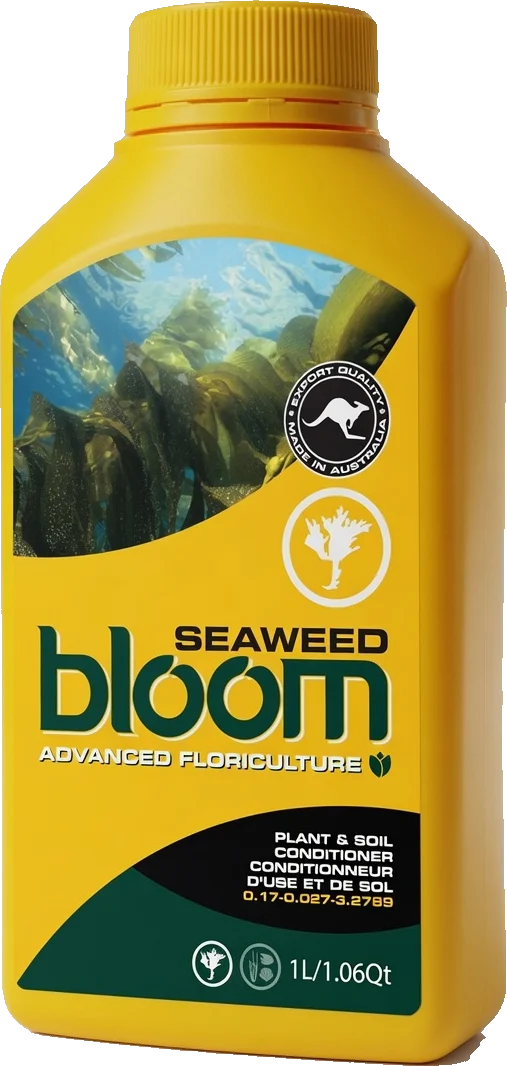
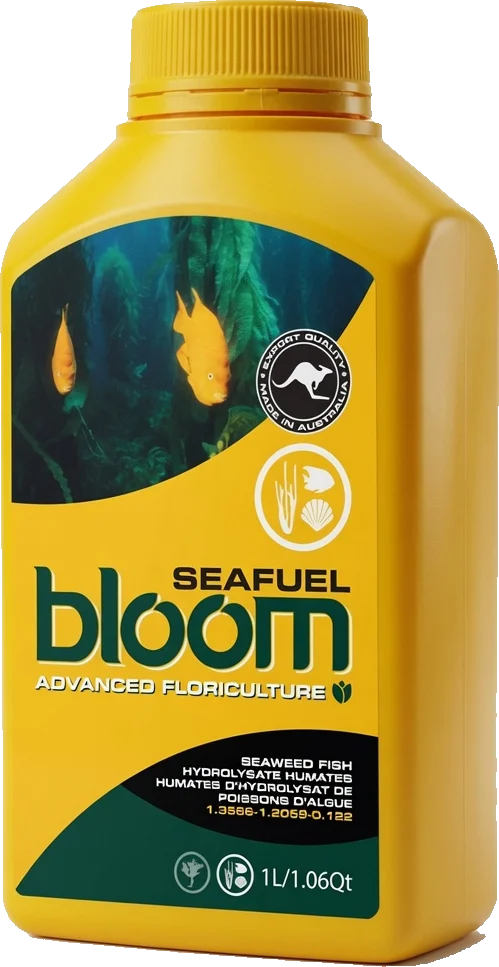
What it does. Seaweed is southern bull kelp; Seafuel is tuna and kelp. Both run at 1 ml/L weekly: Seaweed from seedling through the flush, Seafuel from clone through late flower, tapering at the flush.
Reviews of seaweed extracts report effects on growth and stress tolerance across many crops. Work on protein hydrolysates, which fish inputs belong to, is newer and links them to nutrient uptake, mostly under stress. None of it tests these bottles or cannabis.
Ali et al. (2021), Plants (review) · Malécange et al. (2023), Int J Mol Sci (review)
How it stacks. Jack’s lineup is mineral salts only. Our read: dissolve the Part A and Part B first, then add Bloom’s liquids and check EC against Jack’s stage target.
Humic acid and sea minerals
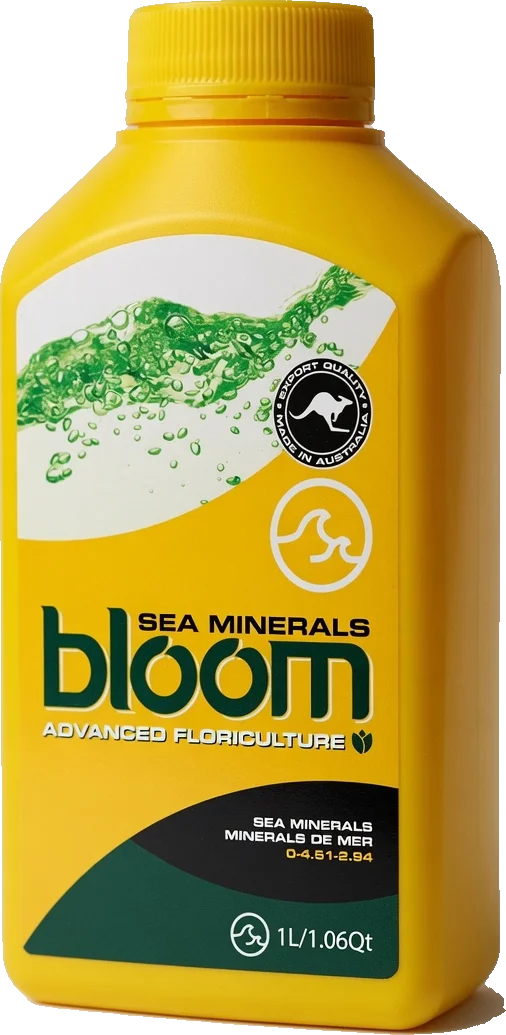
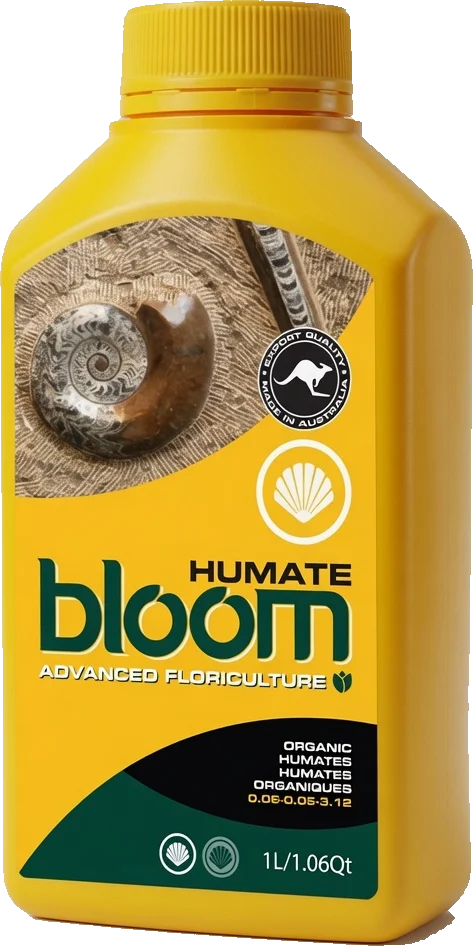
What it does. Humate is 10% humic acid at 2.5 ml/L weekly, seedling through flush. Sea Minerals is trace minerals from sea water at 0.13 ml/L weekly, veg to bloom.
A major review links humic substances to more lateral roots and to root changes tied to nutrient uptake. It doesn’t test either company’s products.
How it stacks. Humic doesn’t supply NPK, so it sits next to the salt base without changing the ppm N plan (our read).
Silica in first
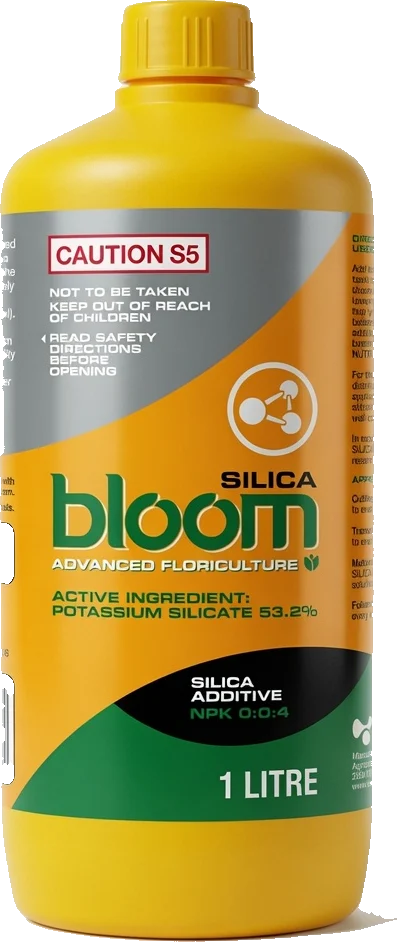
What it does. Silica is potassium silicate, labelled 0-0-4, at 0.33 ml/L weekly, added first. It runs veg through early flower and tapers in late bloom.
A 2017 editorial says silicon is widely studied for stress tolerance, but there’s still no conclusive evidence on exactly how it works.
Deshmukh, Ma and Bélanger (2017), Frontiers in Plant Science (editorial)
How it stacks. Silica goes into the water before the Part A and Cal Nit Part B, per Bloom’s Silica page.
Their line, Bloom’s fit at a glance
Matched on job, not NPK. Jack’s prints dry grams per gallon on a constant liquid feed; Bloom prints ml per litre on a weekly feed chart. Tap a tag to filter.
Keep your base. Bloom’s additives sit on top of a 3-2-1 mix.
Jack’s matches these to the calcium in your water. They stay.
Specialty bases with no Bloom match.
Clone is a feed. Roots is an additive and can sit alongside it (our read).
Jack’s picks your schedule from a water test. Bloom has nothing like it.
Same week of the grow. Theirs is the base for that week; Ultra is an additive. Plan the stack.
Same window. Finish is the base for that week; Final is an additive.
Both lift P and K. Theirs is a base part, PK is an as-needed liquid.
Epsom is Mg only; Cal-Mag lists Ca and Mg with iron and zinc. Check your water test first.
Southern bull kelp, and a tuna and kelp tonic, in a salt tank.
10% humic acid, plus trace minerals from sea water.
Potassium silicate, mixed in before the salts go in.
Carbohydrates and potassium on top of a mineral base.
Mid veg and flower weeks 3 and 4 in the tank, plus lights-off sprays for veg and the flip.
Where the programs complement each other
Extracts in a salt tank
Jack’s lineup lists no seaweed, fish, humic or sea-mineral product. Seaweed, Seafuel, Humate and Sea Minerals go in at 0.13–2.5 ml/L weekly once the salts are dissolved (our read).
Silica first, then the salts
Jack’s lists no silica product. Bloom Silica goes in first at 0.33 ml/L weekly, veg to early flower, before the Part A and Part B.
Let the water test set the Cal-Mag
Jack’s picks your base by the calcium in your water, and Epsom adds 23 ppm Mg. If Cal-Mag goes in at 1 ml/L weekly, run it past that water test first (our read).
Put it side by side
Where both ranges have a product for the same job, the fair answer is a test in your own room. Here’s what to watch and how to keep it fair.
Keeping it fair
- Same plants. Clones off the same mother, same cultivar, same age.
- Same room. Same light, climate, media, pot size and watering.
- Same base. Keep the base feed and EC the same on both sides.
- One change. Change only the product being tested, and write down what you see each week.
Already covered
- Base feed. 5-12-26 Part A and Cal Nit Part B, or a one-part base picked by your water.
- Propagation. 15-6-17 Clone.
- Bud set and finish. 10-30-20 Bloom or 5-50-18 UltraViolet, and 7-15-30 Finish.
- Magnesium and testing. Epsom salt and JRP Lab Services.
Stays exactly as is
- Part A and Part B. The 3-2-1 base stays as is.
- One-part and specialty bases. Bloom has no dry products.
- 15-6-17 Clone. Bloom has no cutting feed.
- The water test. It still sets the base, and any Cal-Mag call.
Background, science and sources
Who Jack’s Nutrients are
Jack’s Nutrients is the nutrient line from JR Peters, Inc. in Allentown, Pennsylvania. The roots go back to 1947, when Bob Peters started a soil testing service for greenhouse growers. John Raymond is president, and Dr Cari Peters is part owner and formulator and heads the lab and tech support.
The range is dry, water-soluble salts: Part A and Cal Nit Part B, one-part bases chosen by water type, and stage formulas like 15-6-17 Clone, 10-30-20 Bloom and 7-15-30 Finish. They sell through their own online store and kits, publish cannabis and hemp schedules matched to your water, and run a lab for water, media and tissue tests. Products are made in the USA.
Sources: JR Peters, Our Company · Home · Lineup
What each company brings
Jack’s Nutrients: Dry two-part and one-part bases matched to source water, stage formulas for clone, bud set and finish, published EC targets per stage, and an in-house testing lab.
Bloom: one additive for each stage of the crop, seaweed, humic and sea mineral inputs, foliar sprays, and weekly feed charts for soil, coco and hydro. Rates and timing are on every product page.
Cropping Solutions, the other brand under Agricultural Organics, isn’t part of this report.
Dose basis: how each side counts
Jack’s prints dry grams per gallon (or per 100 gallons), set by ppm of nitrogen, with an EC target for each stage. The 3-2-1 schedule assumes a constant liquid feed and says rates may need adjusting for source water and feeding frequency. Part A runs 3.79 g/gal and Part B 2.52 g/gal on that schedule.
Bloom prints ml per litre on a weekly feed chart. Jack’s are dry salts and Bloom’s are liquids, so the two don’t line up gram for ml. Add Bloom’s liquids on top and check EC at the end (our read).
Mix calculator
Rates as printed on each company’s page (1 US gallon is 3.785 L). Bloom’s rates are per litre of nutrient solution, dosed weekly per its feed charts. Pick a product and your tank size.
Potassium in flowerWell supported
Hasanuzzaman and colleagues (2018) review potassium’s roles in plants: enzyme activation, stomatal control, photosynthesis and stress tolerance.
Why it matters here: 0-12-26 Part A, 7-15-30 Finish and Bloom PK all lean on potassium late in the run. The review is general plant science and doesn’t compare products.
Sources, all viewed 5 November 2026
Jack’s Nutrients: Home · Lineup · Online store · 5-12-26 Part A · Cal Nit Part B · 0-12-26 Part A · 15-6-17 Clone · 10-30-20 Bloom (Jack’s) · 5-50-18 UltraViolet · 7-15-30 Finish · Epsom Salts · Cannabis and hemp schedules · 3-2-1 schedule, 1 gallon (PDF) · 3-2-1 and 0-12-26 schedule, 100 gallon (PDF) · JRP Lab Services · JR Peters, Our Company
Bloom: Roots · Pre · Ultra · Phat · Ooze · Final · Seafuel · Seaweed · SWTNR · Humate · Cal-Mag · Groigen · Florigen · Sea Minerals · PK · Euro · Grow · Flower · Silica · OrganiShield
Last checked 5 November 2026. Public information only. Not affiliated with, endorsed by or approved by Jack’s Nutrients; product names belong to their owners. Please confirm current details with the manufacturer. Corrections: nathan@bloomyellowbottles.com. All Fit Reports