
Grower education · Silicon
Silica for growers
DIY methods vs. ready-made
Every grower hears that silica toughens plants up. Fewer hear the part that actually decides whether it works: most of the silicon on the planet sits in a form roots can’t touch. Here’s what the common DIY sources really deliver, and where a ready-made bottle fits in.
Reading time ~4 minutes · Two-page A4 print version for the bench · Sources listed at the end
Start here
Why silicon is worth bothering with
New to silica? This is the short version of what it does once it’s actually inside the plant.
Structure
Silicon is laid down in and around cell walls, where it cross-links with hemicellulose. Stems stiffen, branches carry weight, plants hold themselves up instead of leaning on you.
Pest & disease
In the published research it forms a cuticle-silica layer under the leaf surface, and the plant’s own defences — enzymes, phenolics, lignin — are more active where silicon is present.
Heat & drought
Under heat and water stress, silicon-fed plants hold leaf water potential better, use water more efficiently and keep photosynthesis ticking along.
Worth being straight about: silicon isn’t classed as an essential nutrient — a plant will finish a run without it. It’s what plants do with it when it is there that growers notice.
The bit that matters
Plants can’t drink rock
Horsetail, rice hulls, diatoms, sand — all genuinely loaded with silicon. But it’s sitting there as silica and silicates: long polymerised chains. Roots don’t take that up. Plants absorb silicon in exactly one form — monosilicic acid, Si(OH)4, a single small uncharged molecule that fits through the silicon transporters in the root. Everything else has to break all the way down to that first, or it does nothing at all.
Soluble isn’t permanent, either. Silicic acid only stays as single molecules while the solution suits it. Concentrated or mixed in the wrong order, it links back up into silica gel and drops out of reach — which is exactly why silica goes into the tank first, on its own, and gets pH’d before anything else joins it.
Side by side
What each source actually delivers
Bars show how much usable silicon survives the preparation a grower would actually do — not how much silica is in the raw material.
Horsetail tea
Equisetum arvense
Plant-available yield
A standard unboiled tea pulls out ~0.3% of the dried plant’s weight as silicon — under half of even the soluble share. Long soaking and boiling lifts it.
What it actually is
Dried herb runs 5–7.7% silicic acid and silicates. Only about a tenth of that is water-soluble to begin with — call it 0.5–0.8% of dry weight.
Consistency
Swings with species, season, plant age and how you brew it.
Time & labour
Harvest, dry, soak, boil for hours, strain. Every batch.
Rice hull ash
ash or home extract
Plant-available yield
Raw ash in a reservoir does little. Soluble silicate needs a hot caustic (NaOH) extraction, then neutralising.
What it actually is
The ash itself is >90% silica — amorphous if it’s burnt under about 700 °C, crystalline above it.
Consistency
Burn temperature decides the lot. Hard to control in a drum.
Time & labour
Ashing plus wet chemistry — this one stops being gardening.
Diatomaceous earth
natural, uncalcined
Plant-available yield
Water-soluble Si sits in the low mg/kg. Real release, but across a soil season — it’s an amendment, not a tank additive.
What it actually is
Fossil diatom silica, >70% SiO2, already amorphous and porous.
Consistency
Grade, particle size and soil pH set the release. Works over months, not days.
Time & labour
Easy to spread. Mask up — natural DE can carry up to ~4% crystalline quartz. Never use calcined pool grade.
Bamboo leaf
tea or home extract
Plant-available yield
As a tea, the horsetail story again. Doing it properly needs the same caustic-and-acid route.
What it actually is
Richest of the common plant sources — leaves 17–23% silica, leaf ash 76–83% SiO2.
Consistency
Excellent raw material, very hard to standardise on a bench.
Time & labour
Sourcing bamboo leaf in any volume is the first job.
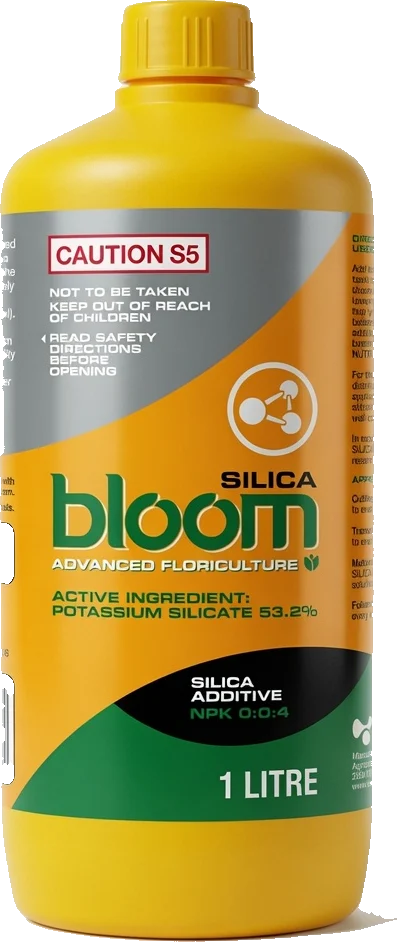
Bloom Silica
ready-made
Plant-available yield
Goes in already soluble — nothing to ash, steep or extract between the bottle and the root.
What it actually is
31% silicon from monosilicic acid, plus 21.2% soluble potash (K2O) derived from potassium silicate.
Consistency
Same figure out of every bottle. Nothing to standardise.
Time & labour
0.33 ml/L. pH it first, on its own in the tank, then add the organics.
Where we land
No knock on doing it yourself
If you like making your own inputs, a horsetail or bamboo brew is a fine thing to have on the bench, and diatomaceous earth earns its place in a soil mix. The catch isn’t whether DIY can work. It’s that you can’t know how much plant-available silicon you actually put in — and with silicon the only number that counts is how much soluble silicic acid reaches the root, not how much silica was in the raw material.
That’s all a ready-made bottle really buys you: you know what went in. If the process is half the fun, keep at it — just run a control alongside it and let the plants settle the argument.
Silicon
31%
Soluble potash (K2O)
21.2%
Rate
0.33 ml/L
Sizes
250 ml · 1 L · 2.5 L · 15 L
Mixing order — get this one right. Silica goes in first, on its own, and gets pH’d before anything else joins it. Potassium silicate is strongly alkaline and will spike a tank. Once it’s settled where you want it, add the organics and the rest — then stop chasing the pH.
Know what went in.
Every time you mix.
Shop SILICA →
Want it on paper? Download “Silica for Growers: DIY Methods vs. Ready-Made” as a two-page A4 PDF — built to pin up next to the res.
Questions on silica for your setup? nathan@bloomyellowbottles.com · (970) 556-1678 · @bloomyellowbottles · @bloom_crew_nate
Sources
EMA/HMPC assessment report on Equisetum arvense L., herba (silica content and water-extractable fraction) · Front. Plant Sci. 6:853 (2015) (uptake form and solubility limit) · Front. Plant Sci. 8:701 (2017) (silicon and plant–pathogen interactions) · 3 Biotech 9:73 (2019) (silicon and abiotic stress) · IJCRT 13(6) (2025) (silica extraction from rice hull ash) · MATEC Web Conf., RSCE 2018, art. 05021 (bamboo leaf ash silica) · Soil Systems 10(9):100 (2025) (diatomite as a silicon source) · OSHA standard interpretation, 24 Aug 2012 (crystalline silica in natural vs. calcined diatomaceous earth) · Bloom Silica guaranteed analysis from the product label.