
If you’re running a biostimulant program across real acreage instead of a grow tent, the question that actually moves the needle isn’t which seaweed species sounds the most impressive on a bag tag. It’s where you put the input. That turns out to have a bigger, better-documented answer than most of what gets argued about in input efficiency and regenerative-ag circles — and it comes from the largest piece of research ever run on seaweed-based biostimulants.
198 studies, 2,021 side-by-side comparisons
A 2026 meta-analysis in Frontiers in Plant Science pulled together 198 peer-reviewed field studies and 2,021 independent treatment-versus-control comparisons of seaweed-extract biostimulants — by far the largest dataset assembled on the category. The authors broke the results down by how the extract was applied, not just what it was made from, and that’s the part worth sitting with if you’re thinking about input efficiency at field scale rather than per-plant.
Soil-directed application — fertigation or a root-zone drench — produced yield gains of roughly +19 to +21%. Foliar application came in lower, at +15.5%. Combining both methods landed lowest of the three, at +14.2% — stacking the two didn’t add up the way you’d guess. For anyone counting passes, fuel, and labor across a few hundred acres, that’s not a rounding difference. It’s the kind of number that should change where a biostimulant dollar goes before it changes what’s in the jug.
Pérez-Oñate et al., Frontiers in Plant Science 17:1803269 (2026) — 198 studies, 2,021 comparisons
What the same study does not let you say
It’s worth being just as clear about what this dataset doesn’t settle. A lot of regenerative-ag talk assumes alkaline extraction automatically outperforms a plain water extraction. The confidence intervals in this exact study overlap heavily enough that the two routes are statistically indistinguishable — alkaline hydrolysis came in at +21.2%, water-based extraction at +16.6%, and alkaline’s own lower bound sits below water’s point estimate. Enzyme-assisted, acid hydrolysis, and a few other routes showed no significant effect at all. Route matters — two of seven tested methods worked, five didn’t — but ranking the two that did work against each other isn’t something this paper backs.
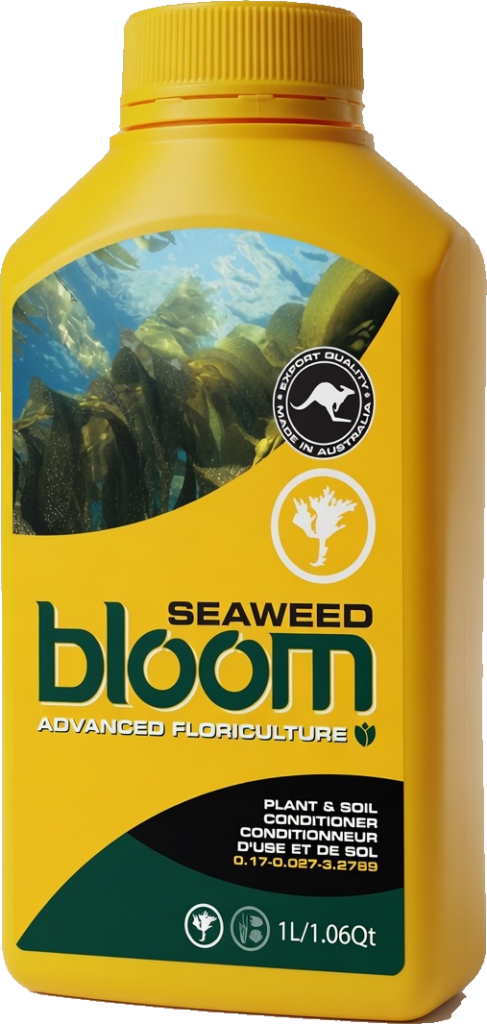
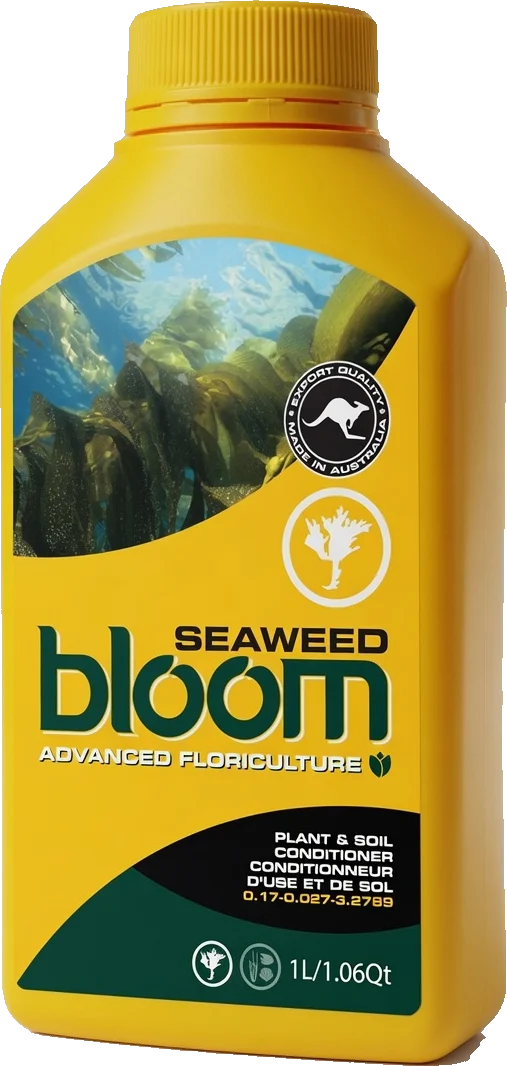
One more honest caveat: Durvillaea potatorum — the seaplant extract declared on Bloom’s own Seaweed label — doesn’t have its own entry in this particular species table. The species breakdown in the study covers Ascophyllum nodosum, Laminaria, Gracilaria, Kappaphycus and a few others, each with its own effect size. That’s a gap, not a knock — it just means the species-specific number isn’t something we can borrow for this one.
0.17 – 0.027 – 3.278
Why this is a field-scale question, not a tent-scale one
On a hydro bench, the gap between a drench and a foliar spray is a few minutes of labor. Across a quarter section, it’s the difference between running a biostimulant through the fertigation line you’ve already got laid, or adding a dedicated foliar pass with its own fuel, timing window, and weather risk. The meta-analysis is effectively telling growers thinking at that scale something concrete: if the input is going to pay for itself, soil-directed delivery through an existing system has the better track record, and a combined program isn’t automatically the safer bet.
Bloom doesn’t publish a dedicated per-acre rate for Seaweed — it’s dosed as a dilution into a fertigation or spray solution, the same way it’s always been labeled. We’re not going to invent a lb-per-acre number that isn’t on the bottle. What we can say, backed by the largest dataset the category has, is that the delivery method you already have running through your system is a legitimate place to put this input, and it isn’t a corner anyone needs to apologize for cutting. For a look at what happens when a field-scale “mineral” input skips that kind of rate discipline entirely, see the arithmetic behind a 70-year-old sea-solids fertilizing patent.
This is about nitrogen-use efficiency and input placement before it’s about any one brand’s bottle — the same conversation the broader regenerative-ag world has been having about getting more out of every pass across the field. The product underneath it, for us, is one line on a label that’s been through CDFA review for years: Durvillaea potatorum, 0.17-0.027-3.278, nothing else declared.
Source: Pérez-Oñate CJ, et al. “Crop yield responses to seaweed extract-based biostimulants depend on application strategy, formulation, and extraction methods: a meta-analysis.” Frontiers in Plant Science 17:1803269 (2026). Guaranteed analysis per Bloom Seaweed label artwork.