A greenhouse grower chasing calcium and magnesium for cut flowers sometimes lands on the idea that a mineral-rich ocean input — a sea mineral product, a home-brewed seawater tonic — ought to cover both. The ocean is, after all, full of calcium and magnesium. The ratio those two minerals actually arrive in, though, runs backwards from what a greenhouse crop wants, and that’s a problem no amount of the right bucket solves.
Seawater’s calcium-to-magnesium ratio is inverted
Full-strength seawater carries roughly 1,292 mg/L of magnesium against only about 412 mg/L of calcium — a magnesium-to-calcium ratio of about 3.1:1 by mass. University extension guidance for greenhouse irrigation water points the other way: a desirable range of 40–100 ppm calcium against 30–50 ppm magnesium, putting calcium ahead of magnesium by roughly 1.3–2:1. Seawater’s ratio is inverted from that target by somewhere around four to six times. It isn’t a trace imbalance — it’s the ratio running the opposite direction from what the crop wants.
Why the ratio matters more than the raw amount
Plant-nutrition extension sources describe calcium, magnesium and potassium competing for the same uptake pathways and exchange sites — an excess of one can displace or restrict the others, independent of whether any single nutrient is technically deficient. UMass’s own greenhouse guidance adds that high sodium specifically “acts to inhibit plant uptake of calcium” and can drive “excess leaching of calcium and magnesium from growing media.” Seawater doesn’t just skew the Ca:Mg ratio — it brings the sodium that actively works against calcium uptake while it does it.
The dilution math makes the actual tradeoff visible. Seawater has to be diluted somewhere around 1:71 before its overall salinity reaches the “no restriction” irrigation band, but even at that dilution the sodium-to-calcium-and-magnesium ratio is still in FAO’s slight-to-moderate restriction range — the two problems don’t resolve at the same dilution. And by the time you’ve diluted far enough to get the sodium hazard down to a comfortable range, the delivered magnesium works out to somewhere around 3–4 mg/L — a small fraction of UMass’s 30–50 ppm desirable range. The dilution that makes seawater safe to put on a crop is also the dilution that makes it nutritionally beside the point.
A single-purpose input, dosed on purpose
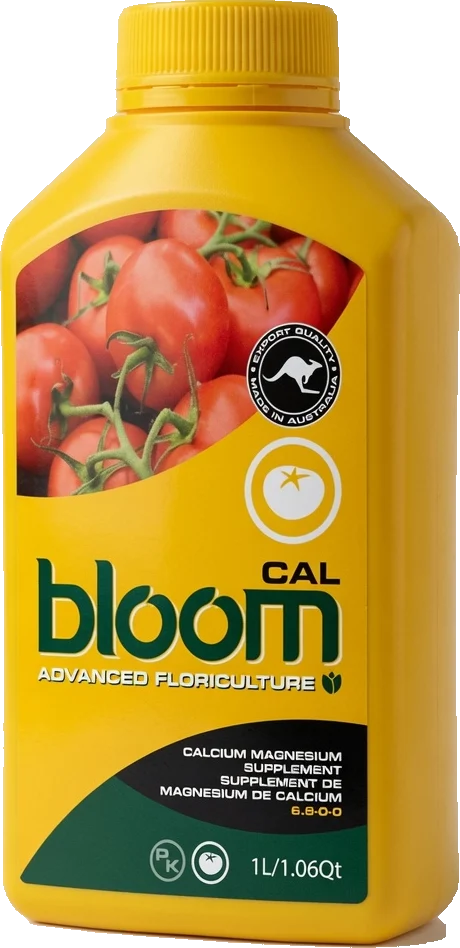
This is the case for a calcium-magnesium product built to do one job rather than a mineral-rich input asked to do several at once. Bloom Cal declares 5% calcium and 1.4% magnesium — a ratio of roughly 3.6:1 calcium-forward — delivered as calcium nitrate and magnesium nitrate, with no sulfate to precipitate against the calcium and no sodium riding along to fight the uptake of either mineral. It isn’t trying to be a mineral cocktail. It’s calcium and magnesium, in a ratio a greenhouse crop can actually use, without the ocean’s sodium tagging along to undo the benefit.
The ratio problem, in one line:
None of this is an argument against sea-derived inputs generally — Bloom’s own Seaweed and SeaFuel products exist because seaweed extract does something a calcium-magnesium supplement doesn’t. It’s an argument for not asking one bucket to cover a job that has its own, very specific ratio requirement. For calcium and magnesium specifically, the ocean’s own numbers are working against the crop, not for it.
A note for anyone tempted to brew their own
Greenhouse growers who’ve heard that diluted seawater can “add trace minerals back in” are usually reaching for a real need — cut flowers and ornamentals are visibly sensitive to calcium deficiency, which shows up fast as tip burn and weak stems. The instinct to go looking for a mineral-dense source isn’t wrong. It’s just that seawater’s own composition answers a different question than the one being asked. The ocean is calcium-poor relative to magnesium and sodium-rich relative to almost everything else, which is close to the opposite of what a calcium-sensitive crop needs corrected. A dedicated calcium-magnesium input, dosed at a known, declared ratio, is simply solving for the actual deficiency instead of solving for whatever happens to be dissolved in the nearest ocean.
That’s the real value of reading a guaranteed analysis before reaching for a bucket of anything mineral-sounding: it tells you the ratio you’re actually getting, rather than the ratio you assumed because the source sounded comprehensive.