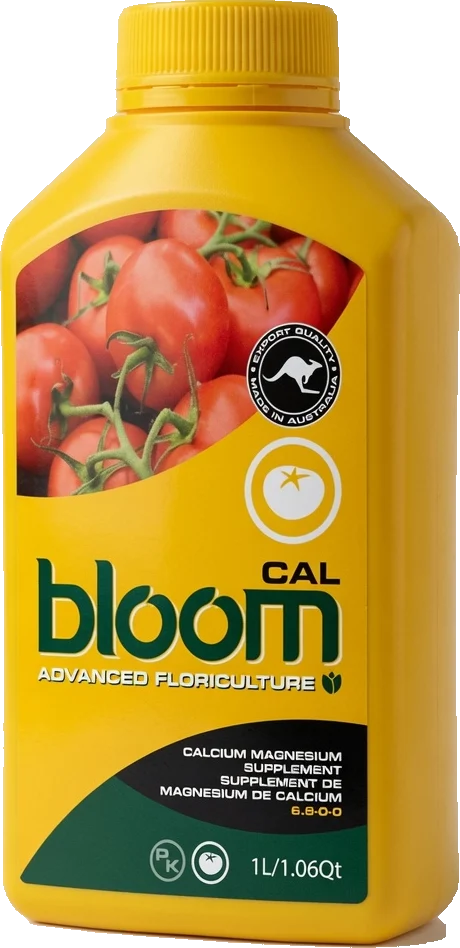
Growers running a calcium-magnesium supplement usually think of it as solving one problem: keeping Ca and Mg available in a system that doesn’t naturally carry much of either. What tends to go unbudgeted is the nitrogen that comes along for the ride — because the most common way to deliver calcium in a bottle is to attach it to a nitrate ion.
What’s actually declared on the label
Bloom Cal’s guaranteed analysis is 5.2% total nitrogen — all of it nitrate nitrogen — alongside 5% calcium and 1.4% magnesium, with iron and zinc carried as chelates. The label names the source plainly: calcium nitrate and magnesium nitrate, plus Iron DTPA and Zinc EDTA. There’s no hedging to do here and no conflicted figure to omit — this is a clean, internally consistent label, and it says exactly what it is: a nitrate-based calcium and magnesium source.
Why this is worth doing the arithmetic on
At 5.2% nitrogen, a 1 ml/L dose of Bloom Cal adds roughly 52 ppm of nitrogen to the reservoir — and because the label declares that nitrogen as 100% nitrate, none of it is held back by a slow-release or ammoniacal fraction. It shows up in the tank on day one. For a grower dialing in a base nutrient program to a specific target EC and N level, that 52 ppm either needs to be subtracted from the base feed’s own nitrogen contribution, or it ends up as an unplanned addition stacked on top of it. Neither is wrong by itself — but only one of them is a decision you made on purpose.
This also means a common criticism of home-mixed calcium supplements doesn’t actually distinguish Bloom from the do-it-yourself route. Calcium nitrate plus magnesium nitrate is the standard DIY cal-mag recipe, and it’s also what’s declared on Bloom’s own label. If a grower’s objection to mixing their own cal-mag is “that dumps a bunch of nitrate into the tank,” the honest answer is that a manufactured cal-mag product built the same way does exactly the same thing. The nitrate load isn’t the differentiator here, and pretending otherwise doesn’t hold up against the label.
Where the real differences actually sit
The differentiators that do hold up are narrower and less dramatic than “nitrate bad.” First: Bloom Cal uses magnesium nitrate, not magnesium sulfate — the classic DIY move is calcium nitrate plus Epsom salt, which puts calcium and sulfate in the same concentrate and precipitates gypsum before it ever reaches the reservoir. Swapping in magnesium nitrate removes sulfate from that concentrate entirely, so there’s nothing for the calcium to react with. Second: the label declares iron as DTPA and zinc as EDTA, specific chelate chemistries with specific pH stability windows — DTPA holds iron in solution to roughly pH 7.5, well past where EDTA iron starts dropping out around pH 6.5. That’s a real formulation choice with a documented basis, not a marketing phrase.
None of that requires pretending the nitrate isn’t there. The more useful framing — and the one that actually respects what’s printed on the bottle — is to treat the 52 ppm as a known quantity to plan around, the same way you’d plan around any other nitrogen source in the feed chart.
Three things the label actually settles:
A nitrate-load argument against mixing your own calcium supplement doesn’t survive contact with Bloom’s own guaranteed analysis — and that’s fine. The honest version of the story is better anyway: know the 52 ppm is coming, budget for it, and let the real differences — no sulfate, a DTPA chelate instead of EDTA — carry the weight they actually earned.
Putting the number to work
In practice this is a two-minute check, not a recalculation of your whole program. Pull up whatever feed chart or calculator you’re already running, find the nitrogen contribution at your current dose rate, and add roughly 52 ppm for every 1 ml/L of Cal in the mix — then see where the total lands against the N target for your current stage. Most growers running a base program with a dedicated cal-mag booster find the number isn’t alarming once it’s actually counted; the point isn’t that 52 ppm is too much, it’s that an uncounted 52 ppm is the kind of thing that quietly explains a reservoir that’s running hotter on nitrogen than the base feed alone would suggest. That’s a five-minute fix once you know where to look, and the label is the only place you need to look.