
A cut-flower propagation bench runs on consistency — the same base feed, cutting after cutting, bench after bench. That’s exactly why “fish fertilizer” is a harder input to standardize than most growers assume. The raw material itself isn’t one thing. Depending on what kind of fish or fish part goes in, the composition shifts enough to change how much processing the batch actually needs before it’s stable.
This is easy to miss because “fish fertilizer” gets talked about as a single category, the way “seaweed extract” or “humic acid” do. But just like those categories, the raw material behind the name covers a real range — different species, different body parts, different leftover fractions from processing lean fish versus oily fish. For a bench that depends on repeatable results, that range is the actual risk, not the fish smell most growers associate with the category.
Fatty fish and white-fish offal aren’t the same starting point
FAO’s own documentation on fish silage draws the distinction plainly: whole fatty fish — the kind of oily species like sprats and sand eels — carry higher protein and fat content, and correspondingly lower water and ash content, than white-fish offal (the trimmings left over from processing lean fish like cod or haddock). Two “fish” inputs, two different starting compositions, before anyone adds a single drop of acid.
This is the same kind of variability already documented for whole fish versus processing byproduct generally — species, body part, and processing route all shift the composition of what ends up in a fish-derived input. Ash content is just one of those variables, but it’s unusually well-documented, because it plugs directly into a published formula for how much acid a batch actually needs.
Why ash content specifically matters
In acid-silage processing, the fish is liquefied with acid to a target pH, which is what stabilizes it against bacterial spoilage. FAO’s documented relationship for how much acid that actually takes is: acid demand (L) = 0.25 + 0.3 × percent ash. Ash content isn’t a side detail — it’s a direct input into the formula that determines how much acid a batch of fish silage needs to reach a safe, stable pH. A higher-ash raw material needs measurably more acid than a lower-ash one, for the exact same volume of fish.
What this means for a propagation bench
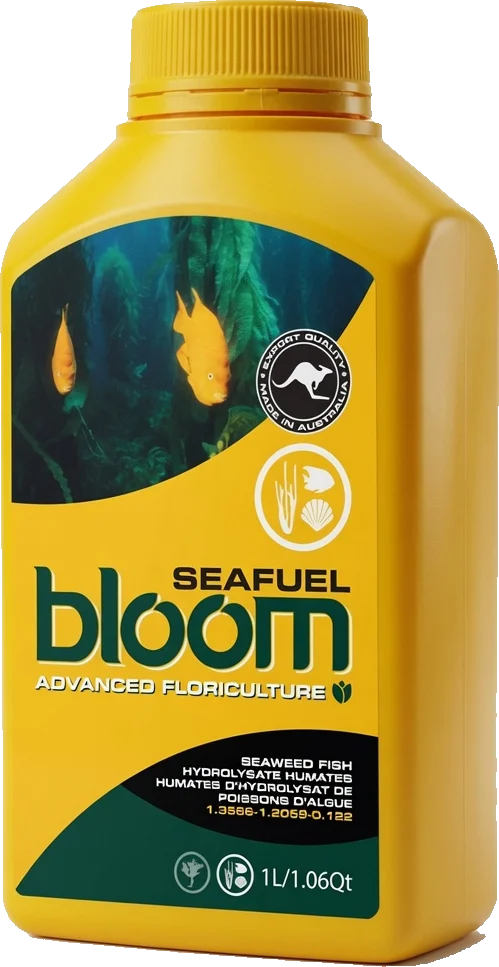
A cut-flower propagation operation runs the same input on the same cuttings, week after week, and needs that input to behave the same way every time. A bottled hydrolysate like Seafuel sidesteps the raw-material variability question entirely — the processing happens before the bottle is filled, against a single declared species (Southern Bluefin Tuna hydrolysate, per the label), not a mixed batch of whatever fish scraps a kitchen or dock happened to produce that week. It goes in at 1 ml/L, from one declared raw material rather than a mixed one.
None of this means a home ferment can’t work. Plenty of growers run one successfully. It means the consistency a propagation bench depends on — the same feed producing the same result on cutting after cutting — is harder to guarantee from a variable raw material than from a single, declared, already-processed input. Ash content is just one of the variables; it happens to be the one with a documented formula attached, which makes it a clean way to see how much a “simple” fish input can actually vary before any acid is added.
For a propagation bench specifically, that variability translates directly into inconsistent cutting-to-cutting results if the feed itself isn’t stable — the same reason a bench manager standardizes everything else about the protocol, from cutting size to bench temperature. A feed input that varies silently in composition undercuts that standardization even when every other variable is controlled.