
Somewhere around week seven or eight, a lot of growers start doing the same thing: they cut the feed down to plain water and run it that way for the last week or two before harvest. The idea is that it pulls built-up nutrients out of the plant and cleans up the smoke. It’s one of the most repeated pieces of advice in the whole hobby, and it turns out the most careful attempt anyone has made to actually measure it found nothing.
What the trial actually measured
An independent nutrient company — not Bloom, and we’re not naming them here — ran a controlled flushing trial on Cherry Diesel in coco: 48 plants, 12 per treatment, four flush lengths: 14 days, 10 days, 7 days, and 0 days (fed straight through to harvest). We’re citing their published results, not claiming the trial as our own work. The results, at P<0.05:
- Yield per plant: no statistically significant difference across any flush length.
- THC%: no statistically significant difference.
- Total terpenes%: no statistically significant difference.
- Flower mineral content — phosphorus, potassium, calcium, magnesium, sulfur: described as “similar across all treatments.” Nitrogen was 6.7% lower at 14 days than at 0 — the only measurable shift, and a small one.
A blind taste panel of industry tasters found no significant effect on flavor, harshness, or ash color either — if anything, the 0-day group scored slightly better on “great” and “good” ratings than the 14-day group, though that difference wasn’t significant. The trial’s own conclusion: “across every one of those measures, the length of the flush made no statistically significant difference.”
A second study, published in Industrial Crops and Products in 2024, ran the same basic comparison — fed-to-harvest versus a distilled-water flush — across five medical cultivars. Same finding: no significant effect on cannabinoid or terpenoid concentration. The flushed plants did show visible yellowing and chlorophyll loss, with no corresponding gain in bud quality to show for it.
The lever that actually moves these numbers is nitrogen, not plain water
If flushing doesn’t do it, what does change cannabinoid concentration? Nitrogen level earlier in flower, by a wide margin. Saloner & Bernstein (2021) found plants fed 160 mg/L N through flower ran about 30% lower in THCA and 20% lower in CBDA than plants at 30 mg/L N — but yielded roughly double. Bevan, Jones & Zheng (2021), running Gelato in deep water culture across 70–290 mg/L N in flower, found the same inverse pattern and put the yield-maximizing point around 194 mg/L: past that, you’re trading potency for bulk you may not need. Caplan et al. (2017) found a similar THCA drop at the highest organic feed rate.
That’s the real trade-off growers are managing — and it’s happening in the feed schedule weeks before harvest, not in the final days with a hose.
Finishing is a different move than flushing
There’s a third option between “feed everything to the last day” and “nothing but water for two weeks,” and it’s closer to how the plant actually works. As cannabis finishes, it naturally pulls nitrogen out of its own leaves and remobilizes it into the flower — a documented process called nutrient remobilization during senescence. The plant wants to recycle that nitrogen into the thing it’s building. Starving calcium, magnesium, potassium and sulfur right alongside nitrogen doesn’t speed that up; it just removes inputs the plant may still be using for other jobs, which is one plausible explanation for the chlorophyll loss and yellowing researchers keep seeing in flushed plants without a corresponding quality gain.
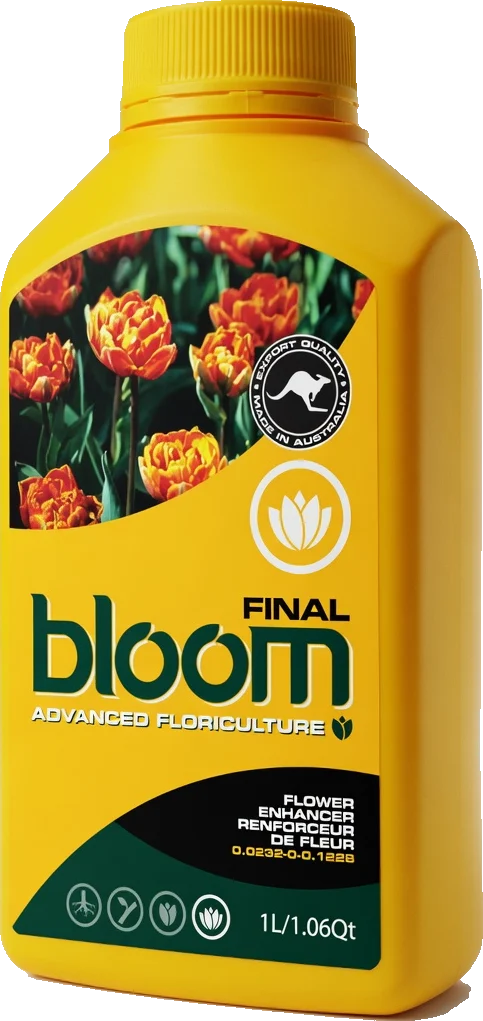
That’s the gap a dedicated finishing input like Bloom Final is built to sit in — not a flush, not a taper of everything, but a change in what you’re feeding as the plant moves into its last stretch. We’re not going to print a GA figure here we haven’t independently verified against the current label, and we’re not claiming a trial result of our own. What we can say, backed by someone else’s careful trial work, is that the plain-water flush most growers are running isn’t the thing doing the work they’re crediting it for.
Run it however makes sense for your grow — but if the only reason you’re flushing is to “clean up” the bud, the best controlled trial on the subject says that part isn’t happening. What’s actually changing the smoke is what you fed weeks earlier, not what you stopped feeding at the end.