Kelp meal and raw seaweed have been pitched to field growers for decades as a cheap, natural way to add minerals back into working ground. The pitch usually stops at “it’s full of nutrients” — which is true, as far as it goes. What rarely gets asked is how much of that bulk is actually plant-available, on what timeline, and how that compares to a product that states its concentration outright on a label.
What’s physically in a ton of raw brown seaweed
Published composition data for the common brown seaweeds used in agriculture — Ascophyllum nodosum, Laminaria digitata, Alaria esculenta — shows real spread, species to species, on a dry-weight basis: ash content runs 15–25% in one species and as high as 21–35% in another. Potassium runs 2–3% in one and 1.3–3.8% in another. Magnesium sits at a tighter 0.5–0.9% range across both. Sodium ranges 0.9–4%, again species-dependent.
That composition table is for the raw plant tissue, not for anything processed. A grower spreading or disking in fresh or dried kelp at field scale is applying that full range of minerals bound up inside intact cell structure, which is a very different thing from applying a product that declares exactly what fraction is soluble and ready for a root to take up today.
Bulk composition is not a release schedule
The largest single fraction of a brown seaweed’s dry weight, alginic acid, sits in the cell wall as an insoluble matrix that physically encloses most of the plant’s other polysaccharides. It does not dissolve on contact with water or soil moisture — it has to be broken down, mostly by microbial activity over weeks to months, before the minerals bound up with it become available to a root. Potassium and the other soluble ions leach out faster than the structural fraction, but the timeline for that release at field scale depends on moisture, temperature, particle size and soil biology — none of which a grower controls precisely, and none of which is printed on a bag of kelp meal.
That is the real input-accounting problem with a bulk raw-biomass input, the same one the biggest seaweed-extract study ever run runs into when it compares application strategies at field scale: the composition number on the lab report is a ceiling, not a delivery guarantee. Two fields receiving the same ton of kelp meal under different weather and soil-biology conditions will not release the same amount of potassium on the same schedule.
What a declared analysis actually buys
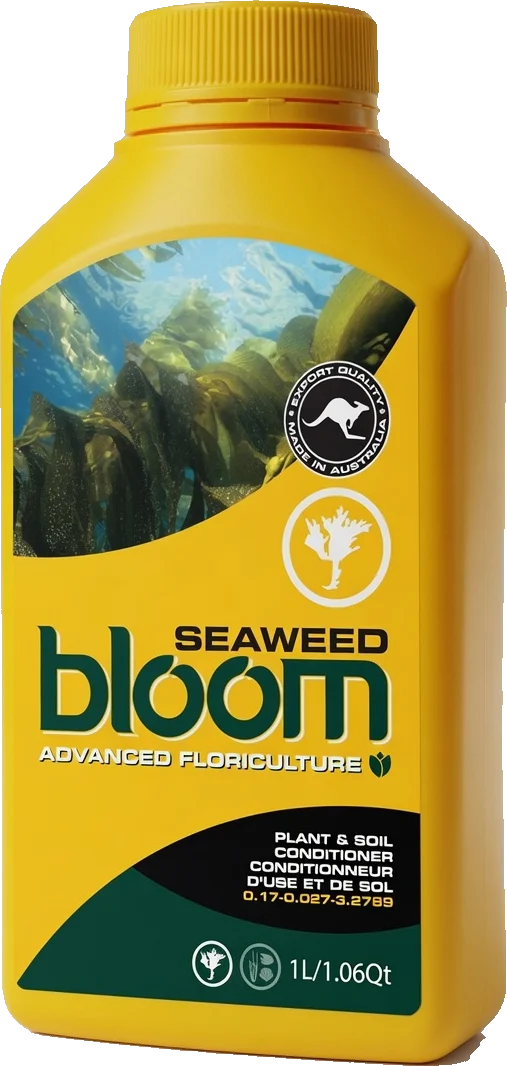
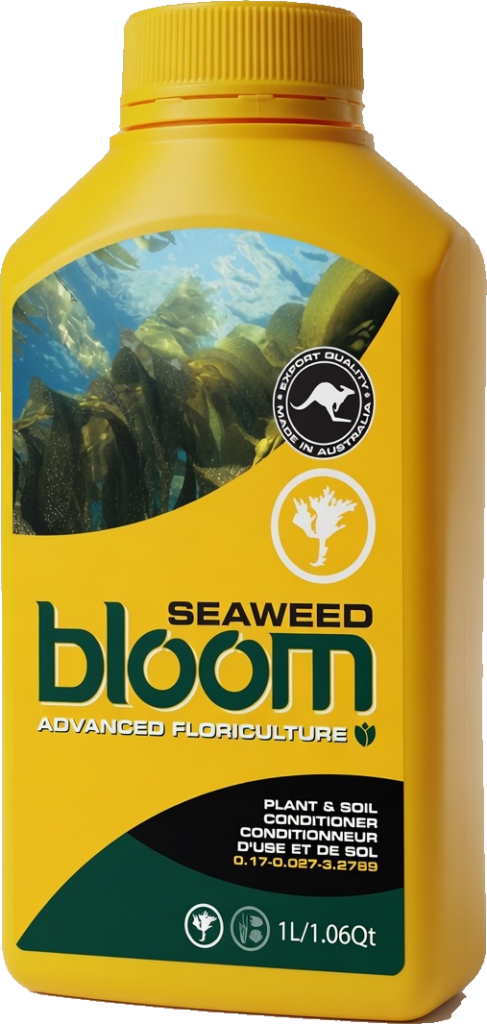
Bloom Seaweed‘s label, read directly off the artwork, declares 0.17% total nitrogen, 0.027% available phosphate (P₂O₅) and 3.278% soluble potash (K₂O), derived from Durvillaea potatorum seaplant extract. That figure isn’t an average pulled from a composition survey of raw biomass — it’s a fixed, soluble concentration the manufacturer is required to guarantee on the label, verified against the bottle’s own printed analysis. The potassium is already in soluble form; it isn’t waiting on microbial decomposition to become available.
None of this is an argument that a declared liquid extract replaces raw organic matter at field scale — building soil structure and feeding soil biology is its own job, and bulk kelp has a real place in that work. It’s an argument about input accounting specifically: if the goal is to know how much available potassium you’ve actually put down this week, a composition average on a bag of raw biomass can’t answer that question the way a guaranteed analysis can. The two aren’t interchangeable line items in a nutrient budget, even when they come from the same plant.
Seaweed extraction and composition research also makes clear this isn’t unique to one species. Durvillaea potatorum, the species Bloom Seaweed declares, doesn’t even appear in the largest published composition surveys of agricultural seaweed products — most of that literature is built on Ascophyllum and Laminaria. That’s a reason to read labels carefully rather than assume one brown seaweed’s composition number applies to the next.