
Specialty collections — bonsai, orchids, succulents, the kind of growing where every bottle on the shelf gets measured by the drop — have picked up silicon supplements over the last few years, usually labeled simply “potassium silicate,” dosed in the kind of amounts measured by the milliliter. That one phrase covers two genuinely different industrial processes, and the label rarely says which one made the bottle in front of you.
Two routes, one name on the label
Per a USDA technical evaluation of potassium silicate, both industrial routes start from the same raw material — silica sand — and end up at the same destination: potassium silicate in solution. How they get there is not the same process at all.
- The furnace route: silica sand and potash (potassium carbonate) are fused together above 1,000°C, producing potassium silicate glass, which is then dissolved and standardized.
- The hydrothermal route: silica sand is dissolved directly in potassium hydroxide solution, no furnace involved, producing the same potassium silicate in solution by a chemical dissolution rather than a high-temperature fusion.
The finished product from either route is filtered and standardized to a target concentration, and in solution it exists as a mix of monomeric, oligomeric, and polysilicate ions, with potassium balancing the charge. Chemically, once standardized, the two routes can land in a similar place — but “similar” isn’t “identical,” and a dropper-bottle label that just says “potassium silicate” gives a collector no way to know which manufacturing history is behind it, or what trace profile came along with it.
Why it matters more at dropper-bottle scale than at field scale
A broadacre operation spreading tons of calcium silicate per acre is working with a bulk mineral amendment where manufacturing route is one variable among many. A specialty collector dosing a single bonsai pot or orchid medium with a few drops of concentrate is working with almost no buffering capacity at all — there’s very little growing medium to absorb an inconsistency, and silicate chemistry is already narrow to begin with. It’s only stable as a soluble ion above roughly pH 11–12, and it starts precipitating out as solid silica gel once the solution drops below pH 9. A product’s standardization process, not just its stated concentration, is what keeps it inside that window on the shelf and in the bottle.
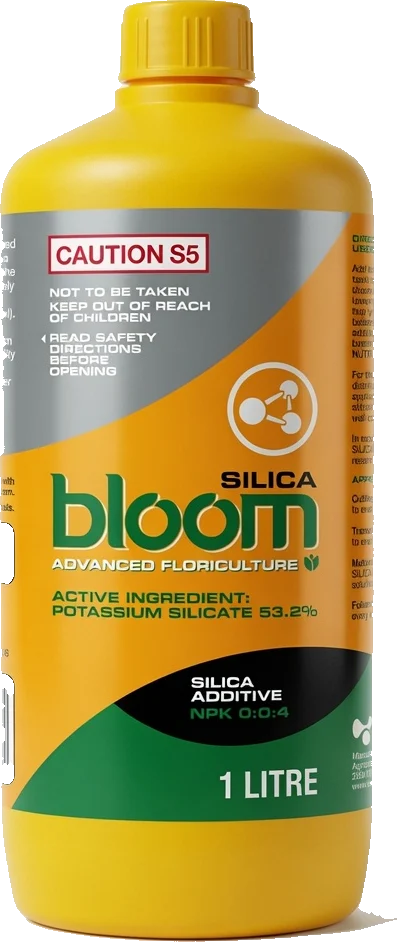
Why “it’s just potassium silicate” undersells the question
It’s tempting to wave this off as a distinction without a difference — both routes land on the same named compound, so why would the path matter? At bulk agricultural scale, where a product is diluted into thousands of gallons of irrigation water, small differences in trace impurities or ion ratios mostly wash out. At the scale a specialty collector actually doses — a few milliliters into a liter of water for a handful of plants that may sit in the same small volume of medium for months between repottings — those same small differences don’t get diluted away nearly as much. A furnace-fused product carries whatever trace elements survived a 1,000°C melt of raw sand and potash; a hydrothermal product carries whatever was in the potassium hydroxide solution it was dissolved in. Neither is inherently better or worse. They’re just not the same manufacturing history, and a label that only says “potassium silicate” erases that history entirely.
That’s really the core of it: the name on the bottle describes the destination, not the road taken to get there, and for a collection measured by the drop, the road can matter more than the industry’s one-size-fits-all label suggests.
If a silicon supplement matters enough to measure by the drop, it’s worth asking the maker which process built the bottle — and worth being skeptical of a label that doesn’t say. We’re asking ourselves the same question about our own.