
Your Bonsai, Orchid, or Terrarium Doesn’t Need Feeding Less Often Because It’s Dormant. It’s Dormant, So It Needs Feeding Less Often — and That Moves Your Restock Date
A 300 mL bottle of ROOTS doesn’t run out on a fixed calendar. It runs out on however many times you actually reach for it — and for collector-scale pots, mounts, and flasks, that number drops hard the moment growth slows for winter. Here’s why the frequency drop matters more than the dose math, and when to restock before the cold stretch closes the window.
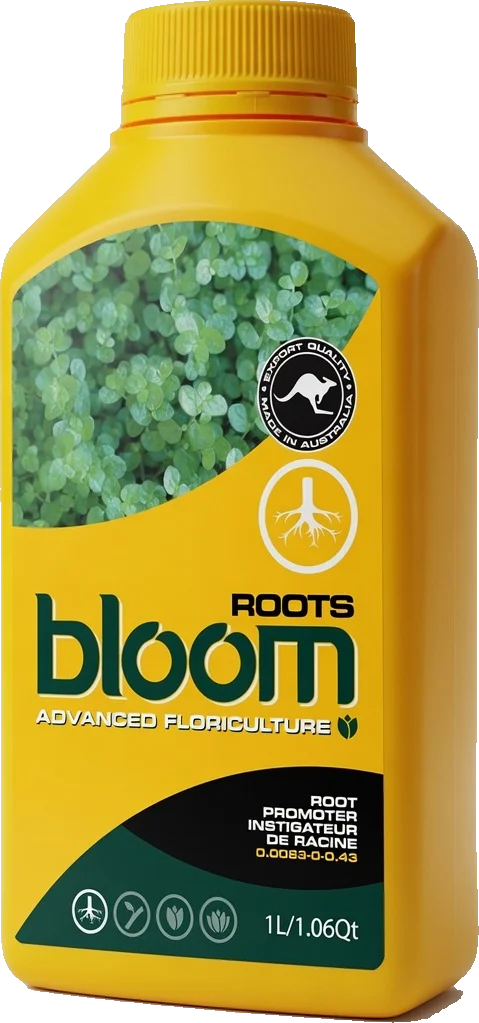
Most of the dosing conversation around ROOTS lives in the rate printed on the label — 0.5 mL per liter as an ongoing feed, 1 mL per liter as a one-time bare-root dip. That rate doesn’t change with the season. What changes, for a bonsai in a shallow training pot, an orchid on a mount or in a flask, or a closed terrarium, is how often you’re reaching for the bottle at all.
In active growth, a lot of specialty-niche collectors are watering and feeding on something close to a weekly rhythm — the pot is small, the medium (or the air, for a mounted epiphyte) dries fast, and the plant is actually using what it’s offered. Once the plant drops into winter dormancy, that rhythm stretches. Watering commonly moves from weekly to every two, three, or four weeks for a lot of dormant bonsai and orchid collections, because a plant that isn’t pushing new growth isn’t pulling water or nutrient through its tissue at anywhere near the same rate. A sealed or near-sealed terrarium can go even longer between interventions once its internal cycle slows.
That’s not a reason to feed more per application to “catch up.” It’s a reason the bottle simply gets picked up far less often for a stretch of months — and a reason the math on when you’ll need a fresh bottle doesn’t look like a flat, year-round average.
Each bar is one feeding. The dormant months use far fewer of them from the same bottle — which is exactly why restocking “when the bottle feels light” during winter is the wrong signal to go by.
Why this isn’t the same arithmetic as “how many years is a bottle”
It’s tempting to treat this as the same bottle-longevity question collectors already run at hobby pace — count total doses in a 300 mL bottle at 0.5 mL/L, divide by how often you feed, get a number of years. That calculation assumes a feeding frequency that holds roughly steady across the year. Winter dormancy breaks that assumption on purpose: the frequency itself is the variable, and it swings low for exactly the months when a trip to the grow-shop or a reorder is least convenient and most likely to get put off.
Run an illustrative example. Say a bonsai in a training pot gets a 250 mL feeding at 0.5 mL/L of ROOTS — 0.125 mL of product — once a week through spring, summer, and early fall. That’s roughly 35 feedings using about 4.4 mL of ROOTS total before dormancy sets in. If feeding frequency drops to once every three weeks for a four-month winter, that stretch adds only about 5-6 more feedings, using well under 1 mL. The dormant season, in other words, barely touches what’s left in the bottle — which is good news for total supply, but it means the bottle can sit untouched long enough that nobody notices it’s getting low until the exact week spring growth resumes and demand jumps back up.
Illustrative example at the label’s 0.5 mL/L feed rate, 250 mL applications. Exact volumes depend on your pot, mount, or flask size and your own watering schedule — the proportions are the point, not the exact mL figures.
The practical takeaway: check the bottle and restock before growth slows, not during the quiet months when you’ll barely use it, and not in early spring when you’ll suddenly need it every week again with no lead time to reorder. Winter is a low-draw period for the bottle, but it’s a bad time to discover you’re out, because the window to replace it closes along with everyone else’s dormancy-season shopping and shipping slowdowns.
What’s happening in the pot while feeding frequency drops
ROOTS carries its seaplant extract (from Durvillaea potatorum) alongside two declared non-plant-food inputs — 0.075% humic acid from Leonardite and 0.054% thiamine hydrochloride (B1). Those two components don’t need the plant to be actively growing to be relevant at the root. A fixed-volume pot, mount, or flask has no fresh soil or expanding root run to draw on between feedings the way an in-ground root system does — whatever buffering capacity and biological activity exists at the root zone has to carry over through a long, low-activity stretch with far fewer top-ups than usual. The humic fraction’s documented role is partly about buffering conditions at the root interface over time, not delivering a single large pulse; that’s a better match for widely spaced winter feedings in a fixed, non-expanding medium than for the frequent, fast-draining feedings of active season.
What this does not mean
It is not a reason to raise the dose rate during dormancy to “make each feeding count more.” The label rate is 0.5 mL/L for ongoing feeding regardless of season. What changes in winter is how often you apply it — not how concentrated the application is.
For orchids mounted or flasked with no soil buffer at all, and for terrariums running close to a sealed internal cycle, the same logic holds with even less margin: there’s no surrounding medium to hold anything over between feedings, so whatever reaches the root zone at each widely spaced winter application is doing the only buffering work available until the next one.
Before the cold stretch
If your bonsai, orchid, or terrarium collection is heading into a feeding schedule that’s about to stretch from weekly to monthly, that’s the signal to check the bottle now — not partway through winter, and not in the first busy week of spring.
ROOTS guaranteed analysis: Total Nitrogen 0.0083% (0.0021% Ammoniacal, 0.0062% Water Soluble Organic), Soluble Potash (K₂O) 0.43%. Derived from Durvillaea potatorum. Non-plant-food: 0.075% Humic Acid (from Leonardite), 0.054% Thiamine Hydrochloride (B1). Feed rate 0.5 mL/L; one-time bare-root dip rate 1 mL/L.