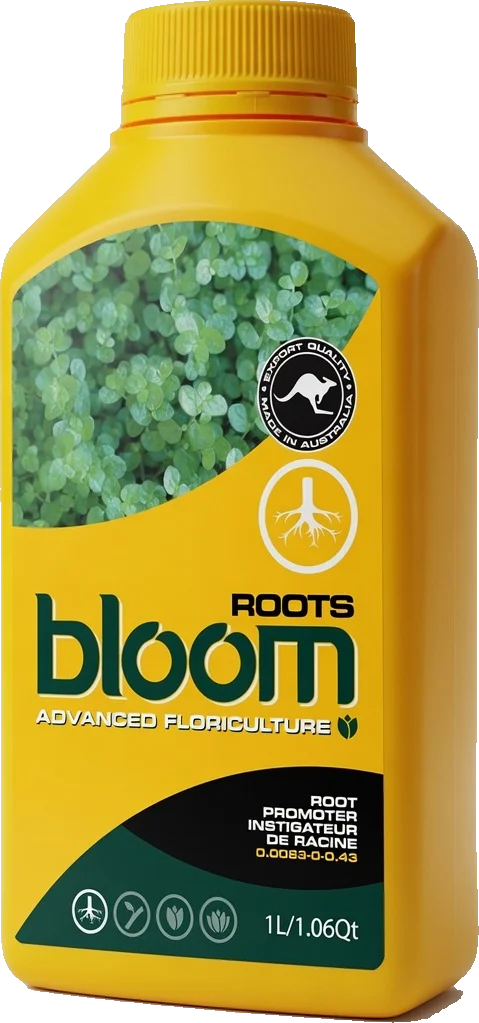
If you grow bonsai, mount orchids on bark, or keep a shelf of terrariums, you’ve probably never actually finished a bottle of anything. Not because the product failed you — because the math of your hobby doesn’t work the way a feed chart assumes it does. Most dosing instructions are written for people filling a 20-gallon reservoir. You’re filling a 500 mL watering can, maybe once every week or two, for a handful of pots. That changes the question entirely: it’s not “will I run out before harvest,” it’s “will this bottle still be good two years from now.”
Worth doing the actual arithmetic before fall stock-up orders go in, because the answer surprises most people.
What the label actually says
ROOTS carries a declared guaranteed analysis of 0.0083% Total Nitrogen (0.0021% ammoniacal, 0.0062% water-soluble organic) and 0.43% Soluble Potash, derived from Durvillaea potatorum seaplant extract, with 0.075% Humic Acid (from Leonardite) and 0.054% Thiamine Hydrochloride (B1) as non-plant-food ingredients. The feed chart rate is 0.5 mL per liter of solution for routine feeding, or 1 mL per liter for a one-time dip.
0.5 mL per liter means a 1-liter watering can uses half a milliliter of ROOTS per feed. That’s one-sixtieth of a teaspoon.
Doses per bottle, not days per bottle
Feed charts talk in milliliters per liter because that’s a ratio, not a quantity. The quantity that actually matters to you is: how many times can I use this bottle before it’s empty? That depends only on two things — the bottle’s volume and your dose size — and neither one cares what crop you’re growing.
Run it for a 300 mL bottle, the smallest Bloom sells. At the 0.5 mL/L feeding rate, that bottle delivers 600 individual one-liter doses. At the 1 mL/L dip rate, it still delivers 300. A bonsai collector feeding a dozen pots every other week is using roughly 24 doses a year. At that pace, a single 300 mL bottle covers 25 years of feeding before it runs dry on volume alone.
So why does “stock up” matter at all?
Because the constraint on a tiny collection was never going to be the number of doses in the bottle. It’s whether the bottle is in your hand when you need it — before a shipping cutoff, before a cold snap limits what arrives undamaged, before a supplier runs a seasonal size out of stock. Fall is when a lot of specialty growers quietly slow down their ordering, assuming they’ll “get to it later” since a bottle lasts so long anyway. That’s backwards: precisely because you’ll be reaching for the same bottle for years, getting the right size in hand now — while shipping is easy and the product line is in full stock — is lower-effort than remembering to reorder mid-winter for one pot.
The honest trade-off: a bottle this small has no practical “I’ll run out” risk at hobby scale. The only real planning question is storage — keep it capped, out of direct heat and light, and it will be waiting for you long after this season’s last feed.
What this isn’t
This isn’t a claim that ROOTS performs any differently on an orchid mount than it does in a hydro tent — the declared analysis and the derived-from seaplant extract are identical regardless of scale. It’s simply an honest accounting of how far a small bottle actually goes once you do the arithmetic instead of guessing. For a precision collection, that arithmetic is the whole case for buying the bottle now rather than waiting.
If you keep a notebook on your bonsai or orchid feeding schedule, it’s worth running your own numbers the same way: bottle volume divided by your dose size, divided by your feeds per year. Most specialty growers find the answer is measured in decades, not months — which makes “did I order enough” the wrong question, and “do I have it on the shelf before the season turns” the right one.
One Bottle for One Collection, Not One Bottle Per Plant
There’s a version of this math that trips up new specialty collectors: buying a separate bottle for every plant group out of a sense that each one “deserves its own.” A single 300 mL bottle, at these dose rates, is already sized for an entire shelf of terrariums, a bonsai bench, and an orchid mount or two combined — not for one plant alone. Splitting your collection across several small bottles just multiplies how many caps you have to keep tightly sealed and how many expiration clocks you’re tracking, without buying you anything in dosing accuracy.
That math holds for feeding, but repotting day calls for the label’s other number — a one-time 1 ml/L dip, not the 0.5 ml/L feed rate. The arithmetic above assumes a dozen pots as a round, conservative example. Scale it to your own collection size and the conclusion holds the same shape almost every time: at hobby scale, one correctly-sized bottle, stored properly, is a multi-year decision — which is exactly why fall is the right time to make it, rather than a time to put it off.