
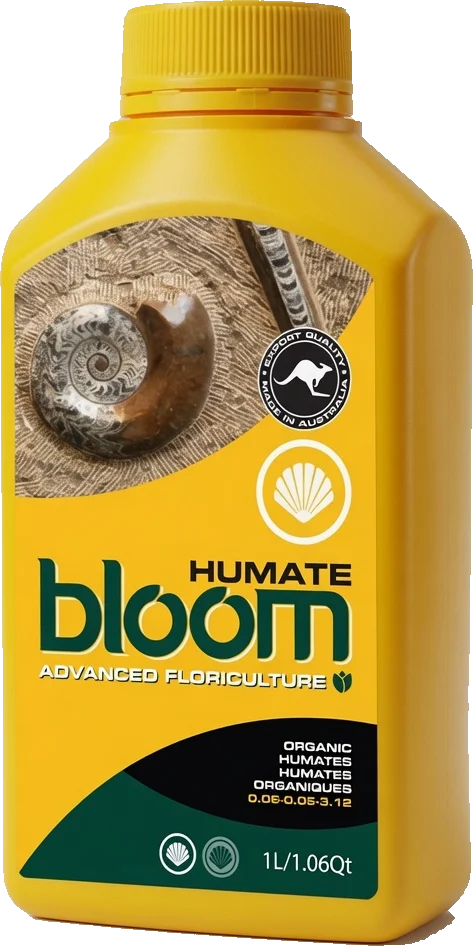
The Potassium Your HUMATE Leaves Behind — And Why a LECA Reservoir Never Rinses It Out
Science & Education · Semi-Hydro & Houseplant growers
Every commercial humic-acid product starts the same way: raw leonardite or lignite ore, where the humic fraction sits locked up as insoluble calcium, iron and aluminum humates. To get it into a bottle as a liquid, a manufacturer has to pull it loose — and that takes an alkali strong enough to deprotonate the humic acid and swap those metal ions out for something that stays dissolved. Whatever alkali does that job leaves its own ion behind in the finished product. That’s not a defect. It’s just chemistry. But it’s chemistry worth knowing if the bottle is going into a reservoir that almost never gets fully dumped.
What the HUMATE label actually says
Bloom HUMATE’s guaranteed analysis is 0-0-3.12 — all of it Soluble Potash (K₂O), nothing declared for N or P. The non-plant-food line adds 10% Humic Acid, derived from Leonardite. Listed rate is 2.5 ml per liter of fertilizer solution. The label’s “Derived From” line for that 3.12% K₂O reads Potassium Hydroxide. That line is telling us where the guaranteed nutrient comes from, not necessarily confirming the exact extraction step — but it does settle one thing plainly: potassium, in the form of KOH, is in this bottle. No sodium hydroxide is declared anywhere on it.
Why a kitchen-scale fact becomes a reservoir-scale question
In a run-to-waste system the leftover counter-ion from any additive washes out the bottom with the next feed. A passive semi-hydro or LECA setup doesn’t work that way. Most growers top the reservoir off as the plant draws it down and only do a full dump-and-refill every so often — weeks apart, sometimes longer, depending on pot size and how thirsty the plant is. Every top-off adds a little more of whatever ion rides along with the nutrients, and none of it leaves until the next full change. That’s the entire reason extraction chemistry, usually a footnote for a flushed system, is worth a second look for a reservoir that mostly just gets refilled.
This isn’t unique to humic acid products — any additive carries some non-nutrient ion, declared or not. Potassium is at least a nutrient the plant is already budgeting for; it won’t do anything useful beyond what the K₂O figure already promises, but it isn’t foreign to the feed chart the way an unrelated counter-ion could be. That’s the practical reason the declared extraction route is worth reading before it’s worth ignoring.
It also helps to know why an alkali is required at all, rather than just accepting it as a label line. Leonardite’s humic acid doesn’t arrive dissolved — in the raw ore it’s bound up as calcium, iron and aluminum humates, largely in a protonated form that water alone moves only slowly. An alkali deprotonates the acid and displaces those bound metals so the humic fraction can actually go into solution as a liquid concentrate. Published extraction work on leonardite and lignite shows the two common alkalis don’t perform identically either — sodium hydroxide has pulled a higher yield of humic acid from lignite than potassium hydroxide did in side-by-side testing, so the choice of alkali is a real formulation decision with a measurable yield tradeoff, not just a matter of which ion ends up in the bottle.
What it means for how you run the pot
Nothing here changes the dose — HUMATE’s listed rate is 2.5 ml per liter of solution, same number whether that liter sits in a run-to-waste drip or a passive LECA reservoir. What changes is how you think about the reservoir between feedings. If a setup is strictly top-off, treat the occasional full reservoir swap as part of the routine rather than an afterthought — it’s the only step that actually resets anything that’s been accumulating, potassium included. If a setup is already on a scheduled full change, this is one more small reason that habit is worth keeping, not a new problem it needs to solve.
The honest version: the label tells us potassium hydroxide is the declared source of HUMATE’s potash — so potassium, not some unrelated ion, is what travels into the bottle alongside the humic acid. In a reservoir you flush, that distinction barely matters. In one you only top off, it’s worth knowing which ion you’re slowly adding to.
There’s no guaranteed-analysis figure for extraction reagents on any fertilizer label — ours included — so this is as far as the label can honestly take the story. What it does settle is useful on its own: whatever alkali did the work on this product, the ion it left behind is one already on the feed chart.