
Why the Potassium Source in Humate Matters More in a Pot That Never Gets Flushed
A hydroponic reservoir gets dumped and rebuilt on a schedule. A cut-flower production bed, grown in a soilless substrate across an entire crop cycle, doesn’t get that reset — irrigation leaches some of what accumulates, but a bag of substrate in a greenhouse bench is closer to a slow-draining container than to a flushed loop. Whatever salt an amendment leaves behind over weeks of repeat applications is still mostly there by the time the crop finishes. That makes the specific chemistry of a humic-acid input — not just how much humic acid it contains, but what else came along with it — a real production variable for floriculture growers in a way it usually isn’t for a system that gets rinsed clean every week or two.
Humic acid doesn’t come out of the ground ready to use
Humic acid in raw Leonardite ore sits mostly as insoluble calcium, iron and aluminum humates, locked in protonated form. It takes an alkali to deprotonate it and displace those cations before it goes into solution — and which alkali gets used changes both how much humic acid comes out and what else ends up in the finished product. A 2024 extraction study (Paul et al.) found sodium hydroxide pulling 18–28.5% of the humic acid out of lignite, while potassium hydroxide at a lower concentration (0.5–2.5%) recovered 9.98–21.89%. The yields differ, and so does the leftover cation: an NaOH route leaves sodium behind in the finished product; a KOH route leaves potassium.
What Bloom’s label actually declares
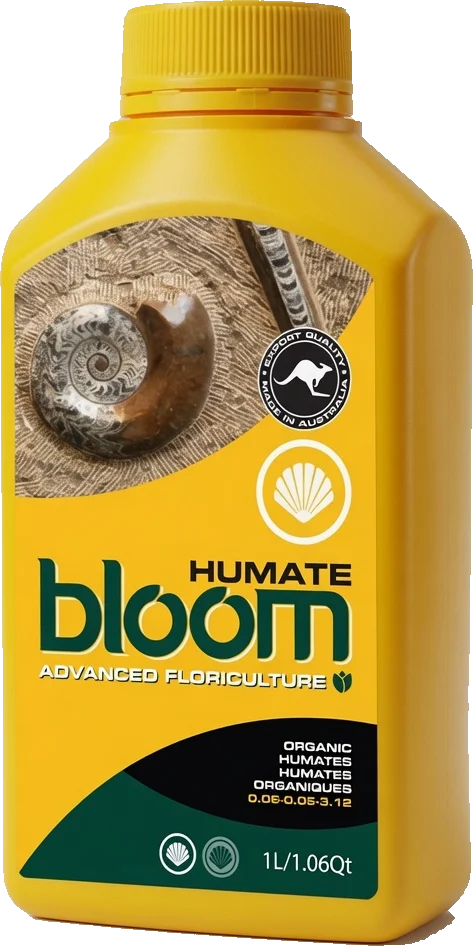
Bloom’s Humate states a guaranteed analysis of 0-0-3.12 — Soluble Potash (K₂O) at 3.12% — with “Derived from: Potassium Hydroxide” on the derived-from line, and a separate non-plant-food declaration of 10% Humic Acid (from Leonardite). That derived-from statement answers a question a greenhouse grower building a season-long fertility program actually needs answered: this is a potassium-hydroxide extraction, not a sodium-hydroxide one. The label doesn’t claim KOH was chosen specifically to protect substrate chemistry — that would be reading more into a neutralizer than the label states — but it does mean the cation accompanying the humic acid, applied week after week, is potassium rather than sodium.
Why that distinction holds up over a full bed, not just a single dose
UMass Extension’s greenhouse water-quality guidance gives a working sense of how little headroom ornamental growers have on sodium: an acceptable level for ornamentals under overhead irrigation is under 50 ppm, and the same guidance states plainly that high sodium “acts to inhibit plant uptake of calcium” and can cause “excess leaching of calcium and magnesium from growing media.” That’s a description of exactly the slow-accumulation risk a substrate bed faces — sodium doesn’t flush out the way it would in a reservoir dump, it builds, dose after dose, toward a ceiling that starts working against calcium and magnesium uptake well before any visible symptom shows up.
Potassium carries no equivalent accumulation risk in a floriculture program, because it’s a nutrient the crop’s own fertility budget already accounts for — adding more of it doesn’t compete with calcium and magnesium the way sodium does. Humate’s 3.12% K₂O is a modest contribution at the label’s rate of 2.5 ml/L of fertilizer solution, but it’s a contribution of the one cation a cut-flower bed can actually use, rather than one it has to find a way to flush back out.
None of this says anything about which extraction route is objectively “better” in the abstract — both get humic acid out of the ore, and the yields differ for reasons that have nothing to do with a grower’s substrate. What the label does let a grower do is plan correctly: know that a season of repeated Humate applications is adding potassium to the bed’s cation balance, not sodium, and plan a long-season fertility program around that fact instead of discovering it the hard way at the end of a crop cycle.
It’s worth sizing the actual contribution, too, so the point doesn’t get overstated. At the label’s 2.5 ml/L rate, Humate is a modest potassium top-up, not a primary feed — the 3.12% K₂O guaranteed analysis sits well below a dedicated potassium input, and a full-season fertility program should still be built around a base program’s own K supply. The value here isn’t the quantity; it’s that whatever quantity does accumulate over a long, unflushed crop cycle is a nutrient the plant can use, instead of one it has to work around.