
Why the Chelate on Your Cal-Mag Bottle Matters More in a Passive Reservoir
Semi-hydro and LECA growers already know their reservoirs behave differently from a drain-to-waste hydro tent — water sits for days between top-ups instead of getting mixed fresh every feed. That difference shows up most clearly with calcium and magnesium supplements, because the micronutrients riding along with them — iron and zinc, in Bloom Cal’s case — are only as available to the plant as the chelate holding them lets them be, and that depends on pH. If your reservoir drifts toward the higher end of the typical range between refills, which chelate is doing the holding stops being a footnote and starts being the whole question.
What’s declared on the Cal label
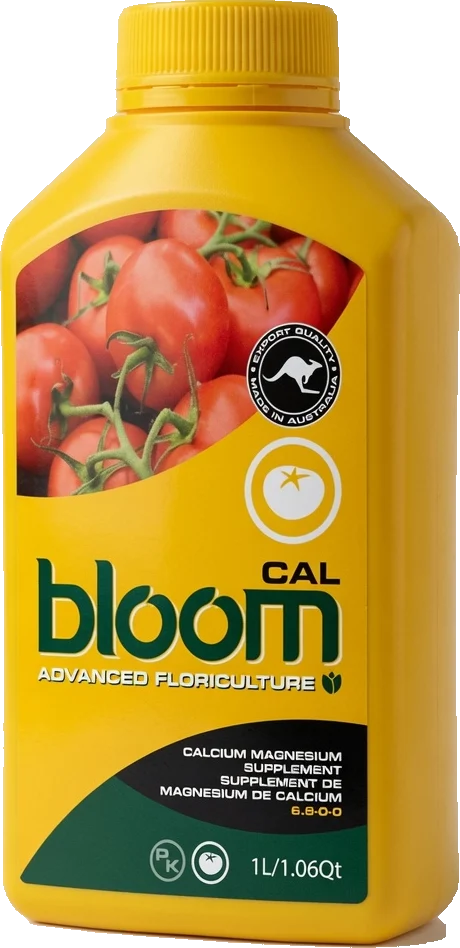
Bloom Cal is 5.2-0-0, with that nitrogen entirely in nitrate form, alongside 5% calcium and 1.4% magnesium. The micronutrient package is 0.5% iron, declared as chelated iron from iron DTPA, and 0.036% zinc, declared as chelated zinc from zinc EDTA. The source ingredients are calcium nitrate and magnesium nitrate — notably, nitrate, not sulfate.
Why DTPA versus EDTA isn’t a technicality
DTPA and EDTA are both chelates — organic molecules that wrap around a metal ion and keep it dissolved and plant-available instead of precipitating out as an insoluble compound. Where they differ is the pH range each one holds together. DTPA keeps iron chelated up to roughly pH 7.5; EDTA’s grip on iron starts failing above roughly pH 6.5. That gap matters most in exactly the kind of system where pH isn’t being corrected every feed — a passive reservoir that’s topped up rather than fully replaced can walk upward in pH over days between interventions, and a chelate that fails at 6.5 will drop its iron out of solution well before one holding to 7.5 does.
The other label detail that matters in a shared reservoir
Bloom Cal’s calcium and magnesium come from calcium nitrate and magnesium nitrate — not calcium nitrate plus magnesium sulfate, which is the combination behind most home-mixed cal-mag solutions. That distinction matters wherever calcium and sulfate might otherwise meet in the same concentrate or reservoir: calcium and sulfate ions react to form gypsum, which precipitates out rather than staying available in solution. Using magnesium nitrate instead of magnesium sulfate removes that reaction from the equation entirely, which is one less thing to go wrong in a reservoir you’re not flushing and re-mixing every day.
The nitrate load is worth being direct about, too: at 5.2% nitrogen, all of it nitrate, a dose contributes meaningfully to your overall nitrogen budget — worth accounting for alongside whatever base nutrient you’re running, rather than treating Cal as a pure calcium-magnesium top-up with no nitrogen contribution of its own.
None of this is a reason to avoid EDTA-based products generally — plenty of feed programs are built around them and work fine with routine pH correction. It’s a reason to know which chelate is in the bottle before you decide how often your reservoir needs attention, especially in a system that goes longer between full resets than a drain-to-waste tent does.
The nitrate point is worth repeating
It’s easy to focus entirely on the chelate question and skip past the nitrogen contribution sitting in the same bottle. Bloom Cal’s 5.2% nitrogen is entirely nitrate form, and in a small, passive reservoir that isn’t being diluted and refreshed on a hydro tent’s schedule, that contribution is proportionally larger relative to total solution volume than it would be in a bigger, more frequently exchanged system. Growers running a lean base program specifically to avoid excess nitrogen late in a cycle should count Cal’s nitrate toward that total rather than treating it as a nitrogen-free calcium top-up — a mistake that’s easy to make with any calcium-nitrate-based product, not just this one.
What to actually do with this
We’re not publishing a specific semi-hydro dose rate for Cal here — follow your feed chart rate for whatever base program you’re running it alongside, and adjust from there on your own system. What’s worth taking away is simpler: check where your reservoir’s pH tends to sit by the time you’re due for a top-up, and read your cal-mag label for which chelate is actually doing the work before you decide that’s the product for a passive system. The same chelate chemistry matters even more at micro-reservoir scale — see Why CAL’s Chelate Choice Matters More in a Flask Than in a Grow Tent.