
Silicon amendments have been showing up more in broadacre conversations — stronger stems, better lodging resistance, some disease tolerance. Before any of that gets decided at field scale, there’s a question that comes before the soil test: does the crop actually going into that ground take up meaningful silicon in the first place? Not every plant does, and the gap between species is large enough to change the decision entirely.
Plants don’t all use silicon the same way
Silicon enters the root as silicic acid — Si(OH)₄ — through a dedicated transport system: an influx transporter (Lsi1) brings it into the root, an efflux transporter (Lsi2) pushes it toward the vascular tissue, and a third transporter (Lsi6) moves it into the shoot. Once it’s up there and water leaves through transpiration, it polymerizes into solid silica gel and stays put — silicon, once deposited, doesn’t move back out of the plant the way mobile nutrients do.
That transport system isn’t equally active across every species. The published accumulator classes, measured as silicon by shoot dry weight, span two orders of magnitude:
- Low accumulators: under 0.1% Si
- Intermediate accumulators: around 1% Si
- High accumulators: over 5% Si — rice shoots can run up to 10%
Grouped by plant family, the grasses and sedges (Poaceae and Cyperaceae — the family that includes wheat, corn, rice, sugarcane and most cereal and forage crops) typically exceed 4% Si. Broadleaf families like Urticaceae and Cucurbitaceae generally run lower, in the 2–4% range. That’s not a minor rounding difference — it’s the reason the silicon-amendment literature is built almost entirely around cereal and grass crops in the first place.
Why this matters before a single acre is spread
Field-scale silicon correction runs in tons per acre, not milliliters per liter — calcium silicate amendments are typically cited at 1–6 tons per acre for crops known to respond. That’s a real input decision with real cost, and every number behind it was generated on crops that are already high accumulators by biology, not on a blanket assumption that silicon helps anything green. A rotation that’s heavy on grasses and cereals is working with a crop built to pull silicon up and lock it into its tissue. A rotation leaning toward broadleaf crops in the lower accumulator range is starting from a different biological ceiling, whatever the soil test says is available.
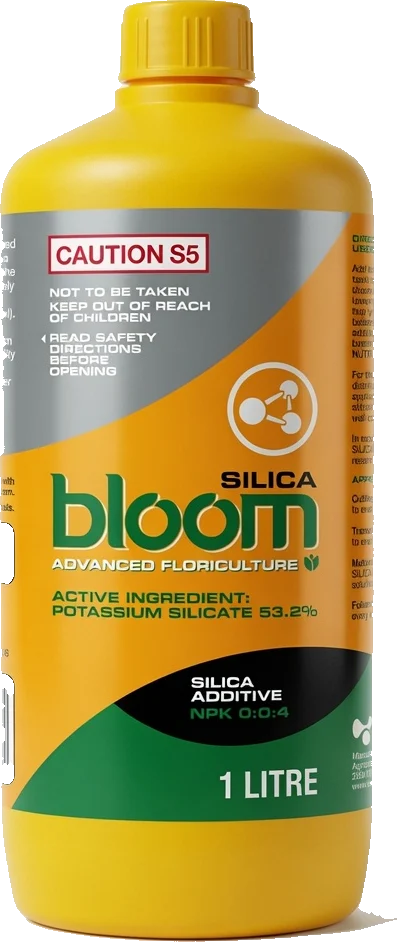
None of this says silicon amendment is a bad idea at field scale — the agronomy on grasses and cereals is real. It says the decision starts with what’s planted, not just what’s in the bag. Know which class your crop falls into before the per-acre math gets run.
What this means for a rotation, not just a single field
Most broadacre operations aren’t running one crop forever — they’re rotating, and a silicon correction applied to the soil doesn’t necessarily carry the same value from one year’s crop to the next. A calcium silicate amendment that pays for itself under a high-accumulating cereal may deliver far less visible return the following season under a low- or intermediate-accumulating broadleaf crop in the same rotation, even though the silicon is still sitting in the soil. That’s a planning question as much as an input question: when in the rotation does the amendment actually line up with a crop built to use it.
It’s also worth remembering that silicon, once it polymerizes into solid silica gel inside the plant’s shoot tissue, doesn’t redistribute or move back out the way more mobile nutrients can. Whatever a high-accumulating crop pulls up and locks into its stem and leaf tissue over a season stays there until that tissue breaks down — residue management, not just root uptake, is part of how silicon actually cycles back through a field over multiple years.