
Product Spotlight
Getting Pre Right: The Rate Your Cheat Sheet Probably Has Wrong
Pre is one of the quieter products in the Bloom lineup — no big flower-stage claims, no flashy before-and-afters. It’s an early-stage input, dosed in small amounts, easy to treat as an afterthought. Which is exactly why it’s worth stopping on today, because there’s a number attached to it that’s been circulating wrong for years.
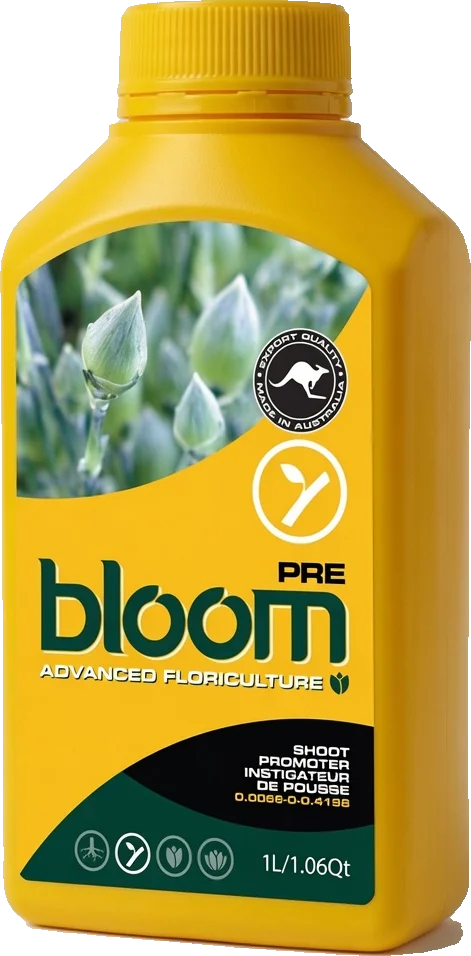
Two rates, one product
If you’ve picked up a Pre cheat sheet at some point — the kind of quick-reference PDF that gets passed around, printed out, and pinned above a res tank — you’ve probably seen a dose of 4 ml/L. It’s on the cheat sheet. It’s been on the cheat sheet for years. It is also wrong.
We checked it against the source that actually governs a dose rate: Bloom’s official feed charts — the Deluxe Soil, Deluxe Run-to-Waste Hydro, and Deluxe Recirculating schedules, the documents built specifically to be handed to a grower as a program, not a summary. Every one of them puts Pre at 1 ml/L.
Confirmed rate: 1 ml/L
Sourced from Bloom’s Deluxe feed charts, the authoritative rate documents for the full nutrient system. A printed cheat sheet is a convenience reference — not the document a dose gets checked against.
A cheat sheet quadrupling a dose isn’t a rounding error. Run Pre at 4 ml/L across a season and you’re burning through four times the bottle you need, and pushing an early-stage input at a concentration it was never programmed for. If your results with Pre have been inconsistent, or the bottle empties faster than it should, this is worth checking against your own reservoir math today.
It isn’t only Pre. The same audit turned up the identical error on Final — another low-volume, easy-to-overlook product where the printed cheat sheet also says 4 ml/L against a feed-chart-confirmed 1 ml/L. Two different products, same wrong multiplier, which is usually the signature of one bad figure getting copied forward rather than two separate mistakes. Worth checking both bottles against the chart, not just one.
Why the two documents disagree
It comes down to what each document is for. A cheat sheet is a one-page leave-behind — quick, informal, written for a shelf conversation, and it has never been treated as the final word on a number at Bloom. A feed chart is a program: a week-by-week schedule built to be run start to finish, and it’s the document we check a rate against before it goes on anything customer-facing. When the two disagree, the feed chart wins, every time — and on Pre, they disagree by exactly 4x.
That hierarchy isn’t specific to Pre — it’s how we treat every number that goes out under the Bloom name, on any product. A cheat sheet earns its keep for the mechanism language, the plain-English “what this does” — not the decimal point. When we’re building a sheet, an ad, or a post like this one, the rule is the same in both directions: if the feed chart and a cheat sheet disagree, we go with the chart; if neither document actually says something, we don’t print a number just to fill the space.
That last part matters as much as the correction itself. Pre doesn’t yet have a published guaranteed-analysis breakdown or a dedicated hero white paper the way Roots, Ooze, Phat, SWTNR and Seafuel do — it’s covered at the segment level, inside Bloom’s broader early-growth program material, rather than as a standalone technical sheet. We’d rather tell you that plainly and give you the one number we’ve actually verified than round out this post with a percentage or a mechanism claim we haven’t checked against the label ourselves.
The bottle behind the number
Pre comes off the same production line as the rest of the range: every Bloom label we’ve checked so far reads Agricultural Organics (Aust) P/L, 5 Belfree Drive, Green Fields, South Australia — the same facility that’s supplied Bloom’s US range for 26 years. Nothing about that has moved. Those same labels also carry the same two disclosures, plainly, rather than tucked away: no USDA organic claim, not labeled for use in organic crop or organic food production in California, and an AAPFCO metals-disclosure line pointing growers to public data on the metals content of the product rather than asking them to take a marketing claim’s word for it. It’s a small thing to put on a label, and most brands don’t bother.
The takeaway for your reservoir: Pre runs at 1 ml/L per Bloom’s Deluxe feed charts. If a printed cheat sheet in your grow room says 4 ml/L, it’s out of date — go by the chart.
We’ll keep working through the rest of the Bloom range with the same standard — label first, feed chart second, everything else checked against those two before it goes on a bottle, a cheat sheet, or a post like this one. If you’ve got a Pre cheat sheet with the old number on it, this is your sign to swap it out.