
One Address, Twenty-Six Years: The Story Behind Every Bloom Label
Flip any Bloom bottle over and the fine print at the bottom of the guaranteed analysis says the same thing it’s said for a long time: Agricultural Organics (Aust) P/L, 5 Belfree Drive, Green Fields SA 5107, Australia. That line doesn’t change from product to product, and it hasn’t changed in 26 years of selling into the US market.
Most growers never read that far down the label — they’re looking at the guaranteed analysis, not the manufacturer block underneath it. But that one line is actually the most honest thing on the bottle. It’s the same answer no matter which of the yellow bottles you’re holding: Roots, Seaweed, Humate, Cal, Ooze, Phat, all of it. One manufacturer, one address, the whole way through.
Twenty-six years, same maker
Bloom has been formulating and selling into the US market for 26 years. That’s not a marketing number rounded up for a subject line — it’s long enough that the range has gone through label redesigns, new products added to the lineup, and a lot of turnover in what’s trendy in the nutrient aisle, all without the manufacturer behind it changing. Every bottle is still made by Agricultural Organics (Aust) P/L, out of Green Fields, South Australia.
There’s a reason that matters more than it sounds like it should. A lot of nutrient brands are labels first — a name and a bottle design, with the actual manufacturing contracted out and sometimes moved around behind the scenes without anyone outside the company knowing it happened. Bloom’s version of that story is boring by comparison, which is sort of the point: same maker, same country of origin, for as long as the brand has existed in this market.
The same handful of inputs, showing up again and again
Pull the label text off three completely different products in the range — Roots (a rooting-stage seaplant extract), Seaweed (a general-purpose tonic), and Humate (a straight potash-and-humic product) — and the same few raw inputs keep turning up in the “Derived From” and “Non Plant Food” lines, just in different ratios depending on what the product is built to do.
What recurs across the range
- Leonardite-derived humic acid — 0.075% in Roots and Seafuel, a much heavier 10% in Humate, where it’s the whole point of the bottle.
- Durvillaea potatorum seaplant extract — the seaweed base declared on Roots, Seaweed, and Seafuel alike.
- Thiamine hydrochloride (vitamin B1) — a small, consistent inclusion: 0.054% on Roots, 0.002% on SWTNR.
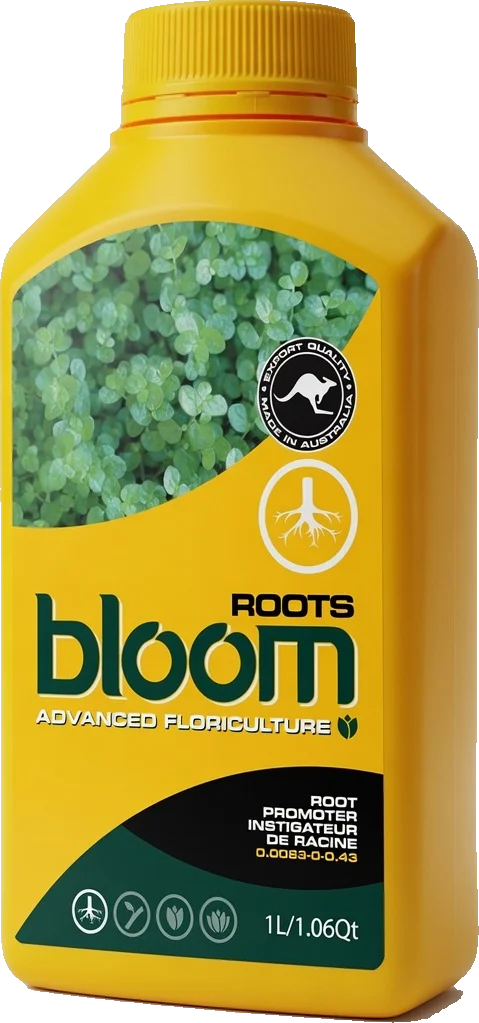
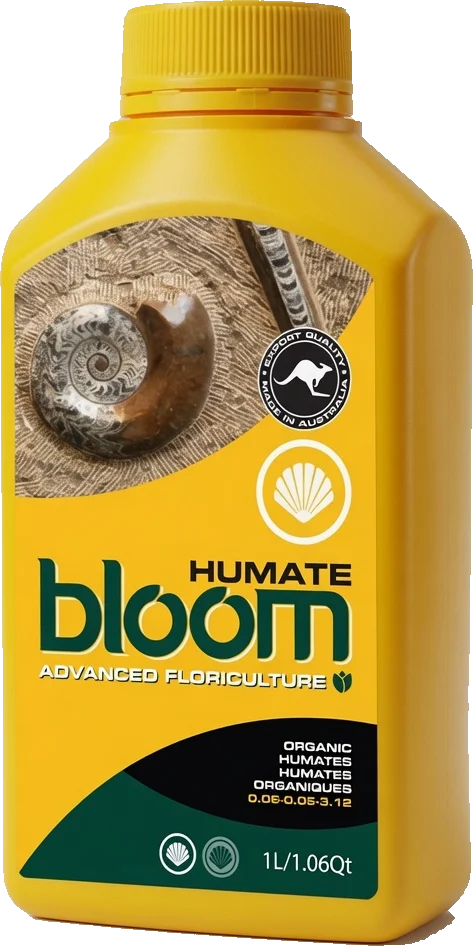
None of that is an accident of reading three random labels — it holds up across every label we’ve checked so far. It’s less a marketing “formula” than a maker’s habit: the same short list of raw materials, dialed up or down depending on what a given bottle is asked to do. Roots leans on the seaweed extract for the rooting stage. Humate leans almost entirely on the humic acid, at a concentration more than a hundred times higher than what shows up in Roots. Same shelf, same pattern, different job.
What the label doesn’t claim
Every Bloom label also carries a line that’s easy to skim past: “Not for use in organic crop or organic food in the state of California.” Bloom doesn’t carry a USDA organic certification, and the label says so plainly rather than leaning on the word “organic” in a way the paperwork doesn’t back up. The labels also point growers to AAPFCO’s public metals disclosure page for the heavy-metals data behind every registered fertilizer — information that’s a matter of public record, not something the brand has to volunteer, but it’s printed on the bottle anyway.
That’s the pattern worth naming here: the label says what’s actually true, not what would sound best. No organic claim where there’s no organic certification. No mystery about who makes it or where. The same manufacturer’s address on every bottle, whether it’s a $20 seaweed tonic or a full-range base nutrient.
Why this is the whole pitch
There’s no dramatic origin story here — just one manufacturer, one country of origin, and the same recurring inputs across a 26-year run in the US market. For a category that sees a lot of relabeled products move between manufacturers without anyone saying so, “nothing has changed back there” is a genuinely rare thing to be able to print.
An operator’s-eye view
From this side of the business, the label consistency isn’t really a talking point we set out to build — it’s just what’s left over after 26 years of not switching who makes the product. Every new SKU that’s gone into the yellow bottle lineup started from the same Green Fields, South Australia manufacturer as the ones that came before it. That’s a much smaller decision than it sounds like when you’re the one signing off on it, and a much bigger one for a grower trying to figure out whether a brand is actually the same thing it was five years ago.
See what’s actually in the bottle
Read the verified label data behind the products you’re already running, or see what growers are saying about the results.