
Grower Story & Trial Proof
Inside the FROST Trial: What the Lab Actually Measured
Most of what gets called “proof” in this industry is a grower’s word and a phone photo. That’s not nothing — a trusted grower’s eye is worth a lot — but it isn’t the same thing as a lab report. So when we built the case for OOZE and PHAT as a finishing layer, we didn’t want to lean on adjectives. We ran the FROST trial: an SC Labs PhytoFacts-verified terpene analysis, still published in full at bloomyellowbottles.us/frost/. This post is about what that kind of trial actually does, why we structured it the way we did, and — just as importantly — what we’re still not willing to claim from it.
Why a third-party lab, and not just a happy grower
PhytoFacts is SC Labs’ analysis program — an independent cannabis testing lab, not a Bloom department. That distinction matters for the same reason a farmer doesn’t grade their own eggs. A guaranteed analysis on a fertilizer label tells you what’s in the bottle. It can’t tell you what the plant did with it. The only way to close that gap honestly is to hand the finished flower to somebody with no stake in the answer and let them run it through their own instruments.
What OOZE and PHAT are actually built to do
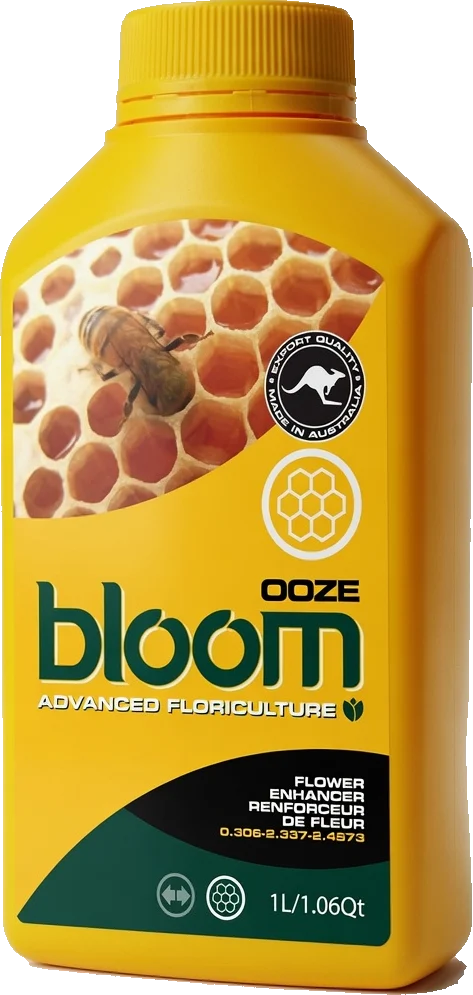
Both products are labeled as a late-cycle layer, not a base program replacement — OOZE carries a “Flower Enhancer” descriptor on its guaranteed analysis, and PHAT is positioned the same way: something that stacks on top of whatever base nutrients a grower is already running, rather than something that asks them to rip out and rebuild a feed schedule they trust. That’s the whole design premise, and it’s why the FROST trial was built around finishing weeks rather than a full-cycle comparison.
+ PHAT
+ OOZE
That timing isn’t arbitrary. It’s the same logic behind why we don’t market either product as a yield booster: the plant’s base nutrient demand is already being met by whatever program it’s on. What a finishing layer can influence — and what an SC Labs terpene panel is actually built to measure — is the flower’s own chemistry in the last stretch, not the size of the harvest.
What we’re not claiming
We’re not going to print a specific percentage lift here, and we’re not going to attach a grower’s name to a quote until that grower has confirmed, in writing, that we can use it. Both of those things exist in our pipeline right now — a trial-grower quote is sitting in our drafts folder waiting on permission — and neither is going in a blog post before that’s settled. If you want the underlying lab numbers, they’re published in full at the FROST page linked above, sourced directly from SC Labs rather than paraphrased here.
The part of the story that’s easy to skip: why the big guys don’t already do this
It’s a fair question. If a finishing layer like this works, why isn’t every large commercial operation running one? The honest answer isn’t secrecy — it’s operations math. A cultivation facility running dozens of rooms is built around consistency and throughput; every additional product in a feed schedule is another step floor staff has to execute correctly, at scale, every time. For an operation optimizing for uniform output across a huge footprint, that complexity often isn’t worth it — even when the underlying science checks out.
That’s a structural reason, not a hidden one, and it’s good news for the independent grower: a smaller operation can add one layer to an existing program without retraining a crew — which is exactly the gap FROST was built to speak to.
Why we’re telling this story again, without a new grower attached
We could have waited to publish anything until a specific grower’s quote was cleared. We decided not to, for a simple reason: the lab data doesn’t need a testimonial to be true, and we’d rather walk you through the trial itself — what SC Labs looked at, why we structured the application the way we did, what a third-party terpene panel can and can’t tell you about a finished product — than hold the whole story hostage to one person’s calendar. When that attribution is confirmed, we’ll publish it properly, with their name and their words, not ours.
Reading a trial like this one honestly
A few things worth keeping in mind, for this trial and any other “lab-verified” claim you come across in this industry:
- Third-party doesn’t mean unlimited scope. SC Labs measured what its PhytoFacts terpene panel measures — a real, independent chemical analysis of finished flower, not a substitute for a controlled, replicated agronomic study.
- A finishing product is not a yield product. We don’t market OOZE or PHAT on bigger harvests, and this trial wasn’t designed to test that question. A comparison that conflates the two is worth being skeptical of — ours included.
- One trial is one data point. We treat FROST as the start of a proof library, not the end of one. The Fort Collins trial program running now will add to it, and we’ll report what it shows — even if the answer is “less than we hoped.”
See the underlying data
The full FROST trial writeup — methodology, lab sourcing, and the SC Labs results as published — is up at bloomyellowbottles.us/frost/. If you’re a shop or a grower who wants to see how OOZE and PHAT fit onto a program you’re already running, reach out and we’ll walk you through it directly.