
Bloom Roots: What’s Actually in the Bottle
Every rooting product on the shelf implies the same promise: better roots, faster. Most don’t tell you what’s actually doing the work. Here’s the guaranteed analysis on Bloom Roots, what the label does and doesn’t claim, and what general published research says about seaweed extracts (research that wasn’t done on Roots).
0.0083-0-0.43 — Total Nitrogen 0.0083% (0.0021% ammoniacal, 0.0062% water-soluble organic), Soluble Potash (K₂O) 0.43%.
Derived from: Durvillaea potatorum seaplant extract.
Non-plant food: 0.075% humic acid (from Leonardite) · 0.054% thiamine hydrochloride (vitamin B1).
What Roots is not
Read that guaranteed analysis again: there’s no auxin figure on it. No IBA, no declared hormone concentration of any kind — because Roots isn’t a synthetic rooting-hormone product, and we’re not going to write copy that implies it is one. If a grower wants a precise, measured dose of an auxin like IBA, the honest answer is that a dedicated rooting-hormone product is the tool for that job, not a seaweed extract.
That distinction matters because it’s exactly where a lot of DIY rooting advice goes wrong. Willow bark, for instance, is often passed around as a natural source of rooting hormone — but the research doesn’t back that up. Lab work measuring willow shoot extract found IAA (a natural auxin) at just 0.3 to 3.5 nanograms per milliliter, the lowest of every compound class tested, with no IBA detected at all. What willow bark actually delivers in quantity is salicin, a different class of compound entirely, and its concentration swings by as much as 25-fold between individual willow clones — so even “the same” home remedy isn’t consistent batch to batch.
How seaweed-extract biostimulants are understood to work — signalling, not a measured hormone dose.
So what does the seaplant extract actually do?
This is general seaweed-extract research, mostly on other seaweed species. It was not a test of Bloom Roots. The published research on seaweed extracts points somewhere more specific than “hormones.” Root-applied extract has been shown to switch on cytokinin-responsive genes in plant tissue — activating a promoter called ARR5 and inducing genes named IPT3, IPT4 and IPT5 — and to alter root architecture under stress conditions. Measured hormone content in these extracts is also reported to vary by literally orders of magnitude between studies, which is itself a clue: the extract’s effect isn’t well explained by “how much auxin is in the bottle.” Researchers who’ve reviewed the field describe it as signalling and whole-extract synergy, and specifically note that fractionating a seaweed extract into its separate components has generally failed to reproduce the whole extract’s effect.
None of that is a guarantee, and we’re not going to write it as one. The same research is explicit that outcomes are species-specific and product-specific, that results vary with dose, crop, cutting type and growing season, and that the same product can perform differently between one grower’s conditions and another’s. That’s a more honest picture than “add this and roots explode” — and it’s the picture we’d rather stand behind.
Alongside the seaplant extract, Roots carries two non-plant-food additions: 0.075% humic acid, derived from Leonardite, and 0.054% thiamine hydrochloride — vitamin B1. Both show up elsewhere in the Bloom range too: the same Leonardite humic acid appears in Seafuel (0.075%) and Humate (10%), and thiamine turns up again in SWTNR. It’s the same handful of raw-material relationships reused across the line, not a different additive story invented for every bottle.
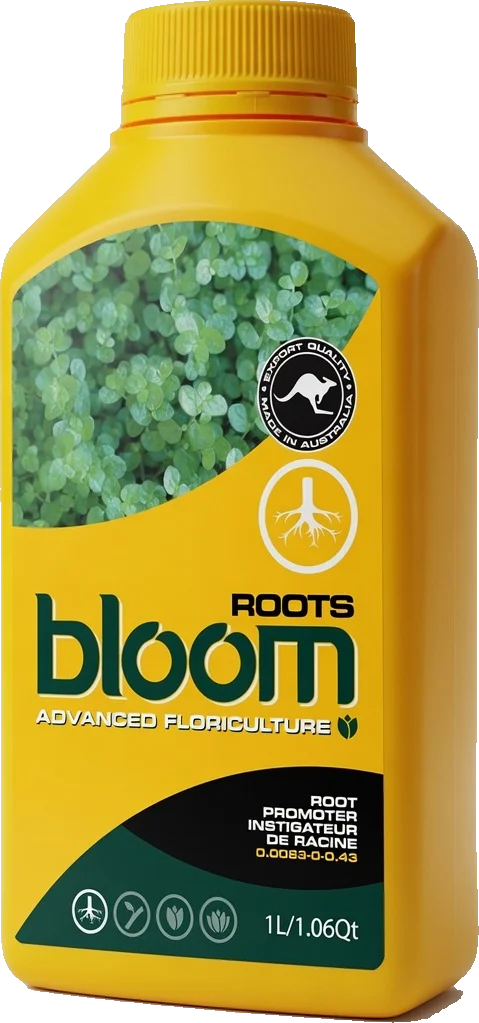
Bloom Roots — Durvillaea potatorum seaplant extract, Leonardite humic acid, and thiamine (B1).
Using it
Per the label and feed chart: 0.5 ml/L in your nutrient solution, or 1 ml/L used as a dip. That’s it — we’re not going to dress up the rate with a mechanism we can’t back up, and we’re not going to promise a specific rooting outcome. What we can tell you is what’s in the bottle and where it comes from.
If that’s a narrower claim than you’ll see elsewhere in this category, that’s on purpose. A bottle that tells you the truth about what’s inside it is more useful in the long run than one that promises more than its label can support.