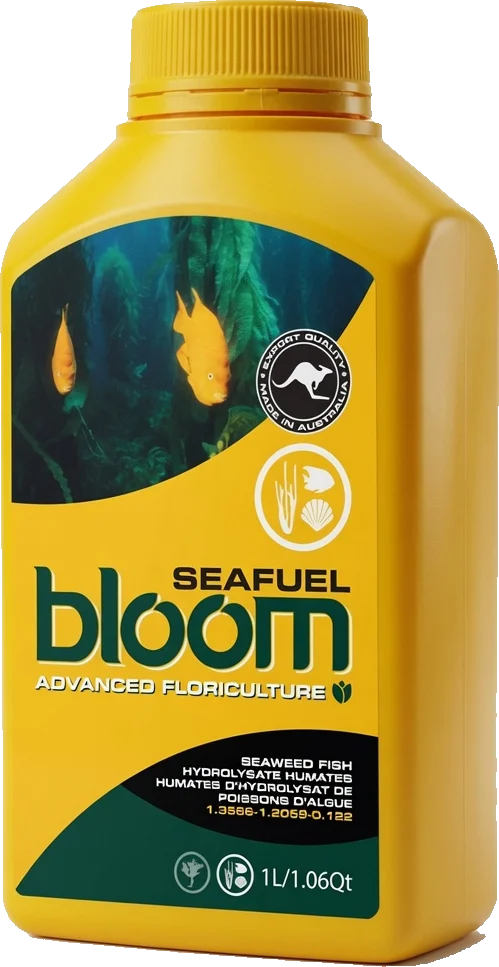
Flowering season has a way of turning a “we’ll grab more next week” supply habit into a scramble. If Seafuel is part of a finishing program, the better question to ask before the room flips to flower isn’t just how much to buy — it’s how that bottle holds up sitting in a cabinet for the weeks it takes to actually get used.
Why fish-based inputs are a shelf-life risk category in general
Any fish-derived liquid fertilizer carries oil from the raw material, and that oil is the thing most likely to go wrong in storage. Fisheries documentation on fish silage and fish-based fertilizers is blunt about this: free fatty acids in stored fish oil increase steadily over time, regardless of the product’s pH. That’s a chemical process, not a contamination one — lipids break down whether or not the product is otherwise stable and well-preserved. A product that retains more of its original fish oil is carrying more of the material that degrades fastest sitting on a shelf.
The USDA’s own technical review of liquid fish products lays out the enzymatic process plainly: enzymes are added to minced fish, the mixture breaks down, and the oil is skimmed off before the remains are concentrated. That’s a structural difference from a process that keeps the oil in the finished bottle — it’s not a claim about any one brand, it’s a description of what the enzymatic route does by design.
What’s declared on Seafuel’s label
Seafuel’s own label declares its inputs as Durvillaea potatorum (seaplant extract) and Hydrolized Blue Fin Tuna (Fish Hydrolysate), with 0.075% humic acid derived from Leonardite as a non-plant-food addition. The word on the label is hydrolysate, which is the same enzymatic category the oil-skimming process above describes — it’s a declared process category, not a claim this piece is inventing. Seafuel’s N-P-K figures aren’t consistent across printings of the label artwork, so they’re left off here.
The home-ferment version of this problem is worse, not better
Growers who’d rather make their own fish input from scraps run into the identical chemistry with less control over it. FAO’s own fish-silage guidance is explicit that the acidity of a home ferment has to be held at pH 4 or lower to prevent bacterial action, and that whole fatty fish specifically — as opposed to lean white-fish offal — needs more acid to hold that line, because ash content changes the acid demand. A bucket that isn’t dosed and mixed precisely enough can rot in pockets even while the overall batch looks and smells fine, and whatever oil is in that batch is degrading the entire time it sits, exactly as the published fish-silage documentation describes. There’s no equivalent of a guaranteed analysis or a stated pH range on a home batch — just a smell test, which several extension sources call out as an unreliable way to judge whether a ferment is actually safe to use.
None of this is a claim that a bottled hydrolysate never degrades at all — nothing fish-derived is immune to time. It’s a narrower, more useful point for anyone planning flower-cycle inputs this season: a process that skims the oil off before bottling has structurally less of the one thing documented to go bad in storage, and buying ahead of the season from a fresh batch beats discovering mid-flower that the bottle in the back of the cabinet, or the ferment started three weeks ago, isn’t what it was when it went in.
A practical habit worth adopting alongside the stock-up itself: store the bottle somewhere cool and out of direct light, same as any oil-bearing input, and use it in the order it was bought rather than reaching for whichever bottle is closest. (Not every bottle in the lineup ages the same way sitting in that cabinet — here’s which ones you can stock deep without worrying about the clock.) Neither step changes the chemistry described above, but both work with it instead of against it — and for a product you’re counting on through an entire flower cycle, that’s worth the five extra seconds it takes.