
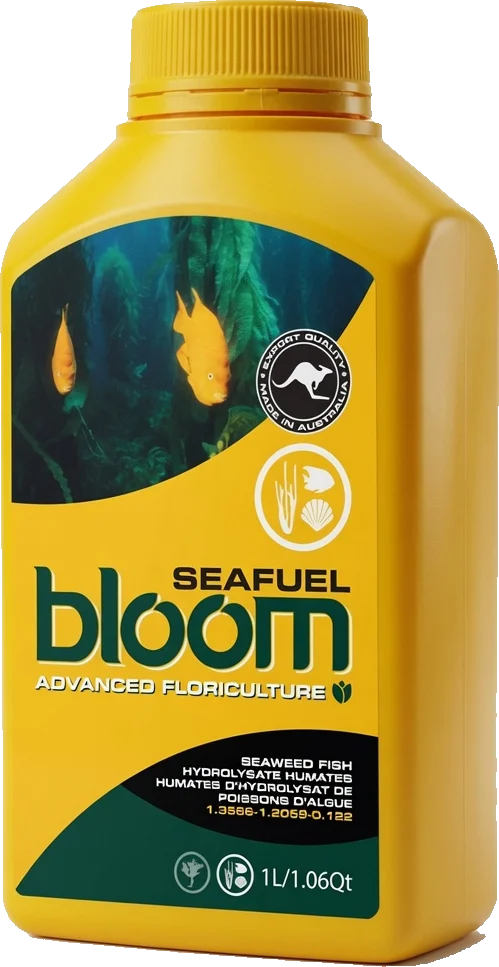
What “Hydrolysate” Actually Means: Inside the Bottle of Bloom Seafuel
Seafuel’s label uses one specific word for how the tuna in it is made, and it isn’t the word that used to be on our own marketing. Here’s the real difference, and why it isn’t just semantics.
The short version: Seafuel’s label declares Durvillaea potatorum seaplant extract and Hydrolized Blue Fin Tuna (Fish Hydrolysate), with a small non-plant-food dose of humic acid from Leonardite riding along. Hydrolysate is made with enzymes, not heat and acid — and that process choice is worth understanding.
“Cold composted” was never the right word
Older marketing copy for Seafuel described it as “cold composted blue fin tuna, cold composted kelp and fulvic acid.” It’s a pleasant-sounding phrase, but it isn’t what the label actually says, and the label is the version that has to hold up to a regulator, not a sales page. The label’s own manufacturer safety data sheet gives Seafuel a pH of 4 to 5, a specific gravity of 1.2 to 1.4, a “sweet/fish” odor, and notes it’s completely biodegradable and incompatible with alkaline agents. None of that describes compost. It describes an acidic liquid built by a specific industrial process — and that process has a name: hydrolysis.
Two ways to break down a fish, and they don’t end the same
There are two established routes for turning fish by-product into a liquid fertilizer input, and extension and regulatory literature draws a clean line between them. A fish emulsion is made by cooking fish waste at temperatures above 180°F to kill off bacteria, then stabilizing it with acid. A fish hydrolysate — the word on Seafuel’s own label — uses enzymes to digest the fish protein instead, at much gentler conditions, with the oil skimmed off rather than cooked in.
That process choice isn’t cosmetic. During acid hydrolysis, several amino acids — tryptophan, cysteine, serine and threonine among them — are partially or totally destroyed by the heat and acid. Worse, many of the amino acids that do survive get converted from their natural L-form into the D-form, a structural flip that strips them of their biological activity in a plant. Enzymatic hydrolysis is gentler on both counts: published comparisons show it retains a higher ratio of peptides to free amino acids, and a higher proportion stays in the L-form that a plant can actually use. It’s the difference between protein that’s been broken down carefully and protein that’s been cooked into submission.
What the research says, stated honestly
Fish hydrolysates are a genuinely studied category of biostimulant, not a marketing invention. Published trials link them to changes in root architecture — more lateral roots, more root tips, greater root surface area — attributed to the peptides and free amino acids complexing nutrients and feeding microbial activity around the root zone. But the honest caveat belongs here too: dose-response in that research isn’t linear, and results vary by raw material, species and process. One published comparison even found a commercial reference hydrolysate show no measurable improvement over a plain water control, while lab-made hydrolysates from the same study did. The category works; no single product in it gets to claim it works automatically.
That’s part of why Seafuel’s label sticks to what it can actually stand behind: the derived-from line, the humic acid percentage, and nothing it can’t back up with a number that’s survived regulatory review. We’re not printing a guaranteed-analysis figure for Seafuel here — the label and an older bottle render disagree with each other on the NPK numbers, and per our own standing rule, a number that can’t be settled doesn’t get printed as a guess. What’s settled, and what this whole post is actually about, is the process: enzymes, not heat and acid, and that’s the label’s word, not ours.
Why the word on the bottle is the one that matters
“Hydrolysate” isn’t a prettier synonym for “composted.” It’s a specific manufacturing process with a specific, documented effect on what actually ends up in the bottle — and it happens to be the gentler, more amino-acid-preserving of the two common routes for turning fish by-product into a liquid input. Seafuel’s label commits to that word, backed by a pH range any grower with a cheap meter could check against the bottle in their hand. That’s a small thing to get right, but it’s the kind of small thing that either holds up or doesn’t when someone actually checks.