
The Mineral a Kelp Steep Runs Out of First
Semi-Hydro & Houseplant · Science & Education
Steep dried kelp in a jar for a LECA reservoir top-up and the pitch is usually about what it delivers — potassium, trace minerals, “biostimulant” compounds. Nobody asks what runs out first. It turns out one mineral hits a usable ceiling long before the one growers actually want gets anywhere close to useful, and the arithmetic uses nothing but the seaweed’s own published composition and ordinary greenhouse water-quality thresholds.
Dried brown seaweed (Ascophyllum nodosum, the species most composition studies are run on) carries sodium at roughly 3–4% of its dry weight and magnesium at roughly 0.5–0.9%. That’s a six-to-eight-fold gap between the two minerals in the same jar of dried kelp — before a single gram goes into water.
A passive LECA reservoir has no soil to buffer a mineral overload, and no flush cycle to correct it — whatever goes in stays in until the next full water change. That makes a water-quality ceiling, not a nutrient target, the thing that decides how much dried kelp a reservoir can actually tolerate.
Running the dose against a real ceiling
University of Massachusetts Extension’s greenhouse water-quality guidance puts the acceptable sodium ceiling for ornamentals at roughly 50 ppm, with desirable magnesium sitting at 30–50 ppm — the two minerals are supposed to land in roughly the same range. Every gram of dried A. nodosum steeped per liter adds about 30–40 mg/L of sodium. Do the division and a grower spends the entire 50 ppm sodium allowance at somewhere between 1.2 and 1.7 grams of dried kelp per liter.
Run that same 1.2–1.7 g/L through the magnesium side of the composition data and the number comes out to roughly 6–15 mg/L of magnesium delivered — call it a fifth to a third of the low end of the 30–50 ppm a greenhouse water-quality program actually wants. The sodium budget is fully spent while the magnesium target is still mostly unmet. Steeping harder to close that gap just spends further past the sodium ceiling that was already the limiting factor.
In a dried-kelp steep, sodium is the mineral that decides how much you can use. Magnesium is just along for the ride, and it never catches up before sodium runs out the clock.
What this does and doesn’t say about a bottled extract
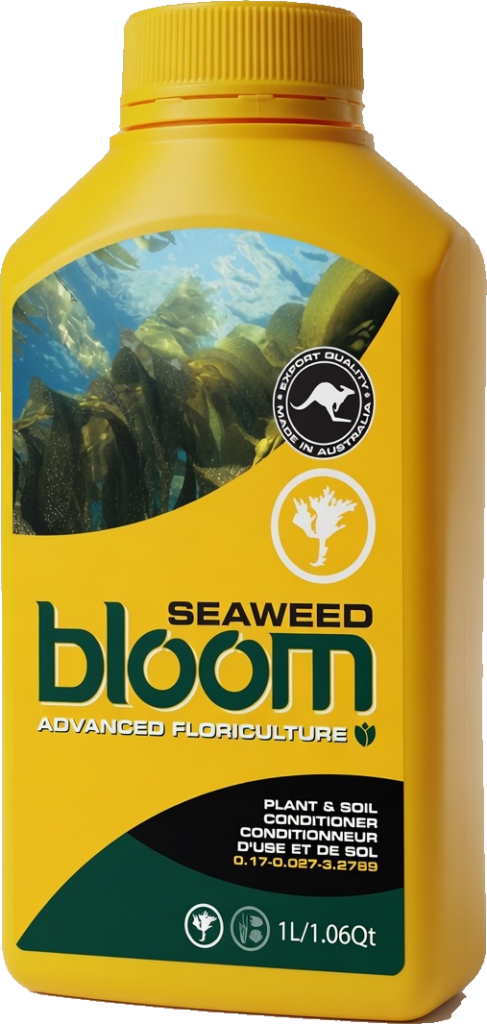
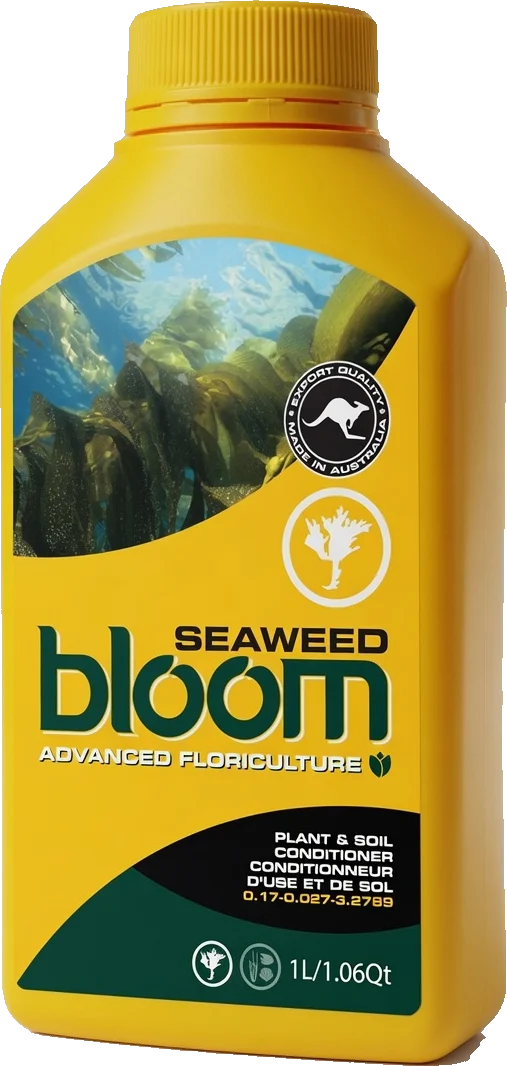
This arithmetic runs entirely on the DIY input’s own published composition — dried seaweed, the species most studies measure, converted through a standard water-quality threshold. It isn’t a figure Bloom’s own label carries, and it shouldn’t be read as one. Bloom Seaweed’s guaranteed analysis is 0.17-0.027-3.278, derived from Durvillaea potatorum, dosed at 1 ml/L of finished liquid — a dose form that isn’t measured in grams of raw biomass per liter at all, so it isn’t subject to the same arithmetic. No sodium or magnesium figure appears on that label, and this piece doesn’t supply one. What the composition data does make clear is a general property of the raw material: a mineral load that scales with how much dried biomass goes into the jar, in proportions a grower doesn’t get to choose.
That’s the trade a finished liquid dosed by the milliliter is actually making — not necessarily “more concentrated” or “purer,” just decoupled from the raw-biomass ratio that locks a home steep into spending its sodium allowance long before magnesium shows up in any useful amount. For a reservoir with no flush cycle and no soil to buffer the difference, that’s a reservoir-chemistry distinction worth knowing before the next steep goes in the jar.
None of this says a home steep is unsafe, or that magnesium can’t be supplied another way — a dedicated Cal-Mag product dosed on its own label figure does that job without borrowing against a sodium budget at all. It says only that two minerals in the same jar of dried kelp don’t arrive on the same schedule, and in a small, unflushed reservoir, the one that runs out first is the one setting the limit on everything else in the jar.
For a grower keeping a passive LECA reservoir topped up through fall, the practical takeaway isn’t “don’t steep kelp” — it’s “don’t scale up a steep to chase a magnesium number it was never going to reach.” Doubling the dried kelp in the jar doesn’t close a sixfold-to-eightfold composition gap; it just moves the sodium total further past a ceiling that was already the binding constraint before magnesium became part of the conversation. Measuring the dried material by weight, rather than eyeballing a handful, is the one step that at least makes the sodium side of that trade-off visible instead of invisible.
Related reading: The Bottle-Size Math Nobody Runs for a LECA Reservoir, on the same passive-reservoir math applied to a different product.