
The Bottle-Size Math Nobody Runs for a LECA Reservoir
Semi-Hydro & LECA Houseplant · Buying & Stocking Up
Fall is repotting season for a lot of semi-hydro growers — last chance to settle a plant into fresh LECA before light levels drop and growth slows for winter. It’s also, conveniently, when a lot of people glance at a small bottle of rooting support and wonder whether to size up before they buy. Nobody seems to actually run the math on how long a bottle lasts at semi-hydro’s dose scale, so we did.
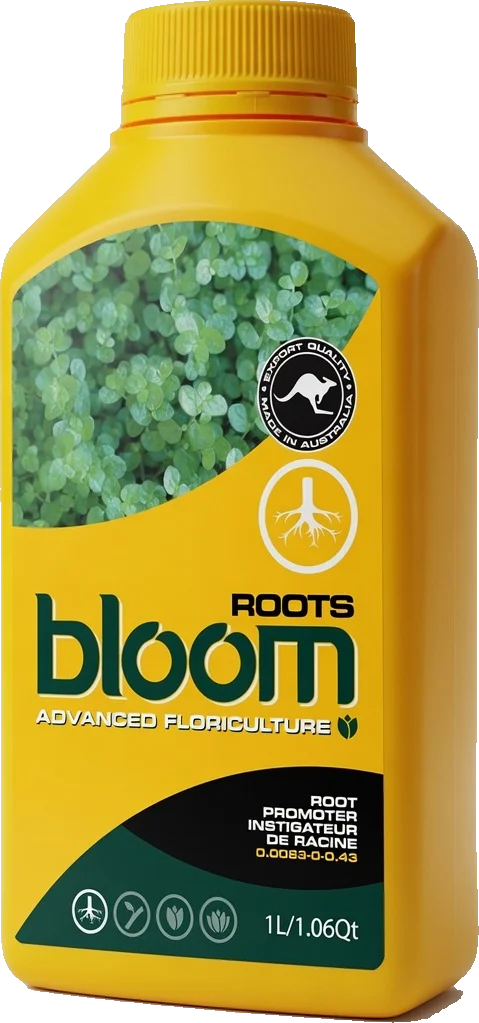
Bloom ROOTS is dosed at 0.5 ml per liter of feed solution (1 ml/L if you’re using it as a dip). That’s a tiny number next to a soil grower mixing up a 20-liter watering can. But a passive LECA reservoir is tiny too — most semi-hydro pots hold somewhere in the neighborhood of a liter of water column, sometimes less for a small pot, more for a big one. Run the dose rate against that reservoir size and the arithmetic gets surprising fast.
A 300 ml bottle of ROOTS, at 0.5 ml/L, treats 600 liters of solution before it’s empty. At one liter per reservoir fill, that’s 600 full reservoir changes from the smallest bottle on the shelf.
From bottle to reservoir fills
Now put that against how often a semi-hydro collection actually gets full reservoir changes. Most passive setups don’t get flushed weekly — growers top up between changes and do a full swap every couple of weeks to a month. Say a grower runs eight pots and fully changes each reservoir roughly every three weeks: that’s about seventeen full changes per pot a year, or 136 fills across the whole collection. Six hundred fills from a 300 ml bottle covers that for well over four years. The bottle most people treat as the “starter size” is, for this vertical, closer to a multi-year supply.
Sizing up changes the number, not the logic
The same ratio holds moving up a size: a 1-liter bottle covers roughly 2,000 reservoir fills, a 2.5-liter covers about 5,000. For a semi-hydro collection, that’s not “buy more because it’s on sale” — it’s recognizing that the smallest bottle on the shelf was sized for a much bigger watering can than the one most LECA growers are actually using. Seaweed-based feeds run a similar pattern at their own 1 ml/L dose rate, just with roughly half the fills per bottle compared to ROOTS at 0.5 ml/L — worth knowing before assuming every bottle in the lineup stretches the same distance.
At semi-hydro’s dose scale, the question isn’t whether a bottle will last the season — it’s whether the size you bought matches how many reservoirs you’re actually running.
Where the math actually changes your plans
Run the same arithmetic against a bigger plant room — say thirty LECA pots instead of eight, each getting a full reservoir change roughly every three weeks. That’s about 510 fills a year across the collection, still well inside the 600-fill ceiling of a single 300 ml bottle for just over a year. Most growers at that scale aren’t thinking of their rooting bottle in terms of annual fills; they’re thinking of it in terms of how often they see it on the shelf. The two framings land in very different places, and only one of them is actually tracking how much product a season’s worth of reservoir changes uses up.
There’s also a practical dosing wrinkle worth naming: because 0.5 ml is a small volume to measure accurately by eye against a full liter of water, some growers premix a larger holding batch — diluting a known amount of ROOTS into a jug of water at the correct ratio, then drawing from that jug at top-ups instead of measuring 0.5 ml directly every time. That doesn’t change the dose or the bottle math above; it’s purely a measuring-accuracy habit worth knowing about if dialing in a fraction of a milliliter by eye has ever felt imprecise at this scale.
None of this changes the dose itself — 0.5 ml/L as a feed rate, 1 ml/L as a dip, same as always. What it changes is which size makes sense to have on the shelf going into fall repotting. If you’re restocking a single pot or two, the small bottle is genuinely built for that. If you’re running a real semi-hydro collection — a windowsill’s worth of LECA pots, a propagation shelf, a plant-room setup — the math above says you’ll be reaching for that same small bottle for years, which is usually the point where the next size up actually pencils out better per treated liter. That’s a sizing decision, not a hard sell, and it’s one worth making with the arithmetic in front of you instead of guessing at checkout.
Related reading: The Fish Behind Seafuel, By the Numbers, on what’s actually in another reservoir-dosed Bloom product, and The Mineral a Kelp Steep Runs Out of First, on the mineral-budget math a passive reservoir imposes on a DIY kelp steep.