
Two Hydrolysates That Actually Worked, From a Review Built to Report the Ones That Didn’t
A 2020 review of fish-derived biostimulants went looking for the full picture — the failures as well as the wins. Two of the wins are worth a hydro grower’s attention.
Most of what gets written about fish-derived plant inputs on this blog starts from the same honest place: the category is mixed. We’ve already walked through a commercial hydrolysate that scored no better than a water control in a 2026 wheat trial, and a strawberry-runner study where an animal-derived biostimulant actually reduced plant weight. That’s not a knock on the category — it’s the whole point of citing real trial data instead of a marketing sheet. But a review built to report the failures honestly also reports the successes, and two of them are worth sitting with.
Both come from the same 2020 literature review on fish by-product biostimulants, which set out to summarize what the field actually shows — good, bad, and unresolved — rather than cherry-pick. One finding: a protein hydrolysate standardized to 11.3% free L-amino acids increased tomato yield against an untreated control. The other: a collagen-derived fish hydrolysate produced a measurable increase in root dry weight and in the root-to-shoot ratio of maize — meaning the plant put proportionally more growth into roots relative to top growth, not just more growth overall.
Why “L-amino acid” is the word doing the work
That 11.3% figure isn’t incidental. Plants can use L-amino acids directly; they generally cannot use the mirror-image D-form the same way. How a fish protein is broken down determines which form you end up with. The two broad routes are heat-and-acid processing (used to make fish emulsion) and enzymatic digestion (used to make hydrolysate). Heat-and-acid routes partially or fully destroy several amino acids and convert others from the L-form to the D-form — a side effect of the chemistry, not a flaw in any particular brand. Enzymatic routes retain a higher share of L-amino acids and a higher peptide-to-free-amino-acid ratio. That’s the mechanism behind why the processing method on a label is worth reading, not just the word “fish.”
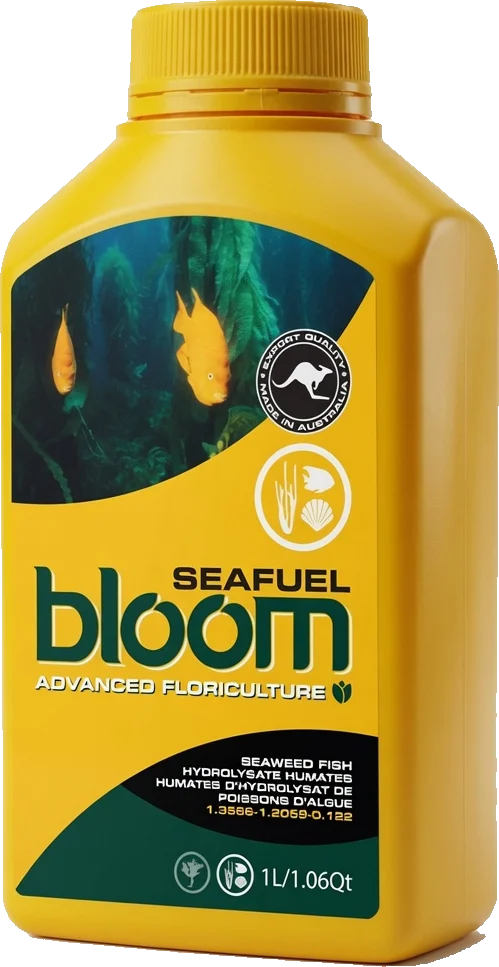
Bloom Seafuel’s label states its own process plainly: it declares Hydrolized Blue Fin Tuna (Fish Hydrolysate) alongside Durvillaea potatorum seaplant extract, with 0.075% Humic Acid as a non-plant-food ingredient, under the descriptor “Seaweed and Humates.” The label calls it a hydrolysate, not a cold-composted blend — that word is the one that matters, because it’s the route the literature above associates with retaining the amino acid form a plant can actually use.
What this does and doesn’t tell you
It would be easy to read “root/shoot ratio improved in maize” and assume that result transfers straight to a cannabis tent. It doesn’t, automatically. Different crop, different hydrolysate source and concentration, different growing conditions. What the finding does establish is narrower and more useful: processing route is not a marketing detail, and a properly hydrolyzed fish input has real literature behind the mechanism that makes it worth including in a program, not just a null result waiting to be repeated.
None of this is a plant-regulator claim, and it isn’t a substitute for reading your own feed chart. It’s one more piece of the “what’s actually in the bottle, and why” series this blog keeps coming back to — because growers who’ve been doing this a while have usually learned to ask.
Scale matters here too. The maize trial used a lab-controlled application rate and a single growth stage; a cannabis grower running Seafuel through a full vegetative and flowering cycle is applying it under very different timing, substrate, and lighting conditions. That’s not a reason to discount the finding — it’s a reason to treat it the way we treat every piece of outside research on this blog: as a mechanism worth understanding, not a guarantee of a specific result in your own tent. The root/shoot ratio finding is useful mainly because it answers a narrower, more honest question than “does fish fertilizer work” — it answers “does properly processed fish hydrolysate do something measurable to root development,” and for that question the answer in this trial was yes.
It’s also worth saying what neither finding claims. Neither is a yield guarantee, a potency claim, or a substitute for a feed chart built around your own strain and setup. They’re two data points in a literature base that, as we’ve said before, is genuinely mixed — which is exactly why we keep citing the losses next to the wins instead of running a highlight reel.
Sources: Madende M, Hayes M. Fish By-Product Use as Biostimulants: An Overview of the Current State of the Art. Molecules 25(5):1122 (2020). Colla G, et al. Biostimulant action of protein hydrolysates. Frontiers in Plant Science 8:2202 (2017). Bloom Seafuel label artwork, derived-from and non-plant-food declarations.