
The Label Wins: How We Decide What Goes On a Bloom Bottle
Not the website, not an old feed chart, not whichever number sounds better in an email — the label. Here’s why that’s the rule, and what it actually looks like to follow it.
The short version: if a number ever disagrees with itself across our own materials — the label, a printed feed chart, the website — the label wins. Every time. If it can’t be settled, the number comes off the page rather than get printed as a guess.
Why the label, specifically
A fertilizer label isn’t just packaging copy. In the US, the guaranteed analysis printed on it is the version that gets filed with state regulators and has to match what’s actually in the bottle. Bloom’s labels have gone through that process for years — real fertilizer-registration review correspondence with the California Department of Food and Agriculture exists for several products in the range, and that filing gets revisited and kept current, not written once and forgotten. That’s the version with the most scrutiny behind it, so it’s the version we treat as true.
A website, by contrast, is just easier to edit. A feed chart gets reprinted every so often and a typo can ride along for years without anyone catching it. Neither one goes through a regulator’s desk the way a label does. So when we’re deciding which number to trust, we don’t start from “which one looks right” — we start from “which one had to survive the most scrutiny to get printed,” and that’s almost always the label.
What a label actually commits to
Take Seafuel. Its label states the derived-from line plainly — Durvillaea potatorum seaplant extract and hydrolyzed Southern Bluefin Tuna, with a small non-plant-food dose of humic acid from Leonardite riding along. The manufacturer’s own safety data sheet backs that up with a pH range of 4 to 5. None of that is a marketing description written to sound good — it’s the version that has to be accurate because it’s the version a regulator, a retailer, or a grower with a pH meter can actually check against the bottle in front of them. That’s the standard we hold every number to, not just the ones that happen to be flattering.
Old feed charts, old web pages, reprinted labels — after that much paper and that many reprints, it would be easy for a small figure to drift out of sync somewhere along the way. When we catch that, we don’t average the two numbers or run with whichever one looks better in a sell sheet. We go back to the label. If the label itself doesn’t settle it, the number simply doesn’t go on the page until it does.
Leaving a number off is not the same as hiding it
There’s a difference between a number we haven’t verified and a number we’re avoiding. The first gets left out until it’s checked — that’s just discipline. We’d rather publish a shorter, plainer page than fill a gap with a figure we can’t stand behind if someone asks where it came from. If you’ve read any of our product or grower-education content and noticed we sometimes say “the label doesn’t declare that” instead of just filling in a plausible-sounding answer, that’s this same rule showing up in a different place.
It’s a small, unglamorous habit, and it will never be the headline on a bottle. But it’s one of the reasons the same range has been able to keep telling the same story in the US for 26 years without having to walk anything back. The label commits to something specific. Everything else we publish about a product has to answer to it — not the other way around.
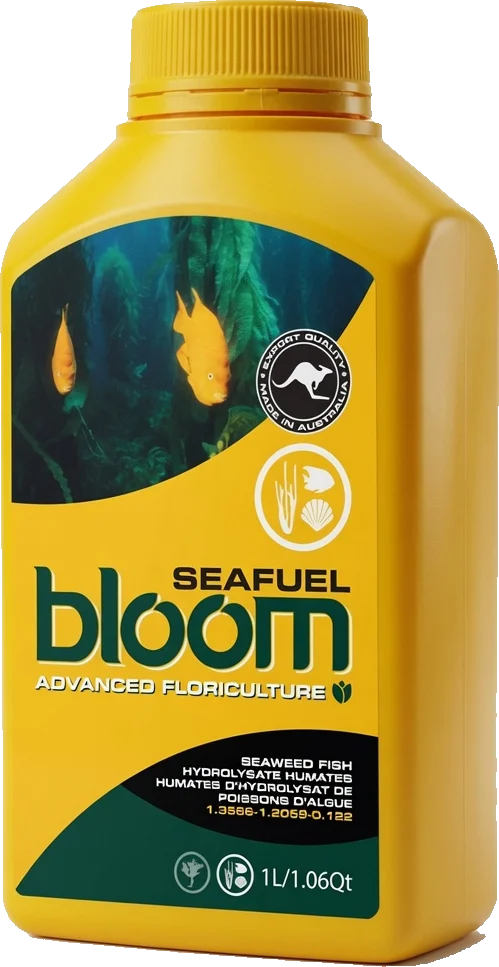
Bloom Seafuel — the label’s derived-from line and pH range are the version we check everything else against.
Why this is worth telling you at all
None of this is a feature. It won’t change how a product performs in your feed room, and it’s not something most growers will ever think to ask about. We’re writing it down anyway because trust in this category is usually built on vibes — nice photography, confident language, a brand that’s been around long enough to feel established — and we’d rather it be built on something you could actually go check. The label is public. The rule we follow about it isn’t a secret, either; it’s just not usually the kind of thing a nutrient company puts in writing.
So the next time you see a figure on our site, a feed chart, or in anything we send you, know that it had to agree with what’s printed on the bottle in your hand before it was allowed to go out. If it doesn’t appear at all, that’s not an oversight — it’s the same rule, working as intended.