
Cut-flower and ornamental growers ask us about silicon more than almost any other category — stronger stems mean fewer snapped blooms on the bench and fewer bent stalks in the vase. It’s a reasonable thing to want. It’s also a product category that’s chemically fussier than most growers realize, and we think that’s worth explaining honestly, even about our own bottle.
Why silicon products are hard to formulate in the first place
Manufactured liquid silicon fertilizers are almost always some form of potassium silicate, made one of two ways: fusing silica sand with potash at furnace temperatures above 1,000°C, or dissolving silica sand directly in potassium hydroxide solution. Either way, the finished liquid only stays in solution within a narrow window — soluble silicate ions are stable at roughly pH 11 to 12. Drop below pH 9 and solubility collapses fast, with silica precipitating out as an amorphous gel. A reference product documented in a USDA technical evaluation runs at pH 11.3–11.7 specifically to stay on the right side of that line.
Collapse zone: pH 9
Gels out: pH < 9
What that means at the bench
This is exactly why silicon products come with their own mixing instructions — add last, mix at full strength before diluting, never combine directly with an acidic concentrate — and why a silicon product that’s mixed carelessly can cloud a reservoir or clog a dripper. It’s chemistry working as expected, not a defect. For a greenhouse running precise fertigation on a bench of cut stems, that mixing discipline matters more than most growers are warned about up front.
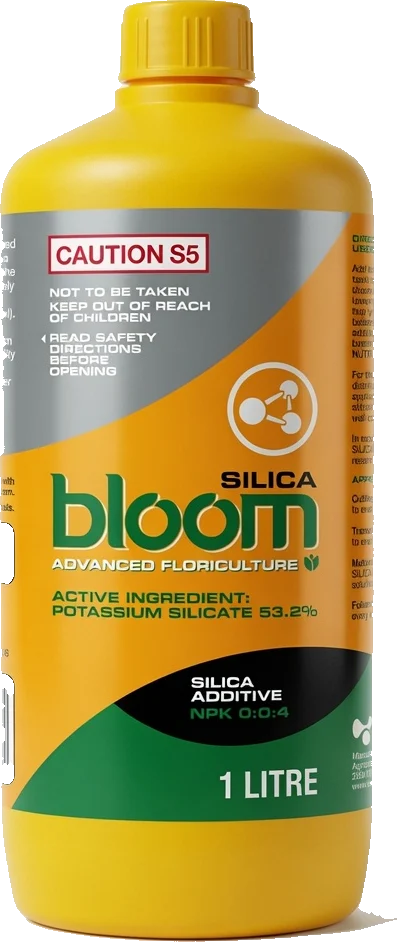
Why we’re telling you this instead of just making the sale
We’ve built this whole site on a simple rule: a figure only goes on the page once it’s been read off real label artwork, not off a render or a cheat sheet. That rule is why some of our own posts about our own products withhold numbers. It would be easy to skip that step for a product most growers don’t scrutinize closely. We’d rather you know the general chemistry — why these products are pH-sensitive, why they need careful mixing, why “silicon supplement” covers more than one manufacturing route — and trust that when we do print Bloom Silica’s own analysis, it’ll be one we’ve actually verified.
That’s the same standard every other product on this site has already been held to. Silica’s turn is coming.
What a grower can actually do in the meantime
None of this chemistry changes the practical mixing advice most feed charts already give: add a silicon product to a reservoir on its own, at strength, before anything else goes in, and never pour it straight into an acidic concentrate. That habit exists precisely because of the pH window described above — it isn’t a brand-specific quirk, it’s true of potassium silicate chemistry generally, whichever bottle it came from. A grower who follows that one rule sidesteps almost every silicon-related mixing problem before it starts, regardless of which manufacturing route produced the product in their hand.
It’s also worth remembering that a cloudy reservoir or a clogged dripper after adding a silicon product isn’t necessarily a sign of a bad batch. Given how narrow the stable pH window is, it’s often just the chemistry doing exactly what the chemistry does once it drops below pH 9. Catching that early — checking reservoir pH before dosing, not after something clouds — is cheaper than troubleshooting a clogged line on a full bench of cut flowers.
For a cutting bench or a greenhouse running back-to-back crops, that small habit change — test first, add silicon on its own, confirm the reservoir is still clear before anything else goes in — tends to matter more over a season than which specific silicate product sits on the shelf. The chemistry doesn’t care whose label is on the bottle.