
We Won’t Print a Silicon Number on Bloom Silica Until We’ve Actually Read the Label
Here’s an uncomfortable thing to admit in public: when we went looking for Bloom Silica’s actual guaranteed analysis to write about it, we didn’t find one. Both label artworks we have on file for this product are placeholder files — the kind a printer uses to check layout, with “EXAMPLE” watermarked across the panel where the real numbers are supposed to go. No Si percentage. No K₂O. Nothing we can stand behind.
So this isn’t going to be the post where we tell you what to dose. It’s the post where we tell you why we won’t, and walk through what the actual silicon science says instead — because that part we can source, and it turns out to be more interesting than a single number would have been anyway.
What we can tell you: we have not read a real, text-legible guaranteed analysis for Bloom Silica into our records. What’s on file is unreadable placeholder artwork. Until that’s fixed, no Si/K₂O figure for this product appears on this page, in a feed chart, or anywhere else we control — even though a different, unverified number exists on an old render and should not be treated as confirmed either.
How a plant actually gets silicon into itself
Silicon doesn’t enter a root the way a lot of growers assume a “silica supplement” works — it isn’t absorbed as some generic mineral slurry. Plants take it up specifically as silicic acid, Si(OH)₄, also called monosilicic acid, and they do it through dedicated transport proteins. One transporter (Lsi1) pulls silicic acid into the root cell; a second (Lsi2) pushes it toward the vascular tissue; a third (Lsi6) moves it across into the shoot. Once it’s up there, transpiration concentrates the water around it until the silicic acid polymerizes into solid silica gel — which is also why, once deposited, silicon doesn’t move back out of the plant the way a mobile nutrient like nitrogen does.
Simplified from Kaur & Greger (2019), Plants 8(4):81 — the Lsi1 / Lsi2 / Lsi6 silicon transport pathway.
Not every plant needs — or wants — the same amount
This is the part a flat “add X ml per liter” instruction tends to skip over: plant families don’t handle silicon the same way, and the differences aren’t small. The accepted accumulator tiers, measured as silicon’s share of shoot dry weight, run low (under 0.1%), intermediate (around 1%), and high (over 5%) — rice alone can reach 10%. Grasses and sedges (Poaceae and Cyperaceae) typically run over 4%; nettle and cucurbit families (Urticaceae and Cucurbitaceae) run 2–4%. Cannabis doesn’t appear in the accumulator-class literature we’ve been able to source at all, which is itself worth sitting with: the plant most hobby silicon products are marketed at hasn’t actually been classified in the data those products’ logic is supposedly built on.
Tiers per Kaur & Greger (2019). Cannabis’s own accumulator class is not established in the sourced literature.
The numbers on hobby silicon bottles aren’t all built the same way
None of this is an argument that silicon supplementation is pointless — the uptake pathway is real and well characterized, and field agronomy on genuinely responsive crops (rice, sugarcane, small grains) is long-established. It’s an argument that a lot of the specific numbers printed on small dropper-bottle silicon products for indoor growers travel on thinner support than their label copy implies. One commonly cited hydroponics guidance page, for example, states that silicon held below roughly 20 ppm in a mixed reservoir stays in solution while concentrations above that risk dropping out and precipitating — a genuinely useful piece of guidance if you’re troubleshooting a cloudy tank, but one that traces to an unpublished internal test and uncited claims on a single industry page, not an independently verified study. We’re not singling that figure out to knock it down; we’re using it as an honest example of the gap between “a number appears on a product’s instructions” and “a number has been through peer review.” It’s exactly the gap we’re refusing to create on our own label by guessing.
Why we’re holding the line: silicate chemistry is also genuinely pH-sensitive — soluble silicate forms are stable only in a fairly narrow alkaline window and drop out of solution as the pH falls, which is part of why manufactured silicon products are finicky to mix in the first place. That’s one more reason a guaranteed-analysis figure that hasn’t been read off a real label — ours or anyone else’s — isn’t a number we’re willing to hand you as fact.
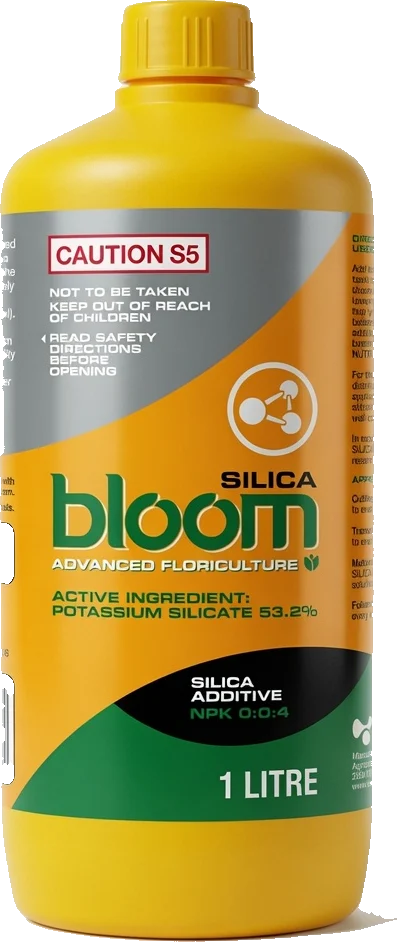
What happens once the label gets read
We’ve said this same thing about other products on our shelf when the records didn’t back up a number, and we’ll say it again here: the moment we have a genuinely legible Bloom Silica label in hand — real guaranteed analysis, real derived-from statement — we’ll publish it, dose rate and all, in ml/L, the way every other confirmed Bloom figure on this site is published. Until then, the honest post is this one: what silicon uptake actually is, why not every plant wants the same amount of it, and why a figure we can’t verify is worse than no figure at all.
Sources used in this post:
Kaur H, Greger M. “A Review on Si Uptake and Transport System.” Plants 8(4):81 (2019) — silicic acid uptake mechanism (Lsi1/Lsi2/Lsi6), accumulator-class tiers (low/intermediate/high), rice up to 10% Si, Poaceae/Cyperaceae >4%, Urticaceae/Cucurbitaceae 2–4%.
USDA AMS, “Aqueous Potassium Silicate: Crops, Technical Evaluation Report” (6 Jan 2014) — soluble-silicate pH stability window and solubility collapse below pH 9.
scienceinhydroponics.com, “Common questions about silicon in nutrient solutions” (Feb 2023) — the 20 ppm practical stability figure, explicitly cited here as industry guidance of unverified origin, not settled science.
Internal records: both Bloom Silica label PDFs on file are unreadable “EXAMPLE” placeholder artwork; no verified guaranteed analysis exists for this product in our records as of this writing.