
Ask ten growers why seaweed extract works, and most will say some version of the same thing: it’s full of natural plant hormones.
It’s one of the most repeated claims in the fertilizer aisle. It’s also, according to the industry’s own research body, not how seaweed extract actually works — and the real explanation is more interesting than the myth.
The threshold problem
Plant hormones only do anything at a minimum concentration — below that line, there isn’t enough of the signal for a plant’s receptors to respond to it. The European Biostimulants Industry Council (EBIC), the trade body for this entire product category, has published those minimums: roughly 100 nanomolar for auxin, 10 nanomolar for cytokinin, and 100 nanomolar for brassinosteroids. Below those numbers, a hormone is present but physiologically silent.
EBIC’s own conclusion, in their words: measured phytohormone levels in seaweed extracts are “far below the threshold levels required for physiological effects,” especially once you account for how little extract actually gets applied to a crop.
What the actual lab numbers look like
One of the most-studied commercial kelp extracts on the market has had its hormone content directly measured by independent researchers: brassinolide at roughly 385–793 picograms per milliliter — about 1.65 nanomolar at the high end of that range. That’s roughly 60 times below EBIC’s own 100 nM activity threshold, before the product is even diluted for use. Auxin readings from other commercial seaweed extracts land in a similar place: single digits to low tens of nanomolar, again under threshold.
This isn’t a knock on those products. It’s the industry’s own published data, and it points to the same conclusion for every kelp-based extract on the shelf, Bloom’s included: hormone dosing isn’t the mechanism.
So what is it actually doing?
Research on Ascophyllum nodosum extracts — the most studied seaweed input in agriculture — points to signalling, not dosing. Root-applied extract has been shown to switch on cytokinin-responsive genes in the plant’s own tissue rather than supplying a hormone payload directly. Separately, researchers have found that isolating individual fractions of seaweed extract (stripping out the polysaccharides to test hormones alone) consistently fails to reproduce the whole extract’s effect. The working theory in the literature: it’s the intact package — alginates, laminarin, fucoidan, trace ions, and whatever signalling compounds ride along with them — acting together, not any single ingredient acting alone.
What’s actually on Bloom’s label
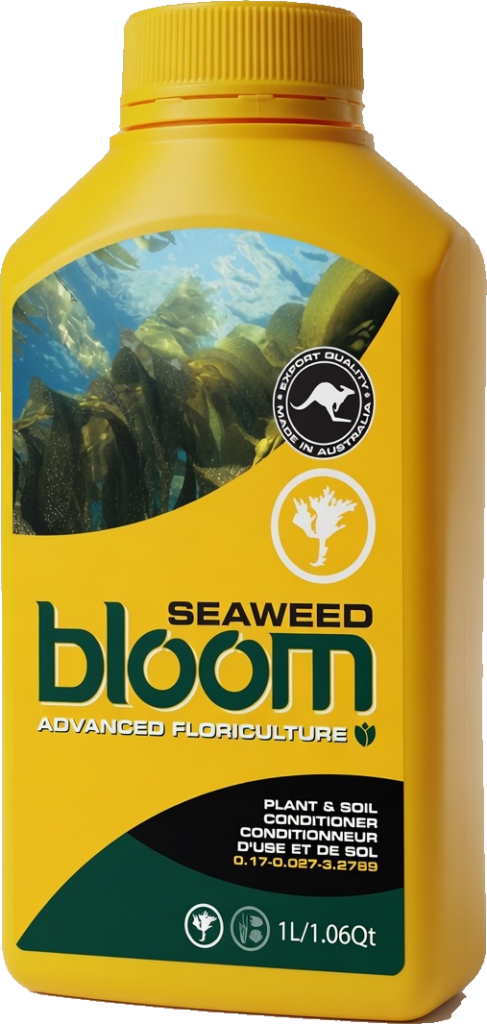
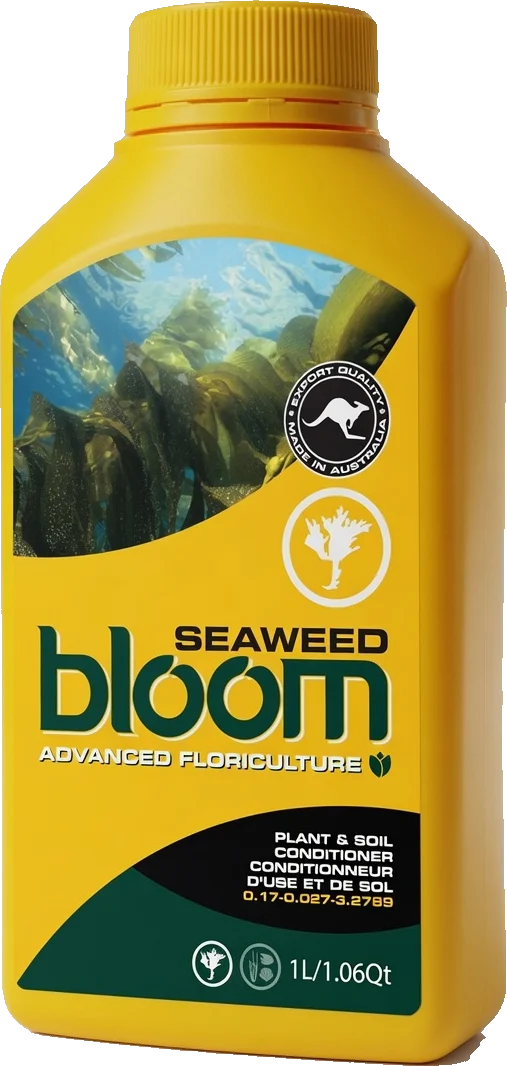
Bloom Seaweed’s guaranteed analysis is 0.17-0.027-3.278 — total nitrogen, available phosphate, soluble potash — derived from Durvillaea potatorum, dosed at 1 ml/L. That’s it. No hormone figure is declared, because no commercial seaweed label carries one — a US guaranteed analysis states plant nutrients, not phytohormone content.
We’re not going to tell you our bottle is the exception to everything above. It isn’t, and neither is anyone else’s.
Where a home kelp steep runs into different math
If you’re steeping your own kelp instead of buying a finished extract, the arithmetic that matters isn’t hormones — it’s sodium. Brown seaweed carries roughly 3–4% of its dry weight as sodium. Extension guidance for containers and ornamentals puts a safe irrigation-water ceiling at around 50 ppm sodium. Do the conversion and a little over a gram of dry seaweed per liter is already enough to spend that entire sodium budget — before accounting for any seawater still clinging to fresh or beach-cast material.
We can show you that math because you can weigh dry seaweed on a kitchen scale. We can’t show you a sodium number for a finished liquid extract, and neither can any competitor — it isn’t a figure any guaranteed analysis carries. That’s a genuine difference in dose form, not a hidden advantage either way.
The takeaway
Seaweed extract isn’t a hormone shot, and the industry’s own published research says so plainly. What it delivers is a package of polysaccharides, trace compounds, and signalling activity that the current science says works together, not a measurable dose of auxin or cytokinin. That’s a less dramatic story than “natural growth hormones” — but it’s the one backed by the data, and it’s the one we’re comfortable standing behind. Willow water gets the same “natural hormone” reputation, and the research holds up about as well there too.