
Science & Education
Seaweed Extract Isn’t a Hormone Shot — So Why Does It Work?
Ask most growers why seaweed extract helps a crop and you’ll get the same answer: “it’s full of plant hormones.” It’s the explanation on the back of a hundred bottles and a thousand forum posts. The industry’s own research body says it’s not true — and understanding why actually makes seaweed extract more useful, not less.
The Threshold Problem
The European Biostimulants Industry Council (EBIC) has published the concentration a hormone needs to reach before it can actually do anything to a plant: roughly 100 nanomolar for auxin, 10 nanomolar for cytokinin, and 100 nanomolar for brassinosteroids. EBIC’s own conclusion, in their words: hormone levels in seaweed extracts sit “far below the threshold levels required for physiological effects,” especially at normal field application rates.
This isn’t a knock on any one brand — it’s true across the category, and the numbers that prove it come from an independent, peer-reviewed assay of a competing commercial seaweed product. Researchers measured the brassinolide (a brassinosteroid) content of Kelpak®, a well-known Ecklonia maxima extract, directly from the bottle: 384.72 to 793.23 picograms per millilitre. Converted to the same units as EBIC’s threshold, that’s about 1.65 nanomolar at the high end — roughly 60 times below the concentration needed to trigger a hormone response, and that’s before a grower even dilutes it into a nutrient solution.
So if seaweed extract isn’t delivering a meaningful hormone dose, what is it actually doing?
It’s a signal, not a supplement
Researchers studying Ascophyllum nodosum extract on root systems found something more interesting than a hormone spike: applying the extract to roots activated the plant’s own cytokinin-signalling machinery. Specifically, it switched on a cytokinin-responsive gene promoter (ARR5) and induced three of the plant’s own hormone-synthesis genes (IPT3, IPT4, IPT5). The extract also measurably improved root architecture under combined phosphorus-deprivation and salinity stress in the same study. In plain terms: the extract isn’t handing the plant hormones from a bottle — it’s tapping the plant’s own internal signalling system and asking it to respond.
HOW THE SIGNAL TRAVELS
Mechanism shown for Ascophyllum nodosum extract on root systems (Shukla et al., 2019, Frontiers in Plant Science). Not a hormone dose — a signal that triggers the plant’s existing pathways.
Why the whole extract, and not a piece of it
This is the part that surprises people most: when researchers have tried to isolate the “active ingredient” in seaweed extract by breaking it into fractions, the fractions stop working. A 2021 review in Plants put it plainly — fractionating seaweed extract into its individual components “has not yielded favorable growth effects,” while “only the whole seaweed extracts have been consistently proven to be very effective.” The benefit comes from the combination — polysaccharides, polyphenols, trace signalling compounds, all acting together — not from any single molecule you could bottle on its own.
That’s also why results vary product to product and season to season more than growers expect. A 2018 study comparing six different commercial seaweed extracts on maize found root length improvements ranging from +15% to +81% against an untreated control, depending on the species and how the extract was processed. A separate large meta-analysis pooling 198 studies found that extraction method matters: some extraction routes produced statistically significant yield gains across trials, others didn’t move the needle at all. Seaweed extract isn’t one uniform thing — species, processing and formulation all shape what ends up in the bottle.
What this means at the feed schedule: seaweed extract works as a consistent, whole-plant biostimulant — not a fast-acting hormone trigger. Growers get the most out of it applied steadily, at label rate, as part of a full program rather than as an emergency fix reached for mid-stress.
Where Bloom Seaweed fits
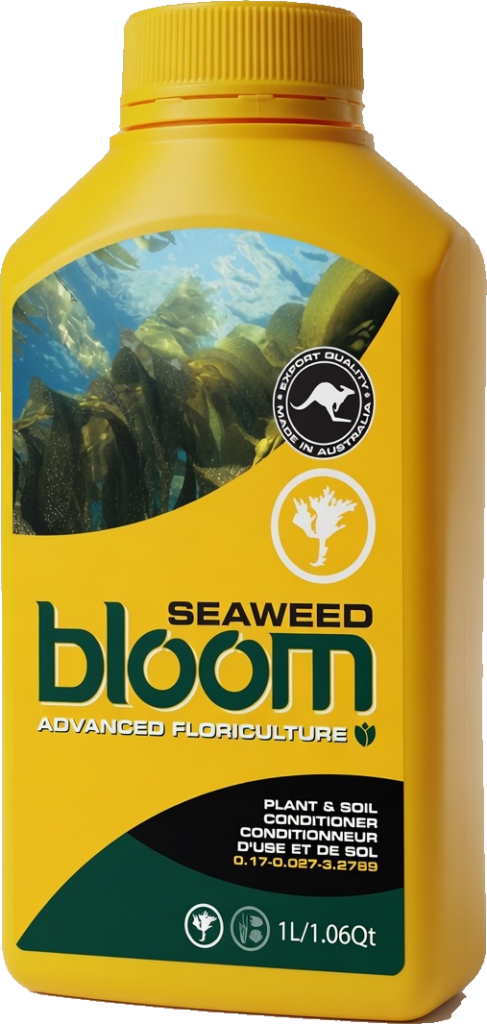
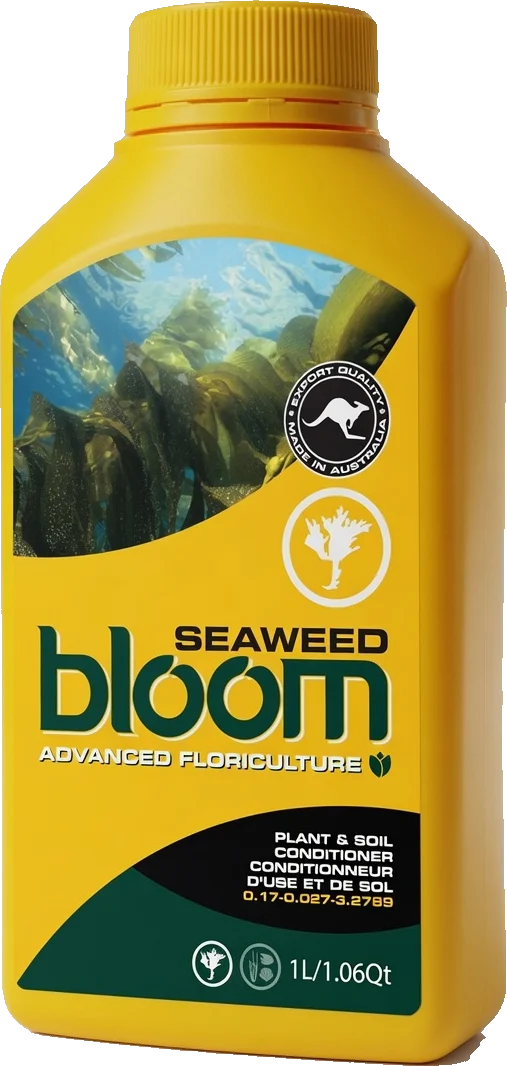
Bloom Seaweed is a straightforward, single-input extract — derived from Durvillaea potatorum, with a declared guaranteed analysis of 0.17% nitrogen, 0.027% available phosphate and 3.278% soluble potash, used at 1 ml per litre of nutrient solution. There’s no hormone figure on the label, and per the science above, there shouldn’t be — not from this product, and not from any other seaweed extract on the market at usable application rates. What’s on the label is what’s actually doing the work: a whole-extract input that feeds the plant’s existing systems, applied consistently as part of a full-cycle program.
Sources: European Biostimulants Industry Council, Recent insights into the mode of action of seaweed-based plant biostimulants (2023); Stirk et al., Journal of Applied Phycology 26(1):561–567 (2014); Shukla et al., Frontiers in Plant Science 10:655 (2019); Ali, Ramsubhag & Jayaraman, Plants 10(3):531 (2021); Ertani et al., Frontiers in Plant Science 9:428 (2018); Pérez-Oñate et al., Frontiers in Plant Science 17:1803269 (2026).