
What a Seaweed Extract Actually Turns On Inside a Stressed Root
Most of what gets said about seaweed extracts and roots stops at “it helps root development” without saying how. There’s a specific, published mechanism behind at least part of that effect, and it’s more interesting — and more relevant to a small, mineral-poor collection — than a vague growth-promoter story.
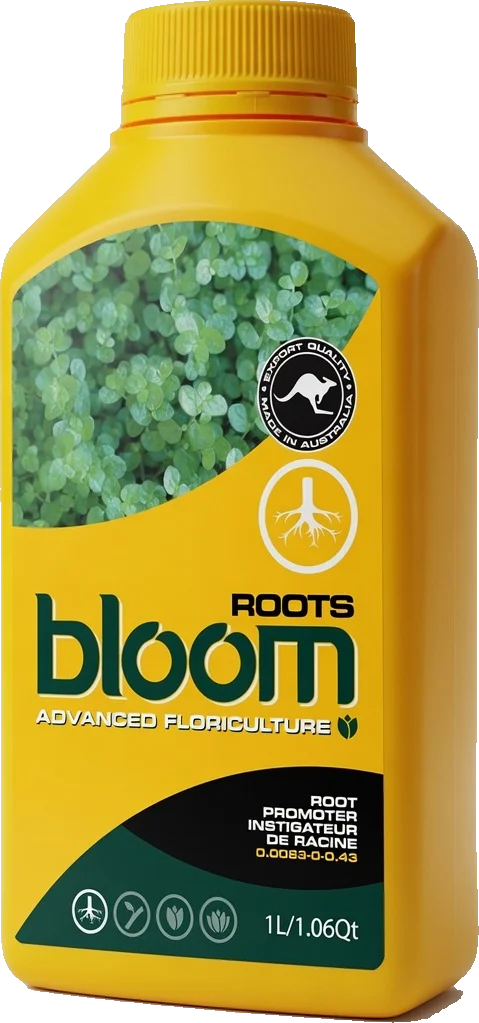
Please note: the study below is general seaweed-extract research on a different seaweed species. It was not a test of Bloom ROOTS or any Bloom product.
The mechanism, as published
A 2019 review in Frontiers in Plant Science traces what happens molecularly when a seaweed extract reaches roots under combined phosphate-deprivation and salinity stress — two stresses that show up together constantly in real growing. In the study, root-applied extract activated the cytokinin-responsive ARR5 promoter, and specifically induced three genes in the isopentenyltransferase family — IPT3, IPT4 and IPT5 — while two related genes in the same family, IPT2 and IPT9, were left unchanged. The extract also modulated two microRNAs, miR827 and miR2111b, both involved in how a plant senses and responds to low phosphate availability. Root architecture improved under that combined stress. This is gene-level signalling, not a hormone dose — the extract is switching on a plant’s own stress-response machinery rather than supplying growth hormone directly.
One honest caveat before going further: that study used Ascophyllum nodosum extract, a different species from Bloom ROOTS’ declared input, Durvillaea potatorum. The specific genes named above were measured for A. nodosum, not for Durvillaea, and the study is not a test of ROOTS or any Bloom product.
Why does a signalling explanation matter more than a hormone-dose one? Because the numbers don’t support a dose explanation at all. Measured hormone levels in seaweed extracts generally run far below the concentration needed to act as a direct growth-hormone supplement once diluted to a field or feed rate — a point this series has made with the actual threshold math in earlier posts. If the extract isn’t delivering hormone at an active dose, but root architecture still measurably changes, something else has to be doing the work. Gene induction — the plant’s own machinery being switched on — is that something else, and it’s a mechanistically different claim from “contains growth hormone,” one with real molecular evidence behind it rather than an assumption carried over from the words “plant extract.”
Why that combined stress is the normal condition for a small collection
Phosphate-deprivation and salinity together sound like a lab-specific test condition, but it’s close to the default state of a lot of specialty-niche growing. A terrarium or small epiphyte mount with a tight, mineral-poor substrate runs chronically phosphate-limited by design — there’s often little soil to begin with. A small, rarely-flushed container accumulates dissolved salts from every feed that goes in and nothing to carry them back out between doses. Put those two conditions in the same pot and you have, roughly, the exact stress combination the 2019 study was testing — not an edge case, but the everyday reality of growing something small in very little medium.
That’s a different framing from the usual one, where a biostimulant input gets reached for only after something visibly goes wrong. The gene-induction research suggests the relevant trigger is the stress condition itself — phosphate scarcity and accumulated salinity, both of which a tight, unflushed container produces quietly and continuously, well before a grower notices a symptom worth responding to.
What ROOTS actually declares
ROOTS’ guaranteed analysis is 0.0083% nitrogen, 0.43% soluble potash, derived from Durvillaea potatorum seaplant extract, with 0.075% humic acid (from Leonardite) and 0.054% thiamine hydrochloride declared as non-plant-food ingredients. Those are small numbers by design — this isn’t a bulk feed, it’s a low-rate kelp extract, humic acid and B1 input. The dose for a small, tight container is the same one on the label for everything else: 0.5 ml/L as a feed, 1 ml/L as a dip.
None of this is a claim about ROOTS. ROOTS hasn’t been tested for gene expression, and the study above used a different seaweed species. It’s general seaweed-extract research, shown here as background.