
What “Finishing” Means When the Finish Line Isn’t Harvest
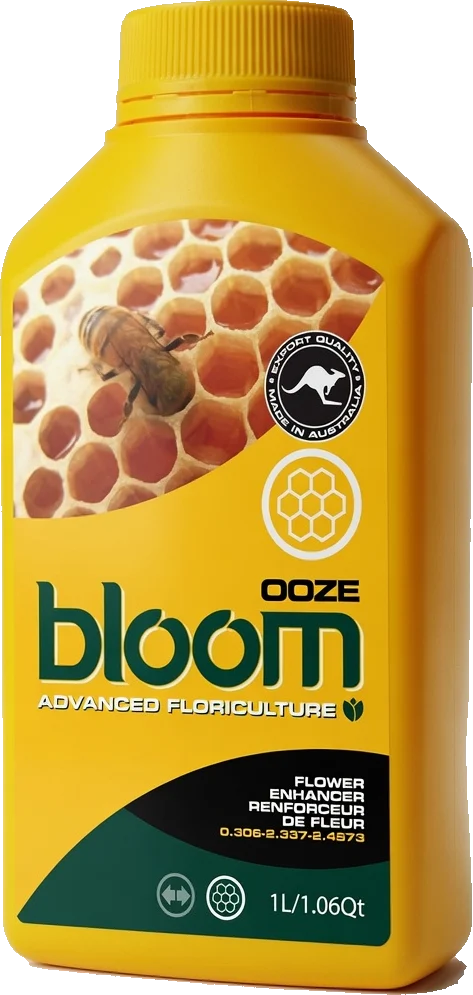
Most of what gets written about Ooze and Phat is written for cannabis growers, because that’s where Bloom’s own trial data was collected. But the mechanism these two products are built around — a finishing-stage layer added on top of an existing base program, timed to the last stretch before the crop is done — isn’t a cannabis-specific idea. Cut flower growers and ornamental producers run the exact same kind of program, with a base feed carrying the plant through growth and a finishing adjustment in the last weeks before the crop reaches its own version of “done.” The crop and the metric are different. The structure isn’t. It’s the same base-plus-booster logic behind what ROOTS brings to a cutting bench earlier in propagation — a declared input layered onto an unchanged program, at a different stage of the same cycle.
Where the data actually comes from
Bloom’s FROST trial, verified independently by SC Labs, measured what Ooze and Phat did when layered onto an existing program in the finishing stretch — and it measured terpenes, because the growers in that trial were producing cannabis flower. The two samples tested came in at 1.94% and 1.95% total terpenes, with myrcene running 4.2 times higher and linalool 2.1 times higher than the comparison baseline. That’s a real, lab-verified result, and it’s the only trial data Bloom has behind this pairing.
None of that transfers directly to a cut flower crop — terpene content isn’t the thing a floriculture buyer is paying for. What transfers is the structural idea the trial demonstrated: a finishing-stage layer, timed to the last stretch of the cycle, measurably changed an outcome that mattered to that crop. For an ornamental grower, the outcomes that matter are bloom color saturation, petal count and density, and how long a stem holds up once it’s cut — vase life, in the trade’s own language.
The honest gap, stated plainly
Bloom has not run a replicated vase-life trial on cut flowers with Ooze and Phat. That trial doesn’t exist yet. What exists is the FROST data on a different crop and a different metric, and the same base-plus-finishing-layer structure that cut flower growers already use with other inputs. Anyone telling an ornamental grower this pairing is proven for vase life would be stating something Bloom hasn’t measured. What’s defensible is narrower: the mechanism — stacking a finishing layer onto an unchanged base program in the last stretch before the crop is done — has verified lab data behind it in one crop, and the same structure is worth testing in another.
Why this is a seasonal, not a permanent, conversation
Ooze and Phat move through warehouse stock in cycles tied to cannabis finishing windows, which don’t line up with a cut flower operation’s own seasonal rhythm. That mismatch is exactly why it’s worth floriculture growers hearing about this pairing now, outside the cannabis finishing calendar — there’s current availability, and a finishing-stage product line that already has verified trial data behind its core mechanism in one crop is worth a small-scale trial in another, on a grower’s own timeline rather than someone else’s harvest schedule.
It also means a cut flower or greenhouse ornamental operation isn’t competing with the cannabis finishing calendar for attention or supply the way it would if everyone needed the same product in the same six-week window. A finishing layer that’s seasonal for one crop can be run almost any time by a grower working a different crop’s calendar, which is a genuinely different proposition than most “limited window” marketing — it’s just a mismatch in timing that happens to work in a floriculture grower’s favor.
What we’d actually recommend: run it on a portion of a bloom cycle, track vase life and color against an untreated control the way you’d track any new input, and treat the FROST terpene data as proof the mechanism does something measurable — not as proof of what it’ll do for your crop specifically.
What we’re not saying
We’re not saying Ooze and Phat will extend vase life, improve color, or outperform anything a floriculture grower already runs. We’re saying the structural idea behind the FROST trial — a finishing layer, timed to the last stretch, stacked on an unchanged base — produced a measured, lab-verified change in one crop, and that’s worth a careful, small-scale look in another, with your own control group deciding the answer rather than ours.