
A Bonsai Pot Never Gets Bigger: What That Means for Humic Acid and Seaplant Extract
Almost every growing system eventually gets more root room — a plant goes up a container size, a bed gets amended, a field gets rotated. Bonsai culture is built around the opposite rule. The pot stays small on purpose, permanently, and the roots get pruned back on a schedule specifically to keep them from filling it. That single constraint — a fixed, small volume of substrate that never expands to match the plant above it — changes what actually matters in anything added to the soil, long before it changes anything about dose or timing.
Why a small, fixed volume changes the question
In an open bed or a large container, a nutrient or mineral that isn’t immediately used by the plant still has somewhere to go — it can bind to a large pool of organic matter and clay, wait in reserve, and get taken up later. A bonsai substrate doesn’t have that reserve. The total volume of growing medium is small and it stays small for years, so whatever buffering and holding capacity the mix has is mostly whatever was built into it when it was potted, plus whatever a grower adds along the way. That’s the specific role humic acid plays wherever it’s used in agronomy generally: as an organic colloid, it carries exchange sites that hold onto nutrient ions and release them gradually rather than letting them wash straight through on the next watering — a function that matters more, not less, in a growing medium that can’t simply get bigger to compensate.
What’s actually declared in the bottle
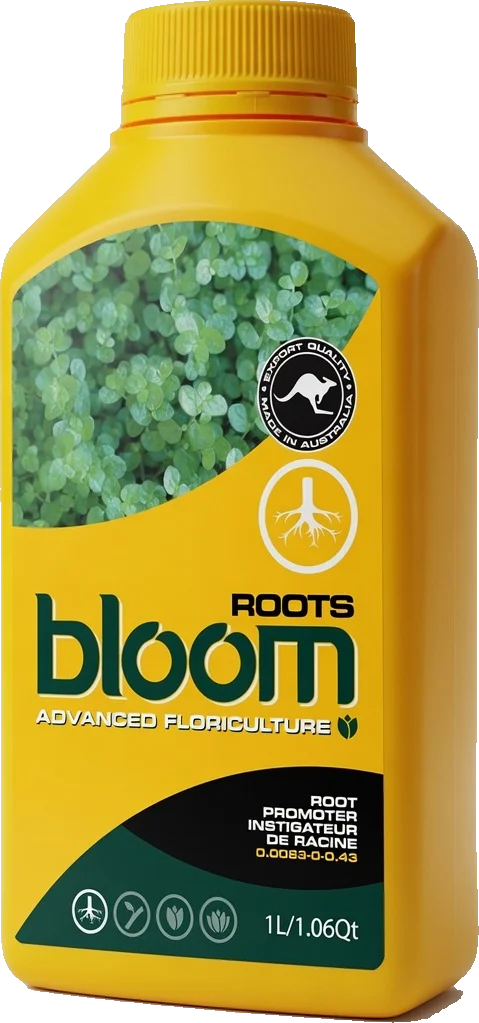
Bloom Humate’s label declares 3.12% soluble potash, derived from potassium hydroxide, alongside 10% humic acid sourced from Leonardite. Bloom ROOTS declares a much lighter guaranteed analysis — 0.0083% nitrogen and 0.43% soluble potash, derived from Durvillaea potatorum seaplant extract — with 0.075% humic acid and 0.054% thiamine hydrochloride as non-plant-food ingredients. Those are two different products built for two different jobs: Humate carries a meaningful concentration of humic acid for substrate conditioning, while ROOTS is a light seaplant-extract input with a much smaller humic fraction riding along.
What this doesn’t mean
None of this is a claim that humic acid or seaplant extract stimulates root growth, triggers a hormonal response, or does anything beyond what’s declared on the label. The honest framing, consistent with what the wider seaweed-extract research shows across the category, is narrower: these are nutrient and biostimulant inputs with a declared composition, and the question worth asking in a bonsai context isn’t “does this grow more root” — it’s “what is this doing in a substrate that has nowhere to hide an excess or make up a shortfall.” That’s a buffering and nutrient-retention question, not a growth-promotion one, and it’s the question a fixed-volume pot actually raises. It’s the same honest, declared-composition-only framing behind what a SeaFuel trial on Phalaenopsis orchids actually showed — another small-volume, specialty-niche crop where the result was reported plainly rather than oversold.
Rate, for a pot this size
Bloom’s feed chart puts ROOTS at 0.5 ml/L for routine feeding, with a 1 ml/L dip rate used separately. Humate’s rate is 2.5 ml/L of fertilizer solution. Neither of those numbers was written with bonsai pot volumes in mind, so the practical adjustment is the same one any grower makes moving between container sizes: keep the concentration the chart specifies, and simply mix less total solution for a smaller pot rather than guessing at a different ratio.
The bonsai-specific takeaway: a substrate that never gets bigger puts more weight on whatever’s doing the buffering and holding work in it. Humic acid is one of the more studied inputs for exactly that role in agronomy generally — not because it makes anything grow faster, but because of what it does for a small pool of growing medium that has no reserve to fall back on.
A note for anyone trying this for the first time
If you’re bringing either of these into a bonsai routine for the first time, start at the lighter end of what the feed chart allows and watch one repotting cycle before adjusting further. A fixed-volume substrate punishes overcorrection faster than an open bed does, in either direction — which is really just the same lesson the rest of this piece has been making, applied to a single watering can.