
Steeping willow cuttings in water and using the result to help root clones is one of the oldest DIY moves in cultivation, and it’s still repeated constantly in grow forums as a free, natural source of rooting hormone. The actual research on willow doesn’t back that framing, and it’s worth walking through exactly why — because the honest version of the story also tells you something useful about what’s actually declared on a product like Roots.
What’s actually in willow bark
Willow bark’s characteristic compounds are salicin and its relatives — salicortin, 2′-O-acetylsalicortin, tremulacin — not auxin, and not free salicylic acid either. Free salicylic acid is a degradation product of these salicylates, something that forms after metabolism, not a compound sitting in the bark ready to go. A European Medicines Agency assessment of Salix species puts it plainly: the characteristic constituents are salicin derivatives, with salicylic acid showing up downstream of them.
As for actual plant hormone content: a 2025 LC-MS/MS analysis of willow shoot extract measured IAA — the auxin most associated with rooting — at just 0.3 to 3.5 nanograms per millilitre, the lowest of every compound class the researchers checked, against salicin readings up to 10,393 ng/mL in the same extract. No IBA — the auxin actually used in commercial rooting products — was reported at all. The authors’ own conclusion was that any hormones present are at low concentration and may degrade further during extraction or storage.
0.3–3.5 ng/mL
Even the species you grab matters
If willow water did carry a useful salicin dose, the species at the end of your clippers would decide whether you got one. The EMA’s assessment lists total salicin content ranging from under 1% up past 8% depending on species — Salix purpurea runs 4-8%, Salix daphnoides over 4% — while Salix alba, the common weeping willow most people actually have access to, sits at roughly 0.5%, the lowest figure on the list. A separate study of 92 willow clones found total phenolic content varying roughly 25-fold between individual clones of the same species, grown at the same site. “Willow” isn’t one input; it’s dozens of them, most unlabeled.
And more wouldn’t necessarily help anyway. Salicylic acid’s own effect on rooting is biphasic — a 2022 review in the International Journal of Molecular Sciences found low concentrations (roughly 3 to 600 micromolar, depending on the study) increased adventitious rooting, while higher concentrations suppressed it, including reducing lateral root number. An uncalibrated steep from an unidentified species has no way to land in that window reliably — it could just as easily land past it.
EMA/HMPC 2017; Zombori et al., Frontiers in Plant Science 16:1650824 (2025); Bloom Roots label artwork.
Where the “kelp and willow both work” idea actually comes from
Seaweed extracts get lumped into the same “natural rooting hormone” conversation as willow water, and the research there tells a similar story, just with a different mechanism. The best quantitative root data on seaweed extracts comes from a 2018 maize trial comparing six commercial products: a Laminaria extract gave +15% root length over control, while the best Ascophyllum nodosum extract in the same experiment gave +81% — a huge spread between products marketed under the same “seaweed extract” label. The mechanism researchers now point to isn’t a hormone dose at all; it’s signalling — seaweed extracts have been shown to switch on cytokinin-responsive genes in roots, rather than simply delivering auxin the way a synthetic rooting compound does. Reported IAA content across different seaweed products has varied by orders of magnitude between studies, which is itself a sign that “hormone content” isn’t really what’s driving the result. That product-to-product variability isn’t limited to hormone content either — see why “seaweed extract” isn’t one thing for just how wide the spread gets on the compounds that do matter.
What’s declared on Roots, for comparison
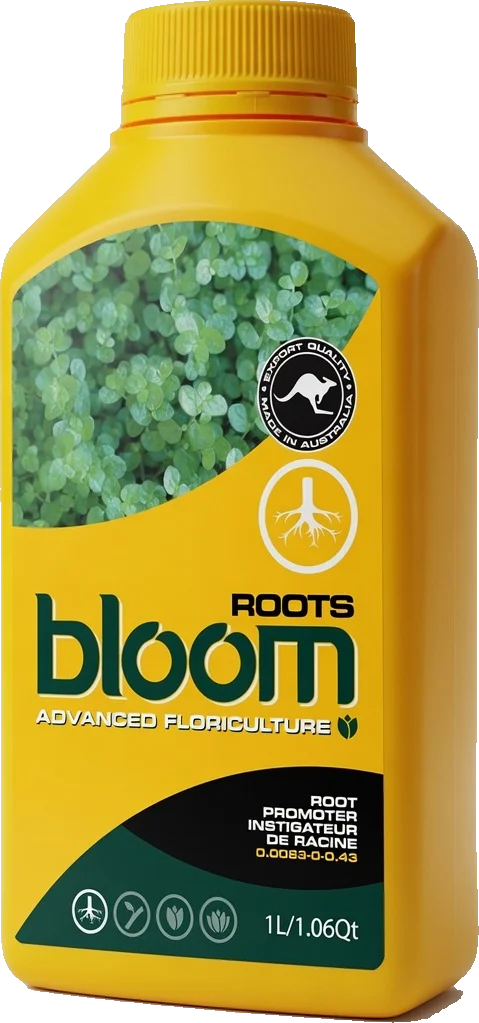
We’re not going to turn this into a hormone sales pitch for Roots, because Roots doesn’t declare a hormone either — its guaranteed analysis is 0.0083-0-0.43, derived from Durvillaea potatorum seaplant extract, with 0.075% humic acid and 0.054% thiamine hydrochloride as non-plant-food declarations. The rate is 0.5 ml/L as a regular feed addition, or 1 ml/L used as a dip. No auxin figure is on that label, and we’re not printing one that isn’t.
The actual difference between the two isn’t “hormone content.” It’s that one is a measured, fixed-concentration input with a declared source, and the other is a home steep of an unidentified species at an unknown concentration, from a plant whose own rooting-relevant compound can vary 25-fold between individual trees. That’s a fair thing to know before you decide what’s actually going into your reservoir.
Sources: Committee on Herbal Medicinal Products, EMA/HMPC/80628/2016 (2017); Zombori et al., Frontiers in Plant Science 16:1650824 (2025); Förster et al., Frontiers in Plant Science 12:579820 (2021); Zemlyanskaya et al., Int. J. Mol. Sci. 23(4):2228 (2022). Roots figures per Bloom ROOTS label artwork.