Every propagation-station post on the internet tells you to steep willow twigs for free rooting hormone, drop a pothos cutting into a jar of LECA and your diluted willow tea, and wait. Almost none of them ask the one question that actually decides whether that tea does anything at all: which willow is it?
The Jar Doesn’t Know What Tree It Came From
Willow’s rooting reputation rests on a group of bark compounds called salicin and its relatives — salicortin, 2′-O-acetylsalicortin, tremulacin. Not free salicylic acid (that’s a breakdown product, not something sitting in the bark waiting for you), and not auxin. The actual rooting hormone most growers assume they’re brewing simply isn’t the thing willow bark is documented to contain in any quantity.
But set that aside for a second, because there’s a problem that comes before it. The European Medicines Agency’s own assessment of medicinal willow bark found total salicin content running from about 0.5% in Salix alba — the common weeping willow most people actually have access to — up to 4–8% in Salix purpurea and over 4% in Salix daphnoides. That’s a roughly 10–16x spread before you’ve even gotten to the jar.
And species is only the first layer. A chemoprofiling study across 92 willow clones found total bark phenolics ranging from 1.70 to 42.31 mg per gram dry weight — a roughly 25-fold spread between individual trees of the same species, grown on the same site. One clone of Salix viminalis had essentially no salicortin at all. The researchers’ own conclusion was blunt: “high intraspecific variability of bark phenolics of Salix cultivated in the same site.” Two willows on the same street can hand you wildly different jars of tea.
Even If You Had the Right Tree, the Chemistry Still Isn’t What People Assume
Suppose you did somehow know your tree’s species and clone. You’d still be dealing with a compound that behaves nothing like a dial you can turn up. Research on salicylic acid’s effect on adventitious rooting describes it as biphasic: low concentrations in a narrow window promote root formation, and concentrations above that window suppress it — including reducing lateral root number. There’s no “more tea, more roots.” There’s a window, and nobody steeping twigs in a kitchen jar has a way to know if they’ve hit it, missed it low, or blown straight past it.
The honest chain, in order: unknown species → unknown clone → unknown salicin concentration → a compound that isn’t even the active one yet → a metabolic step to become salicylic acid → a dose-response curve that punishes overshooting as much as undershooting. That’s five unknowns stacked on top of each other before the first root appears.
What ROOTS Does Instead
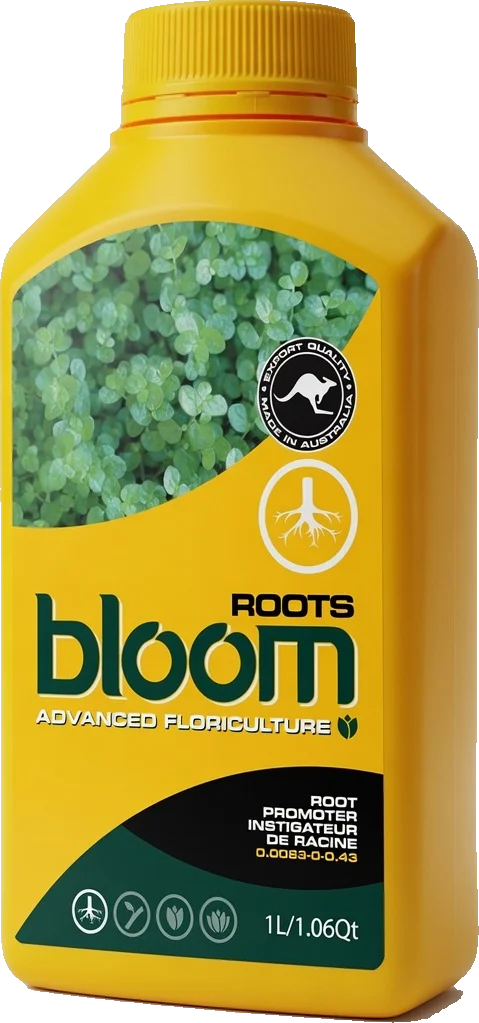
ROOTS doesn’t try to be a hormone in a bottle, because we don’t declare one. The label is 0.0083% Total Nitrogen, 0.43% Soluble Potash, derived from Durvillaea potatorum seaplant extract, with 0.075% humic acid (from Leonardite) and 0.054% thiamine hydrochloride (B1) listed as non-plant-food ingredients. No salicin, no willow, no guesswork about which tree it came from. Rate is 0.5 ml/L in a reservoir, or 1 ml/L as a direct dip — a number that doesn’t change depending on which street corner you cut your twig from.
For a cutting sitting in a few hundred milliliters of water in a net pot full of clay pebbles, that consistency matters more than it would in open soil. There’s no buffering volume to absorb a bad guess. If you want to experiment with willow water anyway, that’s a legitimate thing to try — just go in knowing you don’t actually know what’s in your jar, and that “more concentrated” is not obviously the safer direction to guess.
Why This Matters More in LECA Than in a Pot of Soil
A cutting rooting in soil has a buffer most semi-hydro growers don’t think about: organic matter, cation exchange, microbial activity, and a volume of medium that’s hard to overdose in any meaningful way with a kitchen tea. A passive LECA reservoir has almost none of that. The clay pebbles are inert. Whatever’s in the water is the whole chemical environment the roots are sitting in, undiluted by anything else, for as long as the water sits there between top-ups. That’s exactly the setup where an unknown-concentration DIY input does the most damage if you guessed wrong, and the least good if you guessed right by accident.
None of this means willow water is dangerous in the way an overdosed salt fertilizer can be — the concentrations involved are generally low, and plenty of growers have used it for years without incident. It means the upside is also unpredictable, and unpredictable isn’t a complaint you can level at a water jar with no label. A declared-ingredient product doesn’t need you to guess which tree it came from, because there wasn’t a tree involved in the first place.