
The Jar of Willow Water on Your Windowsill Isn’t the Same Jar It Was Last Week
We’ve written about which willow species has more salicin, and about the dose where that compound helps rooting instead of hurting it. There’s a third variable gardeners rarely account for: time on the shelf.
Soaking willow cuttings in water to make a home rooting aid is one of the oldest tricks in the garden, and we’ve spent two earlier posts taking it seriously — looking at how much salicin different willow species actually carry (anywhere from 0.5% in common weeping willow up to 8%+ in other species), and at why salicylic acid’s effect on rooting is biphasic, meaning a little helps and too much actively suppresses root formation. Both of those posts treated “fresh willow water” as a fixed thing you could reason about once you controlled for species and dose.
A more recent analysis of willow shoot extracts adds a detail that complicates that picture further: the plant hormones in the extract are already present at very low levels to begin with — measured auxin (IAA) came in at just 0.3 to 3.5 nanograms per milliliter, the lowest of every compound class the researchers measured, compared to salicin at levels as high as 10,393 nanograms per milliliter and total flavonoids up to 119,155 nanograms per milliliter. And the researchers noted something gardeners rarely plan for: those hormone compounds “may degrade during extraction or storing procedure.”
What this means for the jar on your counter
Most home willow-water instructions tell you to cut a handful of young shoots, soak them for a day or two, then keep the liquid in the fridge for later use — sometimes for weeks. That convenience is exactly where this finding bites. If the already-small hormone fraction degrades over time in storage, then a jar used on day one and the same jar used on day fourteen aren’t delivering the same thing, even though the color, smell, and recipe are identical. There’s no visual cue for this kind of change — unlike a ferment going sour, a degrading hormone fraction gives you no warning.
To be precise about what is and isn’t established here: there’s no published study measuring exactly how fast willow water degrades on a kitchen counter, at what temperature, or in what container. What’s established is the starting point — an already very small hormone fraction — and the researchers’ own caution that storage is a degradation risk for that fraction. The chart above is illustrative of that shape, not a measured curve. We’d rather say that plainly than imply a precision we don’t have.
Where a bottled input is built differently
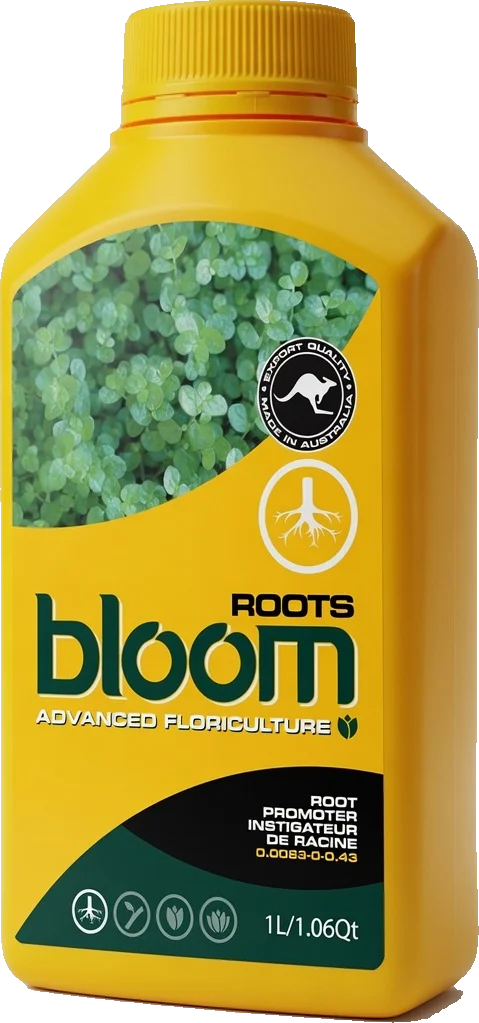
This is really a freshness problem, and freshness problems are exactly what a sealed, manufactured product is built to avoid. Bloom ROOTS doesn’t rely on hormone content at all — its label declares Durvillaea potatorum seaplant extract, 0.075% Humic Acid, and 0.054% Thiamine Hydrochloride, used at 0.5 ml/L (1 ml/L as a dip). Because none of those are the fragile, low-concentration hormone fraction this willow research is worried about, the bottle you open in week three is the same formulation as the bottle you opened on day one. That’s not a knock on trying willow water in the garden — it’s a reason to use it fresh, in small batches, rather than brewing a big jar and drawing it down over a month.
There’s a practical takeaway hiding in this, even without a decay curve to point to. If the hormone fraction is both tiny and potentially shrinking, the lowest-risk way to use willow water is the way most instructions don’t describe: brew a small batch sized to what you’ll use within a day or two, rather than a large jar meant to last the season. That doesn’t require knowing the exact degradation rate — it just avoids betting a cutting’s success on a jar that’s been sitting in the fridge since the last round of pruning.
It’s also worth separating this from the ferment-safety question we’ve covered elsewhere on this blog, which is about bacterial risk in home-brewed inputs generally. This is a different mechanism entirely — not spoilage, but a slow loss of an already-minor active fraction in a liquid that can still look, smell, and behave exactly the same. Two different reasons to treat a homemade brew as something with a shelf life, even when nothing visible tells you so.
Sources: Zombori Z, Szalai G, Hamow KÁ, et al. Bioactive compounds in extracts from short rotation willow shoots. Frontiers in Plant Science 16:1650824 (2025). Bloom ROOTS label artwork (verified guaranteed analysis and derived-from statement).