
Fish-based inputs show up across cut-flower and ornamental propagation benches in a few different forms — emulsion, hydrolysate, home-fermented fish amino acid — and growers tend to treat them as more or less interchangeable because they all come from the same raw material. The processing route is actually the whole story here, and it’s worth understanding before deciding what’s going into a propagation feed.
Two different processes, two different products
Extension literature draws a clean line here. Fish emulsion is made from fish waste that’s been heat and acid processed — the USDA’s own technical evaluation describes it as by-products “cooked at temperatures in excess of 180°F” to control bacterial activity. Fish hydrolysate instead uses enzymes to break the material down, at much lower temperatures, with the oil skimmed off along the way. Acid-route products (sometimes called fish silage) are acidified — with sulfuric, citric or phosphoric acid in regulated organic production — down to roughly pH 3.5, which stabilizes the material without heat.
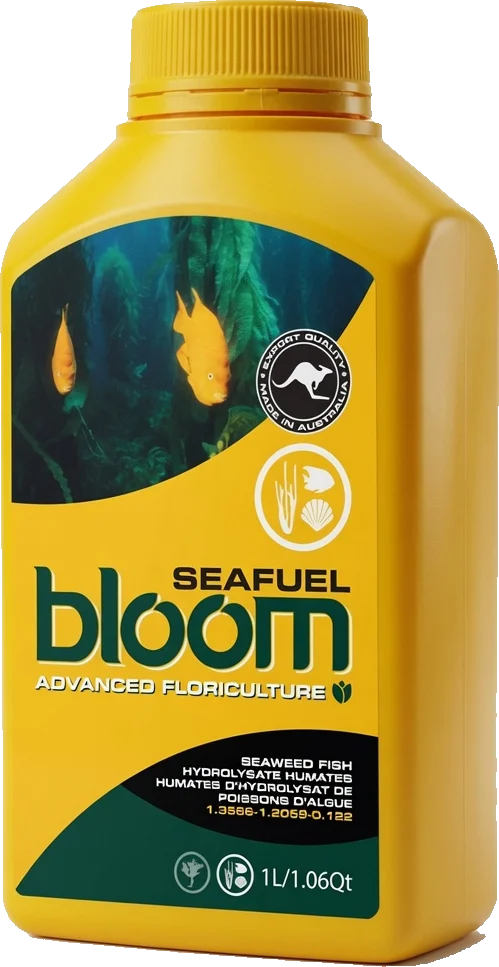
Bloom’s own Seafuel label is specific about which route it uses: it declares Durvillaea potatorum (seaplant extract) and Hydrolized Blue Fin Tuna (Fish Hydrolysate) as its derived-from ingredients, plus a non-plant-food declaration of 0.075% humic acid from Leonardite. The label’s own descriptor is “Seaweed and Humates.” Its safety data sheet lists a pH of 4-5. That’s a hydrolysate framing, and it’s backed by what’s actually printed on the artwork — not a marketing gloss on top of it.
Why the route changes what survives
The reason this distinction matters isn’t cosmetic. A 2017 review in Frontiers in Plant Science lays out the chemistry plainly: during acid hydrolysis, amino acids including tryptophan, cysteine, serine and threonine are partially or fully destroyed, and many of the amino acids that survive get converted from their natural L-form into the D-form — a process called racemization — which strips them of their biological activity in the plant. Enzymatic hydrolysis avoids both problems, retaining a higher ratio of intact peptides to free amino acids, and keeping those amino acids in their usable L-form.
Colla et al., Frontiers in Plant Science 8:2202 (2017); USDA AMS National Organic Program TER, Liquid Fish Products (2006).
What this means on the bench
For a cut-flower or ornamental propagation program, amino-acid and peptide inputs are typically used around rooting and early establishment, where plant tissue is doing active cell signaling and nutrient uptake is complexed through those same peptides. We’re not citing a vase-life or rooting trial for Seafuel here — none exists in our records for this specific metric, and we’re not going to imply one does. What we can say with confidence is that the declared process on the label is the one the published research associates with intact, usable amino acids, rather than the route known to destroy and racemize a share of them.
This also explains why a home-fermented fish amino acid brew and a labeled hydrolysate aren’t really comparable inputs, even when both start from similar raw fish. A home ferment’s safety and consistency depend entirely on getting the pH low enough, fast enough, to control bacterial activity — commonly cited around pH 4 or below — and most home methods have no way to verify that number, relying on smell instead. A declared hydrolysate route and a declared pH on a safety data sheet are two separate confirmations a bench input can give you that a bucket in the corner of a greenhouse can’t. The same living-vs-declared distinction shows up in compost tea’s own biology, where a brew’s effect depends on what’s still alive in it, batch to batch, rather than on a fixed, declared number.
Raw material matters here too. The USDA’s own evaluation notes that composition varies depending on the type of process, the species of fish, and the acid used — a whole fatty fish like a tuna behaves differently under hydrolysis than a white-fish offal stream would, with more oil and protein and less water and ash in the starting material. That’s part of why “fish-based input” isn’t a single category any more than “seaweed extract” is: the species, the part of the fish used, and the processing route all move the final product in different directions, and a label that names all three — species, process, and pH — is giving you more to go on than a typical “typical analysis” sheet does.
None of this is a claim about yield or bloom quality — it’s a claim about chemistry, and it’s one we can back all the way to the label.
Sources: Colla et al., “Biostimulant action of protein hydrolysates,” Frontiers in Plant Science 8:2202 (2017); USDA Agricultural Marketing Service, National Organic Program, Technical Evaluation Report: Liquid Fish Products — Crops (2006); Colorado State University Extension, CMG GardenNotes #234. Ingredient and pH figures per Bloom SEAFUEL label artwork and MSDS.