
There’s a pitch that shows up constantly in input-efficiency and regenerative-ag circles: a single product that claims to carry dozens of trace elements, as if more entries on an ingredient list automatically means more value per acre. It’s an appealing pitch, and it’s mostly wrong. The published research on beneficial plant elements says the opposite — the elements that actually do something measurable only do it at very specific, deliberate rates, and burying them in a bulk blend is usually the least efficient way to deliver them.
Two elements, two very different rates
Take cobalt. It’s genuinely required — not just “beneficial” — for legume nitrogen fixation, because rhizobial bacteria depend on cobalt-containing cobalamin to run the enzymes that make fixation work. But the rate where it matters is tiny: published corrective applications run from about 1.8 to 145.6 grams per hectare. That’s a few grams across a hectare, not a bulk ingredient.
Silicon sits at the opposite end of the scale entirely. It’s genuinely useful for rice, wheat, corn, sugarcane and several other responsive crops — better drought tolerance, better disease resistance — but getting there takes real tonnage. Field trials use calcium silicate at one to six tons per acre, and the benefit only shows up once soil silicon testing clears roughly 40 mg/L (most field soils sit closer to 14 mg/L). A product claiming to deliver meaningful silicon at a few quarts an acre is making a claim the agronomy doesn’t support.
Rate ranges from published agronomy sources — not to scale by design, to make the point visible.
What this means for a blend product
A single input that’s supposed to deliver both a gram-scale micronutrient and a ton-scale amendment at the same quart-per-acre rate can’t actually be dosing either one correctly — the math doesn’t close. That’s not a knock on any one brand; it’s a structural problem with marketing “full spectrum” as the main selling point. The honest takeaway for a grower is the opposite of what the pitch implies: broad coverage and precise delivery trade off against each other, and the research on beneficial elements keeps landing on precision, not breadth.
It’s also worth being clear about where the evidence is genuinely thin. Several other elements sometimes lumped into “beneficial mineral” claims — vanadium, titanium, aluminum — have weak or outright contradictory support in the review literature. Sodium shows a weak-to-moderate benefit, and only in halophytes and drought-stressed xerophytes specifically. Lumping those together with cobalt and silicon in one pitch is exactly the kind of imprecision the rate data argues against.
0 – 0 – 3.12
Why Bloom builds boosters this way
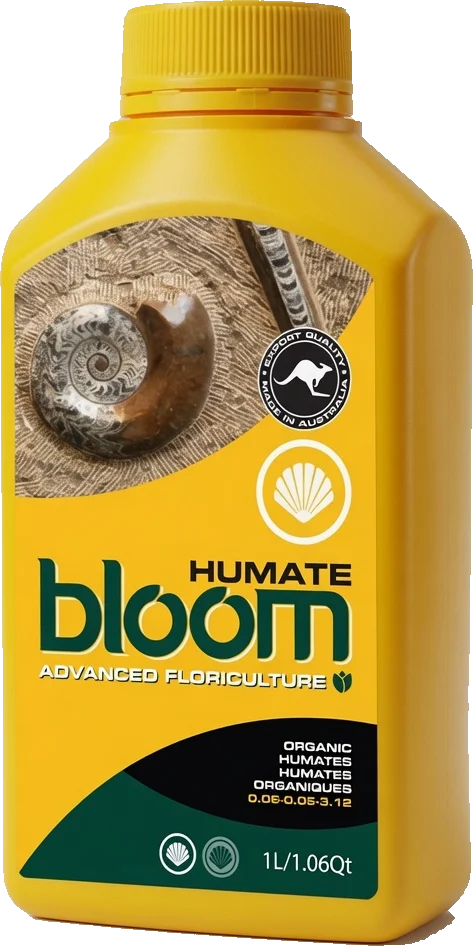
This is the reasoning behind keeping Bloom’s booster line as single-purpose, individually labeled products rather than one blended catch-all. Humate carries one declared potash figure and one declared humic-acid percentage, both on the bottle, both run through CDFA’s registration review process. Seaweed carries its own single declared input — Durvillaea potatorum — at 0.17-0.027-3.278, nothing else on the label. Neither product claims to be everything at once, and that’s deliberate: a grower running real acreage can match a specific, labeled input to a specific agronomic question, instead of trusting that a long ingredient panel is quietly dosing each item correctly.
None of this is an argument against trace elements generally — cobalt and silicon are both real, both supported by solid agronomy. It’s an argument for matching the delivery method to the rate the element actually needs, which a labeled, single-purpose product can do in a way a bulk blend structurally can’t.
It’s a useful filter to apply to any input before it goes in a tank: ask what rate the active ingredient actually needs to work, and ask whether the product’s own stated application rate is even in the right order of magnitude for that number. A gram-per-hectare element dosed at a bulk-blend rate is almost certainly under-dosed into irrelevance; a ton-per-acre amendment dosed at a quart-per-acre rate is almost certainly a rounding error on the field. Neither failure shows up on the label — it only shows up in whether the claimed benefit actually materializes, which is exactly why the rate numbers matter more than the ingredient list. For a field-scale look at how one declared, single-ingredient input performs, see our breakdown of the largest seaweed-extract meta-analysis ever run.
Sources: Hu X, Wei X, Ling J, Chen J. “Cobalt: An Essential Micronutrient for Plant Growth?” Frontiers in Plant Science 12:768523 (2021). Heckman J. “Silicon Needs of Soils and Crops.” Fact Sheet FS1278, Rutgers New Jersey Agricultural Experiment Station (2017). Singhal RK, et al. “Beneficial elements: New players in improving nutrient use efficiency and abiotic stress tolerance.” Plant Growth Regulation 100:237–265 (2023). Guaranteed analysis per Bloom Humate label artwork.