
When a greenhouse crop starts showing tip burn or marginal necrosis on new growth — a calcium deficiency symptom — the instinct is almost always the same: add more calcium to the tank. It’s a reasonable instinct, and it’s also not how calcium actually gets where it’s needed. The research on this is uncomfortable for anyone selling a cal-mag product, including us, and we’d rather print it straight than oversell what a bottle can do on its own.
Supply and delivery are two different problems
A 2026 study from Langenfeld & Bugbee found that calcium could not be forced into the crop by raising the calcium concentration at the root zone. That specific result was measured on lettuce, not on ornamentals generally, so we’re not stretching it into a universal guarantee — but the mechanism behind it is basic plant physiology that applies well beyond one crop. Calcium doesn’t move through the plant the way nitrogen or potassium do. It travels almost exclusively through the xylem, carried along with water that’s moving because the leaf is transpiring. No active transport mechanism redistributes it afterward, and it barely moves through the phloem at all. That means calcium delivery to a given leaf is largely a function of how much water is moving through that specific leaf — not how much calcium is sitting in the reservoir.
A tissue that’s shaded, humid, or simply not transpiring much — new growth low in a dense canopy is a common example — can be starved for calcium even sitting in a solution with plenty of it dissolved. Pouring more into the tank doesn’t fix a transport problem.
The airflow number that moved the ceiling
Cornell’s tipburn research on lettuce found the same story from the other direction. At 12 mol·m⁻²·d⁻¹ of light (a moderate photosynthesis rate), tipburn showed up reliably — not because calcium was unavailable, but because growth outran the transpiration-driven delivery to the youngest leaves. Adding 140 cfm of downward airflow per square foot — moving air across the canopy, raising local vapor pressure deficit at the leaf — let that same crop run clean at 17 mol·m⁻²·d⁻¹, a substantially higher growth rate, without tipburn returning. The fix wasn’t more calcium. It was more airflow.
Where Bloom CAL fits in that order
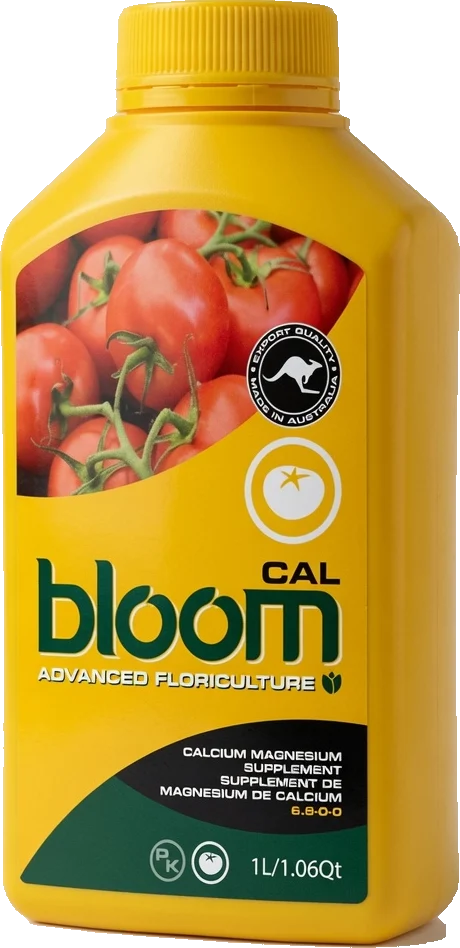
Bloom CAL is labeled for hydroponic use, delivering 5.2% total nitrogen (all nitrate form), 5% calcium, and 1.4% magnesium, with iron and zinc held in chelated form. It’s a real, verified supply of calcium into the feed — and supply is still the first requirement. A crop can’t move calcium it was never given. But once that supply is sitting in the reservoir, getting it into the leaf that actually needs it is an airflow and canopy-management job, not something a stronger dose solves by itself.
Where the symptom shows up tells you where to look
This is also why calcium deficiency symptoms almost never show up evenly across a crop. The newest, least-expanded leaves — the ones still building cell walls and most dependent on an active, steady calcium supply — are also usually the ones tucked lowest in transpiration, shaded by the canopy above them, in the most humid pocket of air in the whole greenhouse. That’s the exact combination that slows xylem flow the most: low light, high humidity, still air. It’s not a coincidence that tip burn and marginal necrosis concentrate there rather than on the oldest, most exposed leaves, which are moving plenty of water and therefore plenty of calcium along with it.
For a cut-flower or ornamental grower walking a greenhouse row, that gives you a diagnostic shortcut before reaching for the feed tank at all: if the symptom is concentrated in the densest, stillest part of the canopy, air movement is the more likely lever than concentration. If it’s showing up everywhere, including on exposed growth that should be transpiring freely, that’s a better sign an actual supply shortfall is in play.
If you’re seeing tip burn on a crop that’s getting a real calcium feed, don’t reach for a stronger dose first. Check what’s happening in the canopy where the symptom is showing up. That’s where the research says the answer actually lives.
Related reading: The Potassium Line on the Humate Label Is Doing More Than Feeding the Plant, another nutrient-mechanism piece for cut-flower and ornamental growers.