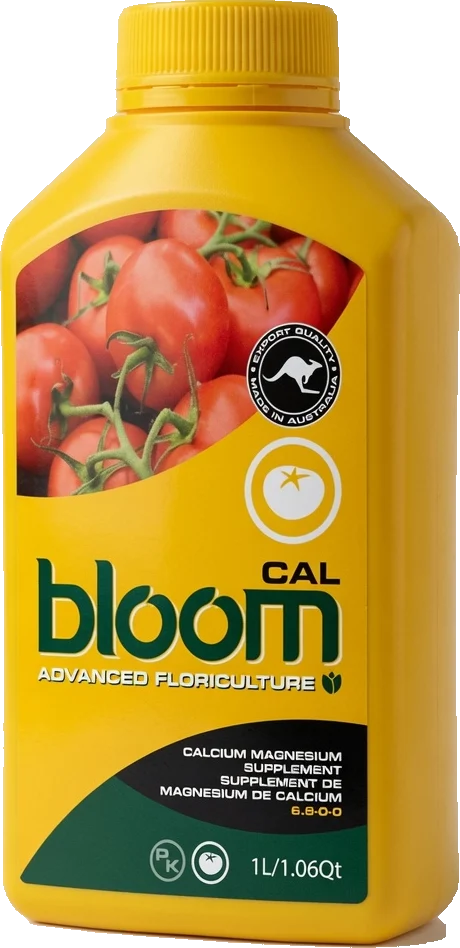
Serious cut-flower and greenhouse operations test their irrigation water before they build a feed program on top of it. That test comes back with ranges — calcium, magnesium, sodium, chloride, electrical conductivity — and those ranges decide what a grower actually needs to add. Read against Bloom CAL‘s own declared analysis, the two line up more directly than most growers realize.
What the water test is actually checking for
Extension guidance for greenhouse floriculture gives specific target bands: desirable calcium 40–100 ppm, desirable magnesium 30–50 ppm (with a sulfate supplement recommended if magnesium runs under 50), sodium under 50 ppm and chloride under 140 ppm for ornamentals under overhead irrigation, and electrical conductivity under 1.5 mS/cm for untreated water. The same guidance notes that high sodium “acts to inhibit plant uptake of calcium” and can cause “excess leaching of calcium and magnesium from growing media” — so a water test isn’t just measuring what’s present, it’s flagging what might already be working against the crop.
Those are targets for what reaches the root zone overall, not a statement about any single product. A grower whose water test comes back light on calcium and magnesium, or whose test flags sodium pressure that’s already competing with calcium uptake, needs an input that supplies calcium and magnesium directly and predictably — which is exactly the job a declared Cal-Mag analysis is built to do.
What CAL actually declares
Bloom CAL’s label, read directly off the artwork, declares 5.2% total nitrogen (all nitrate nitrogen), 5% calcium, 1.4% magnesium, 0.5% iron (chelated as DTPA), and 0.036% zinc (chelated as EDTA). It’s labeled for hydroponic use. Two things on that label are worth reading past the headline Ca and Mg numbers — the same label behind why more calcium in the feed doesn’t fix tip burn.
First, the nitrogen is real and it’s all nitrate — a figure worth counting in a crop’s overall nitrogen budget alongside everything else feeding the bed, rather than treating a Cal-Mag addition as nitrogen-free. Second, the two trace metals on the label are each held by a different chelating agent, and that choice tracks directly back to water chemistry: DTPA keeps iron in soluble, plant-available form up to roughly pH 7.5, while EDTA holds zinc effectively only to about pH 6.5. A water test that comes back alkaline, or with meaningful bicarbonate — the same UMass guidance sets an overhead-irrigation bicarbonate band of under 1.5 me/L as the low-risk zone, rising to “slight to moderate” concern up to 8.5 me/L — is exactly the condition DTPA iron is formulated to survive where a plain EDTA iron chelate would start failing.
Why zinc gets its own chelate
Zinc isn’t riding along on the iron’s chelation — it’s declared and chelated separately because it’s a different ion with its own stability ceiling. In a greenhouse bed that gets flushed and refreshed on a normal fertigation schedule, that ceiling matters less than it would in a sealed or rarely-flushed reservoir, but it’s still the reason the label lists a chelate name next to each metal rather than just a bare percentage. A full-spectrum trace-mineral claim without a named chelate per metal is asking a grower to trust that every metal on that label survives the same water chemistry — and, chemically, they don’t all survive it the same way.
None of this replaces an actual water test. It’s a reason to read one, if you have it, alongside the Cal-Mag label rather than instead of it — the two documents are answering related but different questions, and a feed decision that only looks at one of them is working with half the picture.
What a water test can’t tell you about a bottle
A water test also has a blind spot worth knowing about: it tells a grower what’s already in the irrigation source, not what will happen chemically once a calcium input is added to it. The extension guidance that sets the magnesium target also flags that a sulfate supplement is the usual fix when magnesium runs under 50 ppm — which is a reasonable move on its own, but it matters which calcium source it’s paired with. A calcium-nitrate-plus-sulfate combination run through the same stock tank can react directly, precipitating calcium sulfate (gypsum) before it ever reaches the crop. CAL’s own magnesium comes from magnesium nitrate rather than magnesium sulfate, so that particular reaction has nothing to react with in the bottle — a detail that only matters once a grower starts combining inputs to chase a water-test target, not something the test itself would ever flag.
That’s the real case for reading the water test and the product label together rather than treating either one as sufficient on its own. The test tells you what the source water is missing or carrying too much of; the label tells you what a given input will and won’t react with once it’s added to the tank. A feed program built on only one of those documents is guessing at the other.